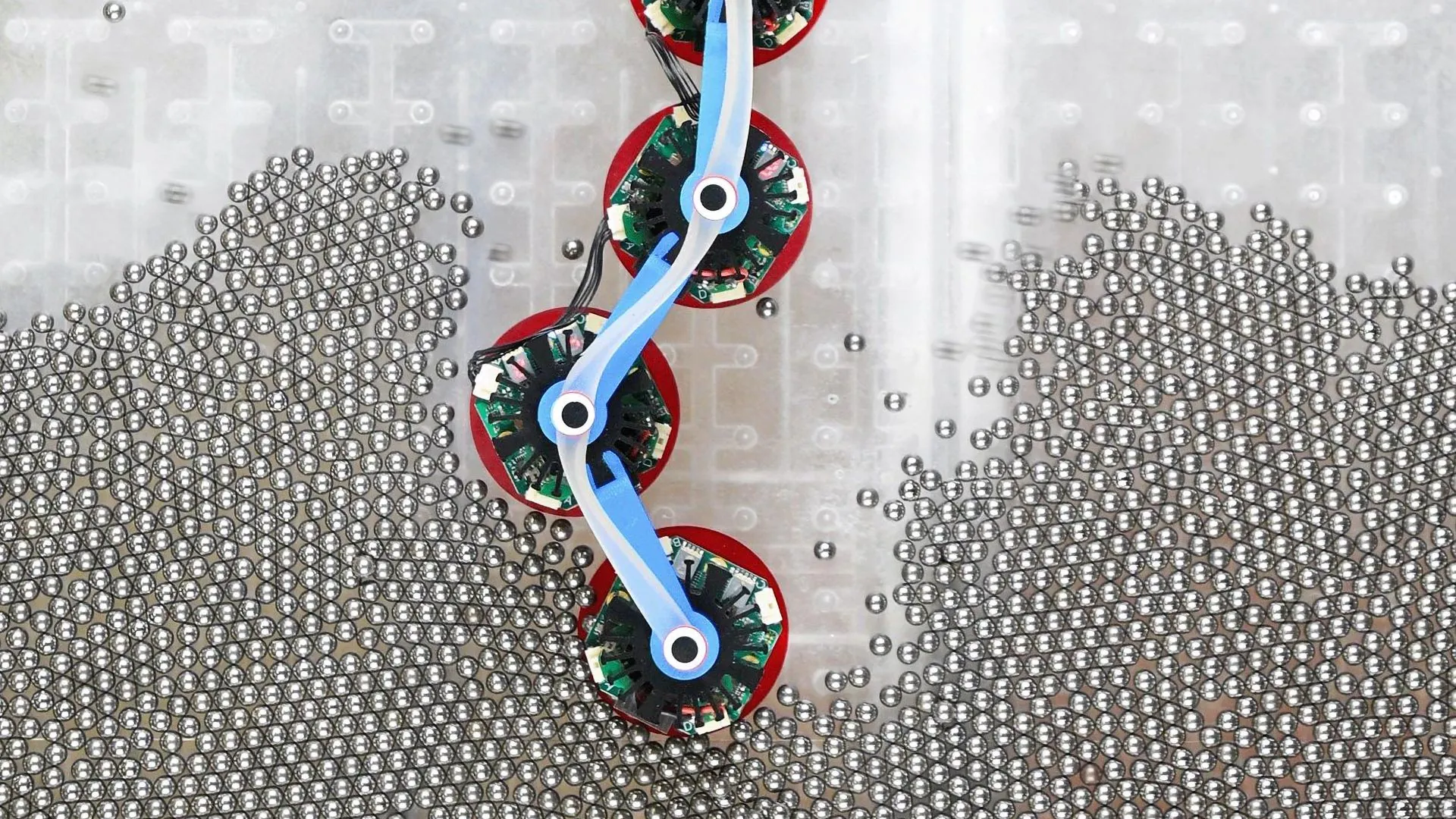
Active Chains Crawl, Walk and Dig; Lattices Defy Le Chatelier’s Principle
- Active chains with motors at their joints turn a single buckle into repeated oscillations that propel the structure forward.
- A flat lattice of the same components becomes less responsive overall when individual motors are made more active, contradicting a standard engineering rule.
- Findings appear in Proceedings of the National Academy of Sciences and Physical Review X.
Researchers at the University of Amsterdam, the University of Cambridge and the University of New South Wales assembled flexible chains of rods linked by miniature motors at each joint.
The motors create non-reciprocal interactions — moving one rod affects its neighbor differently than the reverse — so the chain does not simply snap once and stop. Instead it buckles and snaps repeatedly, producing oscillations that resemble crawling, walking and digging.
The team transformed the system’s critical point, where snapping normally occurs, into what they call a critical exceptional point. Sami Al-Izzi of the University of New South Wales and Yao Du of the University of Amsterdam are joint first authors of the paper, which appears on the cover of Proceedings of the National Academy of Sciences.
Lattices that defy Le Chatelier
A second study by the same collaboration built a two-dimensional lattice of motors and rods to test Le Chatelier’s Principle, the engineering rule that stiffening individual components should stiffen the whole structure. The researchers found the opposite: increasing the activity of some components can reduce the overall activity of the material.
The key is percolation. If too many low-activity components block connected pathways, elastic responses cannot spread through the lattice, even when other components are highly active. Jack Binysh is first author of the paper published in Physical Review X.
Implications for soft robots and biological systems
The discoveries suggest a route to materials that perform complex tasks without centralized control, a potential advance for soft robotics. The same principles may also illuminate the behavior of biological gels, epithelial monolayers and neuromorphic networks that mimic biological information processing.