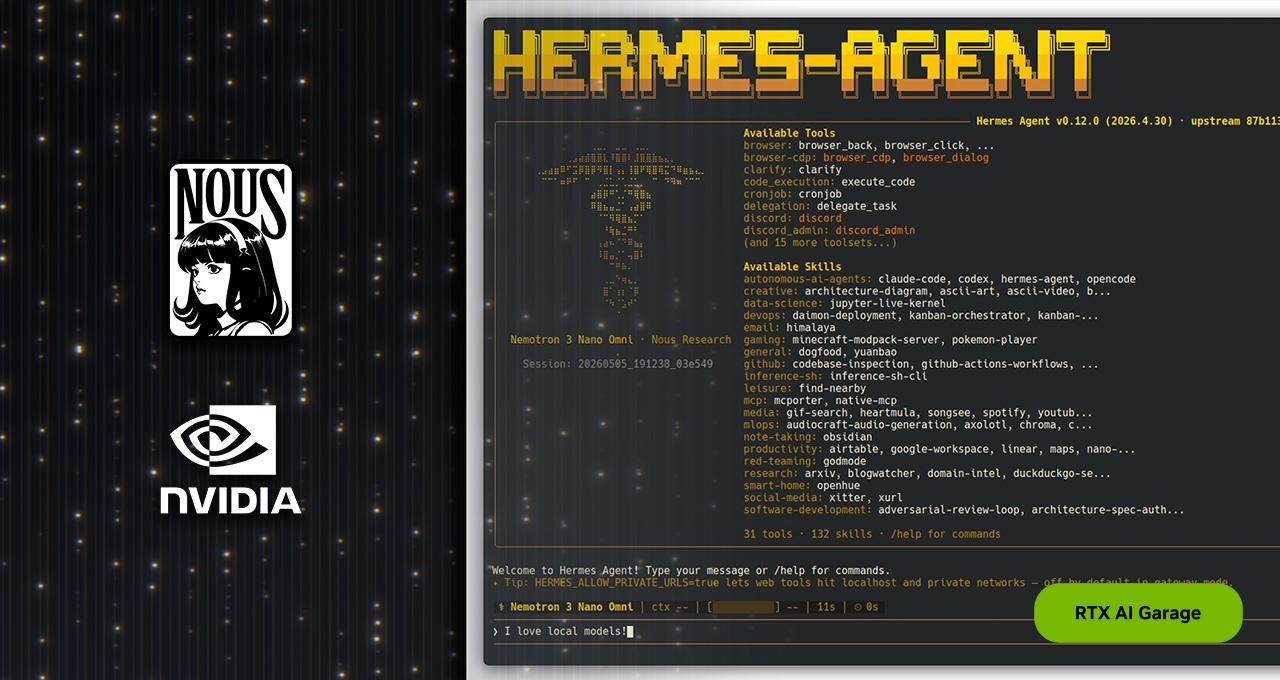
Accelerate Local Agentic AI with Hermes Agent and NVIDIA Hardware
Hermes Agent: Deconstructing the Local Orchestration Layer
The industry is finally moving past the “chatbot” phase, shifting toward agentic AI that actually executes. But for most developers, “agents” have been little more than thin API wrappers with brittle prompt chains. Hermes, the new open-source framework from Nous Research, attempts to solve this by treating the agent as a persistent orchestration layer rather than a series of stateless calls.
- The Shift: Hermes moves from task-by-task execution to a persistent local orchestration layer, utilizing “self-evolving skills” to refine its own logic.
- Hardware Efficiency: Optimized for NVIDIA RTX and DGX Spark, specifically leveraging Qwen 3.6 models (35B) that outperform 120B-parameter models while requiring only 20GB of VRAM.
- Deployment: Native support for llama.cpp, LM Studio, and Ollama, enabling 24/7 autonomous local workflows without cloud dependency.
The fundamental bottleneck in agentic AI has always been the trade-off between intelligence and latency. To get high-reasoning capabilities, developers typically offload to frontier models via API, sacrificing privacy and incurring massive token costs. Local models often lacked the “reliability” to handle multi-step tasks without hallucinating into a loop. Hermes addresses this by decoupling the agent’s logic from the underlying LLM, creating a framework where the agent manages its own “skills” and deploys isolated sub-agents for specific sub-tasks.
The Architecture of Self-Evolution vs. Thin Wrappers
Most agent frameworks are essentially glorified loops: Input → Prompt → LLM → Tool Call → Output. If the tool call fails, the agent often collapses. Hermes introduces a self-evolving skill set. When the agent encounters a complex task or receives feedback, it doesn’t just resolve the ticket; it writes and refines a “skill” for future use. This effectively transforms the agent’s experience into a local library of curated capabilities.
From a systems architecture perspective, the use of “contained sub-agents” is the real win here. By treating sub-agents as short-lived, isolated workers with focused contexts, Hermes minimizes context window bloat. This allows the system to maintain high performance even when running on 30 billion-parameter-class models, which typically struggle with long-term coherence. For enterprise deployments, this architectural shift reduces the need for massive context windows, lowering the hardware barrier for entry.
However, self-evolving code introduces a non-trivial security surface. An agent that writes its own skills is an agent that can potentially introduce logic vulnerabilities or execute unintended system commands. As these autonomous workflows scale, corporations are urgently deploying vetted [Cybersecurity Auditors] to implement guardrails and ensure that self-evolving skills adhere to SOC 2 compliance and strict permissioning models.
The VRAM Math: Qwen 3.6 and the Efficiency Leap
The viability of local agents depends entirely on VRAM pressure. The release of Alibaba’s Qwen 3.6 series changes the math for local deployment. The Qwen 3.6 35B model is the current sweet spot, requiring roughly 20GB of memory while surpassing the performance of previous 120B-parameter models (which typically demand 70GB+). Even more aggressive is the Qwen 3.6 27B dense model, which matches the accuracy of the 400B-parameter Qwen 3.5 397B while being one-sixteenth the size.
This efficiency allows for “always-on” agentic workflows on consumer-grade hardware. When paired with NVIDIA Tensor Cores, the inference throughput is sufficient to refine skills in seconds. For those scaling beyond a single workstation, the NVIDIA DGX Spark provides 128GB of unified memory and 1 petaflop of AI performance, enabling the execution of 120B-parameter mixture-of-experts (MoE) models without the latency spikes associated with swapping memory to disk.
Integrating this level of hardware into a production environment isn’t a “plug-and-play” affair. Many firms are now partnering with [Managed Service Providers] to optimize their local AI clusters, ensuring that thermal throttling doesn’t kill the 24/7 autonomy Hermes is designed for.
Implementation: Deploying Hermes Locally
For developers looking to move beyond the GUI, Hermes integrates directly with the standard local LLM stack. The most efficient path to deployment involves using Ollama or LM Studio as the runtime provider, with the Hermes orchestration layer sitting on top.
To initiate a local instance using a compatible runtime, the workflow typically follows this CLI pattern:
# Pull the optimized Qwen 3.6 model via Ollama ollama pull qwen3.6:35b # Launch Hermes Agent with the local runtime configuration # Ensure your NVIDIA drivers are updated to support the latest CUDA toolkit python3 -m hermes_agent --runtime ollama --model qwen3.6:35b --config ./local_config.yaml # Verify agent connectivity and skill-set initialization curl -X GET http://localhost:8080/agent/status Tech Stack Comparison: Hermes vs. Standard Agent Wrappers
To understand why Hermes is gaining traction (crossing 140,000 GitHub stars in under three months), we have to look at the orchestration logic compared to traditional “thin” frameworks.

| Feature | Standard LLM Wrappers | Hermes Orchestration Layer |
|---|---|---|
| State Management | Stateless / Session-based | Persistent / Local State |
| Skill Acquisition | Hard-coded prompts | Self-Evolving (Writes/Refines skills) |
| Resource Usage | High (Requires massive models) | Optimized (Efficient via Sub-Agents) |
| Dependency | Cloud API dependent | Local-first (RTX/DGX Spark) |
| Execution | Task-by-Task | Continuous / Always-On |
The “reliability by design” claim from Nous Research stems from the curation and stress-testing of the tools and plug-ins that ship with the framework. By reducing the need for constant debugging, Hermes allows developers to focus on building custom skill sets rather than fighting the LLM’s tendency to hallucinate tool arguments.
As organizations move toward this autonomous model, the demand for specialized [Software Development Agencies] capable of building custom “skill libraries” for Hermes is expected to spike. The goal is no longer just “prompt engineering,” but “agent engineering”—building a robust, local knowledge base that the agent can evolve over time.
Editorial Kicker: The End of the API Tax?
The trajectory is clear: the “intelligence” is becoming a commodity, but the “orchestration” is where the value resides. By moving the agentic layer local and allowing it to self-improve, Nous Research and NVIDIA are effectively attacking the “API tax” imposed by cloud providers. If a 35B model on an RTX workstation can outperform a 120B model in the cloud due to better orchestration and zero latency, the incentive to stay in the cloud vanishes. The only remaining question is how we secure an AI that is literally rewriting its own operational manual in real-time.
Disclaimer: The technical analyses and security protocols detailed in this article are for informational purposes only. Always consult with certified IT and cybersecurity professionals before altering enterprise networks or handling sensitive data.