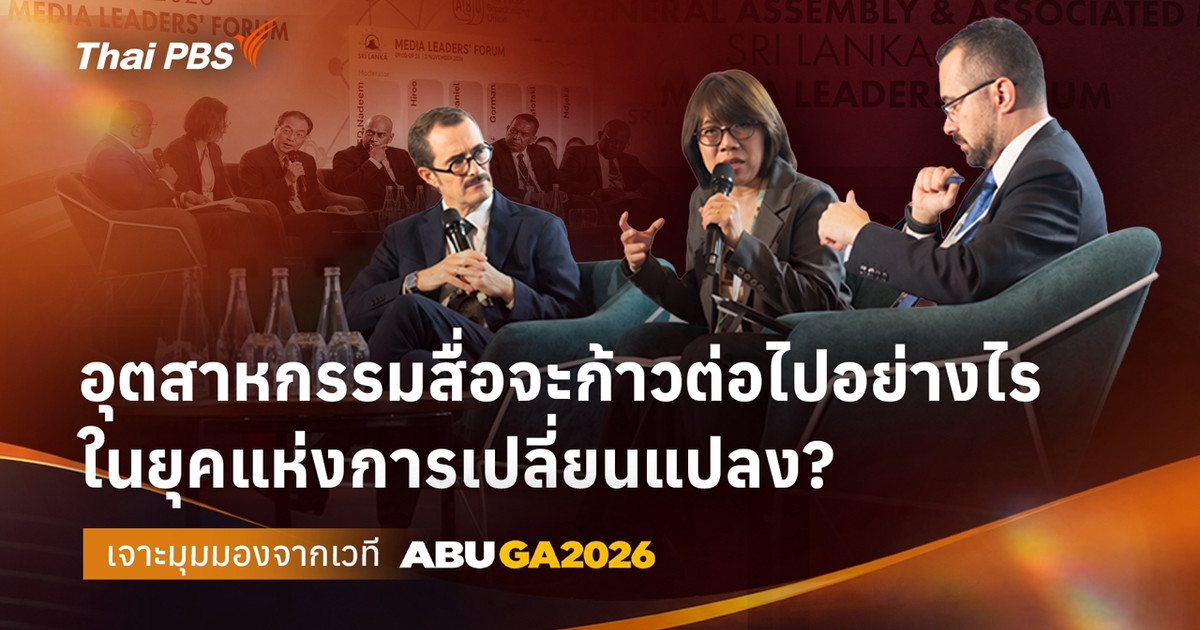
ABU Assembly in Colombo: Media Leaders Pivot to Public Value and AI Amid Funding Crises
Media leaders at the 63rd Asia-Pacific Broadcasting Union (ABU) General Assembly in Colombo, Sri Lanka, are recalibrating operations to address declining traditional broadcast audiences and the rise of artificial intelligence.
More than 400 participants from 83 organizations across 41 countries convened in early November 2026 to discuss the theme, “Media for Peace and Humanity: Truth, Trust and Transformation,” Thai PBS reported.
Financial and Platform Transitions
NHK, Japan’s public broadcaster, faces a decline in direct license fee revenue, which previously accounted for over 95% of its income. Executive Vice President Yamana Hiroo said that the organization plans to integrate AI to streamline operations while shifting from fixed broadcast schedules to a “Public Media Platform.”
“The next three years will be a crucial period for determining the future of the organization,” Yamana told Thai PBS. This transition aims to distribute content across internet platforms, mobile services, and on-demand archives to ensure public access remains relevant as traditional television viewership wanes.
Redefining Value Beyond Ratings
For commercial and public entities, the challenge lies in shifting focus from mere volume to societal impact. Chevaan Daniel, Group Director at Maharaja Media Network in Sri Lanka, argued that media organizations currently face an “identity crisis.” He suggested that instead of chasing viewership numbers, outlets must leverage the public trust they have built over decades.
“The organization should consider whether the audience still trusts the organization, whether they still need the organization, and whether the organization contributes to making people’s lives better,” Daniel told Thai PBS. He said that while commercial pressures persist, the focus should remain on creating public value rather than competing solely on content volume.
Resource Constraints and New Opportunities
Smaller broadcasters are increasingly looking toward digital platforms to bridge funding gaps. The Fijian Broadcasting Corporation (FBC) experienced a 70% reduction in government support, yet Sitiveni Halofaki said that digital reach has allowed the organization to monetize its content for the Fijian diaspora. Between January and September 2026, roughly 9% of FBC’s revenue originated from overseas audiences.
Geographic and economic contexts vary significantly across the region, according to Grégoire Ndjaka of the African Union of Broadcasting (AUB). He cautioned that media challenges in sub-Saharan Africa cannot be generalized, as broadcasters operate under vastly different regulatory and market conditions compared to their counterparts in North Africa or Asia-Pacific.
Responsible Integration of AI
The industry is currently debating how to manage the impact of AI on information discovery, particularly regarding “zero-click search” where AI provides answers without driving traffic to original news sources. NHK is evaluating whether to allow AI providers to use its content, weighing the benefit of wider information distribution against the loss of direct audience engagement.
The Asia-Pacific Broadcasting Union (ABU) facilitates collective action among its members to navigate global media challenges, as seen in its role in negotiating coverage rights for major sports events since its formation in 1964. This function helps broadcasters in the region, such as NHK, secure shared access to content while addressing financial pressures.
“AI is not a technology that has just emerged, because people have been using systems related to AI in their daily lives for a long time,” said Giuseppe Solinas of Italy’s Radiotelevisione Italiana (RAI). Media leaders agreed that journalists and media organizations should collaborate with AI developers to embed ethical standards into systems before they are finalized.
Related reading