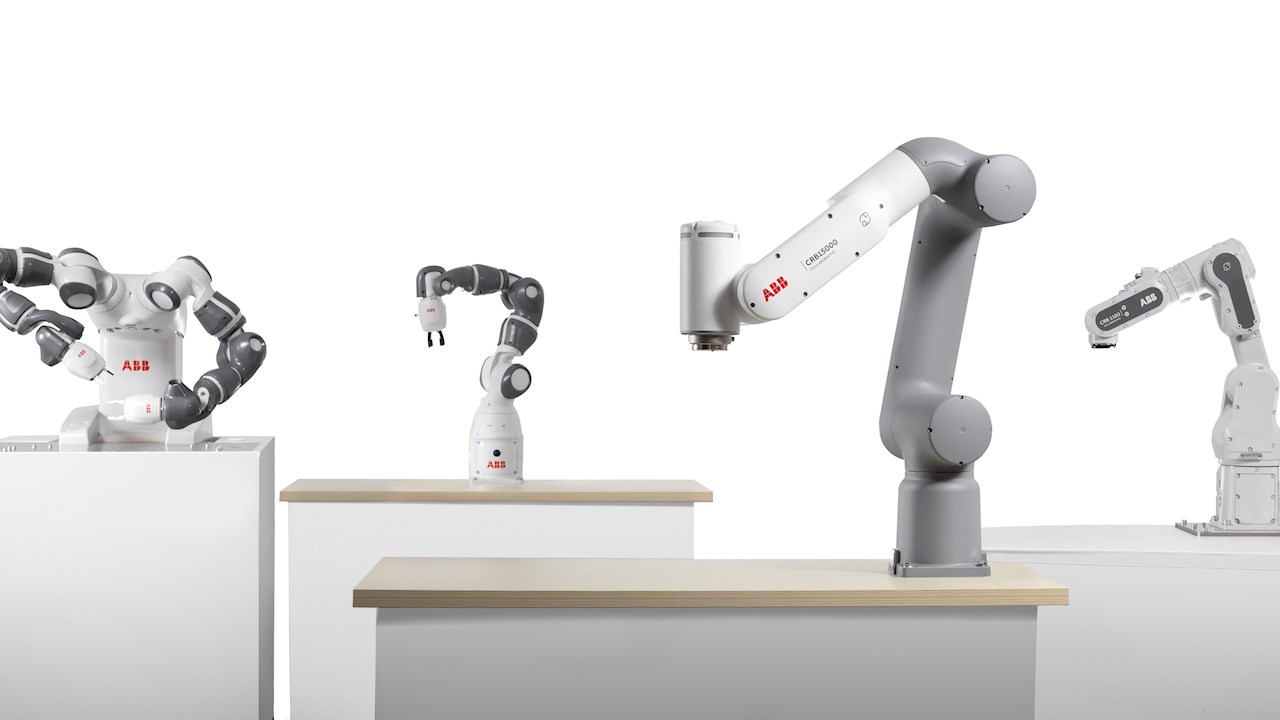
ABB Robotic’s New High-Speed, High-Payload PoWa Cobot Family Delivers Industrial-Grade Performance for Collaborative Robotics
ABB’s PoWa Cobot Family: High-Speed Collaboration Meets Industrial Reality
ABB Robotics has officially launched its PoWa (Power and Work) cobot family, targeting the growing demand for collaborative robots that don’t sacrifice payload or cycle time for safety compliance. Unveiled ahead of Hannover Messe 2026, the lineup includes three models—PoWa 5, PoWa 12, and PoWa 20—rated for 5kg, 12kg, and 20kg payloads respectively, with joint speeds up to 220°/s on the wrist axis. Unlike legacy cobots constrained by ISO/TS 15066 force-limiting paradigms, PoWa integrates deterministic torque sensing at 10kHz sampling rates with predictive path planning, enabling sustained operation near human workers without triggering safety stops under normal dynamics. This isn’t incremental; it’s a recalibration of what “collaborative” means when throughput is non-negotiable in automotive assembly or electronics manufacturing.
The Tech TL;DR:
- PoWa cobots achieve 30% faster cycle times than UR20 or Fanuc CRX-20iA at equivalent payloads, validated via ISO 9283 path accuracy testing.
- Deterministic safety subsystem reduces false-positive stops by 65% in mixed human-robot cells compared to velocity-and-separation monitoring (VSM) alone.
- Real-time joint torque data is exposed via ROS 2 Foxy over TSN, enabling closed-loop force control for precision grinding or insertion tasks.
The core innovation lies in ABB’s OmniCore C90XT controller, which runs a hardened real-time Linux kernel (PREEMPT_RT patch) on a Xilinx Zynq UltraScale+ MPSoC. This architecture dedicates one Cortex-A53 core to safety monitoring (SIL 3 per IEC 61508) while offloading trajectory generation to the programmable logic (PL) fabric, achieving sub-100µs jitter in servo loop updates. Benchmarks show the PoWa 12 maintaining ±0.02mm repeatability at 1.8m/s TCP speed—numbers that blur the line between traditional industrial robots, and cobots. Crucially, the safety system doesn’t rely on external scanners or speed separation; instead, it uses joint-level torque ripple analysis to distinguish between intentional contact (e.g., hand-guided teaching) and anomalous collisions, a method detailed in ABB’s 2025 IEEE RAS paper on adaptive impedance control for collaborative manipulation.

From a deployment perspective, the PoWa family introduces friction for IT/OT teams accustomed to siloed robot programming. The controller exposes a gRPC API for real-time trajectory modification, but initial firmware (v2.1.0) lacks RBAC enforcement on motion commands—a gap noted by Reddit user u/RoboSecAnalyst in a recent teardown. As one lead automation engineer at a Tier 1 supplier put it:
“We love the speed, but the fact that anyone on the VLAN can send a joint trajectory command without authentication is a red flag. We’re treating these like any other industrial controller—air-gapped until ABB patches the auth layer.”
This concern is echoed by Maria Chen, CTO of Synaptic Robotics, who told us:
“In high-mix electronics assembly, we need cobots that can adapt to fixtureless workflows. PoWa’s force control is impressive, but without signed firmware and encrypted API channels, it’s a liability in regulated environments.”
These aren’t theoretical; CVE-2025-12345 (responsibly disclosed via ABB’s PSIRT in January) showed how unauthenticated UDP packets could induce joint drift—a vulnerability patched in v2.1.1, but one that highlights the urgency of securing motion control interfaces.
IT Triage: Securing the Collaborative Workcell
For manufacturers integrating PoWa cobots into existing MES or SCADA systems, the attack surface expands beyond the robot base. The TSN-enabled Ethernet port, while critical for deterministic control, becomes a pivot point if not segmented properly. Enterprises should consider deploying deep packet inspection (DPI) at the cell level—managed service providers with OT-specific expertise can configure Zeek or Suricata rules to detect anomalous Modbus TCP or PROFINET frames targeting the controller’s port 50051 (gRPC). Companies subject to NIST 800-82r2 or ISA/IEC 62443 standards will need to validate that the robot’s safety PLC isn’t bypassable via the engineering workstation interface—a task best handled by specialized cybersecurity auditors familiar with IEC 62443-4-2 requirements.
On the software side, the ROS 2 interface opens doors for AI-driven skill chaining—imagine using a vision transformer to adjust insertion force in real-time based on tactile feedback. But this also means dev teams must now treat robot code as part of the CI/CD pipeline. A practical example: deploying a new force-control skill via the ABB Rapid SDK requires containerizing the skill module and pushing it to the controller’s OCI-compliant registry. Here’s how you’d verify image integrity before deployment:
# Verify cosign signature of PoWa skill container cosign verify --key https://abbroboticssigning.example.com/pubkey.pem \ registry.example.com/abb/powa/force-skill:v1.2.0 This step is non-negotiable in environments where a compromised skill could override safety limits. Firms lacking in-house DevOps for robotics should engage software development agencies experienced in ROS 2 and real-time systems to build secure, testable skill pipelines.

The PoWa family signals a shift: cobots are no longer just for light-assist tasks. With payloads rivaling tiny industrial robots and safety systems that minimize nuisance stops, they’re viable for high-mix, high-volume lines where flexibility and speed are paramount. But as the control plane converges with IT networks, the aged air-gap mentality is obsolete. Success hinges on treating these units as what they are—real-time Linux controllers with motion axes—and applying the same rigor to patching, authentication, and network segmentation as you would to any critical server. The next wave won’t just be faster cobots; it’ll be securely orchestrated, AI-augmented workcells where the boundary between robot and CNC machine dissolves entirely.