
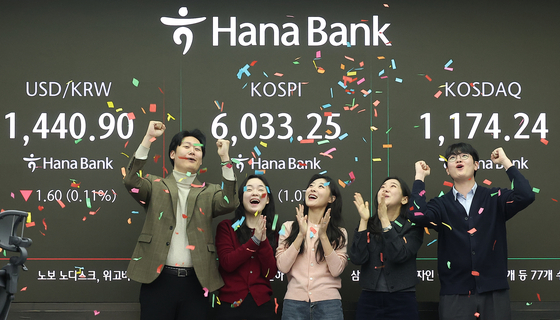
South Korea’s benchmark Kospi index saw its highest-ever daily average trading volume in February, surpassing 30 trillion won for the first time, according to the Korea Exchange. The daily average reached 32.234 trillion won (approximately $23.7 billion USD), a 19% increase from the 27.056 trillion won recorded in January.
The surge in trading activity coincided with the Kospi’s climb above the 6,000 point mark for the first time, fueled by positive momentum from U.S. Tech stocks and anticipation surrounding the passage of a third revision to South Korea’s commercial code, designed to improve corporate governance. The Kospi rose 20% in February, breaching the 6,000 level on February 25th and reaching 6,300 the following day.
Trading volume was heavily concentrated in shares of major semiconductor companies, particularly Samsung Electronics and SK Hynix. These three stocks – Samsung Electronics, SK Hynix, and Samsung Electronics preferred shares – accounted for 33% of the total Kospi trading volume in February, with a daily average of 10.502 trillion won.
Market turnover also accelerated significantly. The Kospi’s stock turnover ratio for February reached 28.0%, the highest level in three years and ten months, since April 2022. This represents a 55% increase from the previous month’s ratio of 18.13%. A higher turnover ratio indicates increased activity and a faster rate of stock ownership changes.
Analysts at Mirae Asset Securities suggest that while the Kospi’s long-term outlook remains positive, a period of consolidation may be likely in the short term. They point to valuation concerns, noting that the 12-month forward price-to-earnings (PER) ratio for the Kospi is 10.4x, in line with historical averages, but the PER excluding Samsung Electronics and SK Hynix rises to 13.2x. The price-to-book (PBR) ratio is also noted at 1.27x.
