
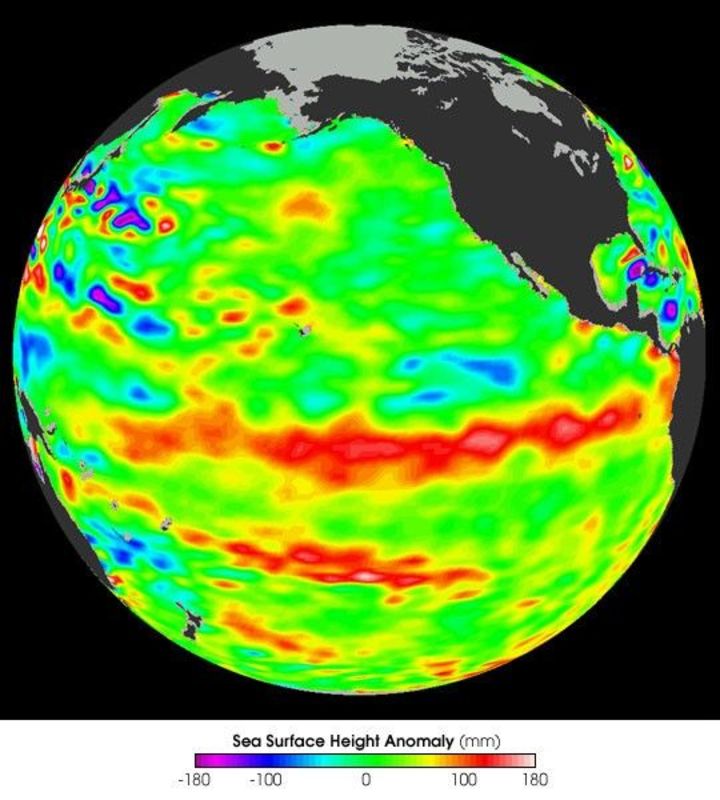
Surf forecasters are watching the Pacific Ocean closely as conditions suggest a potential return of El Niño by the winter of 2026. The last significant El Niño event concluded in April 2024 and the cyclical shift towards a warming phase could bring larger, more consistent swells to the US West Coast, and Hawaii.
El Niño and La Niña are opposing phases of the El Niño-Southern Oscillation (ENSO) cycle, a naturally occurring phenomenon involving fluctuations in sea surface temperatures in the central and eastern tropical Pacific Ocean. NOAA defines a third phase, ENSO-neutral, where temperatures are neither significantly warmer nor cooler than average. Currently, the ENSO cycle is in its La Niña phase, characterized by cooler-than-average sea surface temperatures.
Generally, El Niño conditions correlate with increased swell activity for the US, while La Niña tends to produce less consistent surf. La Niña years often feature high-pressure systems that can block storm development and movement towards the coastline. Conversely, La Niña can bring more easterly swell to Australia, potentially improving surf conditions there.
The onset of El Niño is triggered by a complex interplay of atmospheric and oceanic factors. “The first indicators of an El Niño season are the weakening of the trade winds in the South Pacific,” explains surf forecaster Tony Butt. “When they weaken, it allows the water to warm up, creating a warm pool of water. This then starts to drift across the Pacific and eventually up towards Japan.” This warming alters the jet stream and impacts circulation patterns, potentially shifting storm tracks towards the US and Hawaii, and intensifying storm systems.
While it’s still too early to build a definitive prediction, the latest assessment from NOAA indicates a 50-60% chance of El Niño developing. NOAA’s recent ENSO status report, published earlier this month, noted that a transition to ENSO-neutral conditions is expected between February and April 2026, with a 56% probability of remaining neutral through the Northern Hemisphere summer (June-August 2026). Though, the report also highlights a 50-60% chance of El Niño formation in the late summer and beyond, though acknowledges considerable model uncertainty.
The report detailed a significant increase in the equatorial subsurface temperature index, indicating warming waters across the Pacific. Atmospheric anomalies, while weakened by short-term variability, still exhibited aspects of La Niña. Westerly wind anomalies were observed in the western equatorial Pacific, and upper-level westerly anomalies continued across the east-central equatorial Pacific. Suppressed convection was noted near the Date Line and over the equatorial Maritime Continent, with enhanced convection off the equator.
NOAA’s North American Multi-Model Ensemble (NMME) also predicts the onset of ENSO-neutral conditions in February-April 2026, a consensus shared by the agency’s team. Historical data suggests that strong El Niño events, such as those in 1982/1983 and 1997/1998, have been associated with powerful North Pacific storms and significant surf on the US West Coast. These events create conditions conducive to baroclinic instability – the interaction of temperature and pressure gradients – and persistent convective energy, extending even into the interior of the US and affecting the Gulf Coast.
Recent notable surf events coinciding with the tail end of the previous El Niño included Jojo Roper’s ride at Maverick’s on December 28, 2023, and Steve Roberson’s Jaws ride in November 2023. Molly Picklum’s performance at Pipeline in February 2024 also drew attention, and Caity Simmers’ statement, “Pipeline’s for the fucking girls,” became widely quoted.
The situation remains fluid, and further monitoring of climate drivers is ongoing.
