
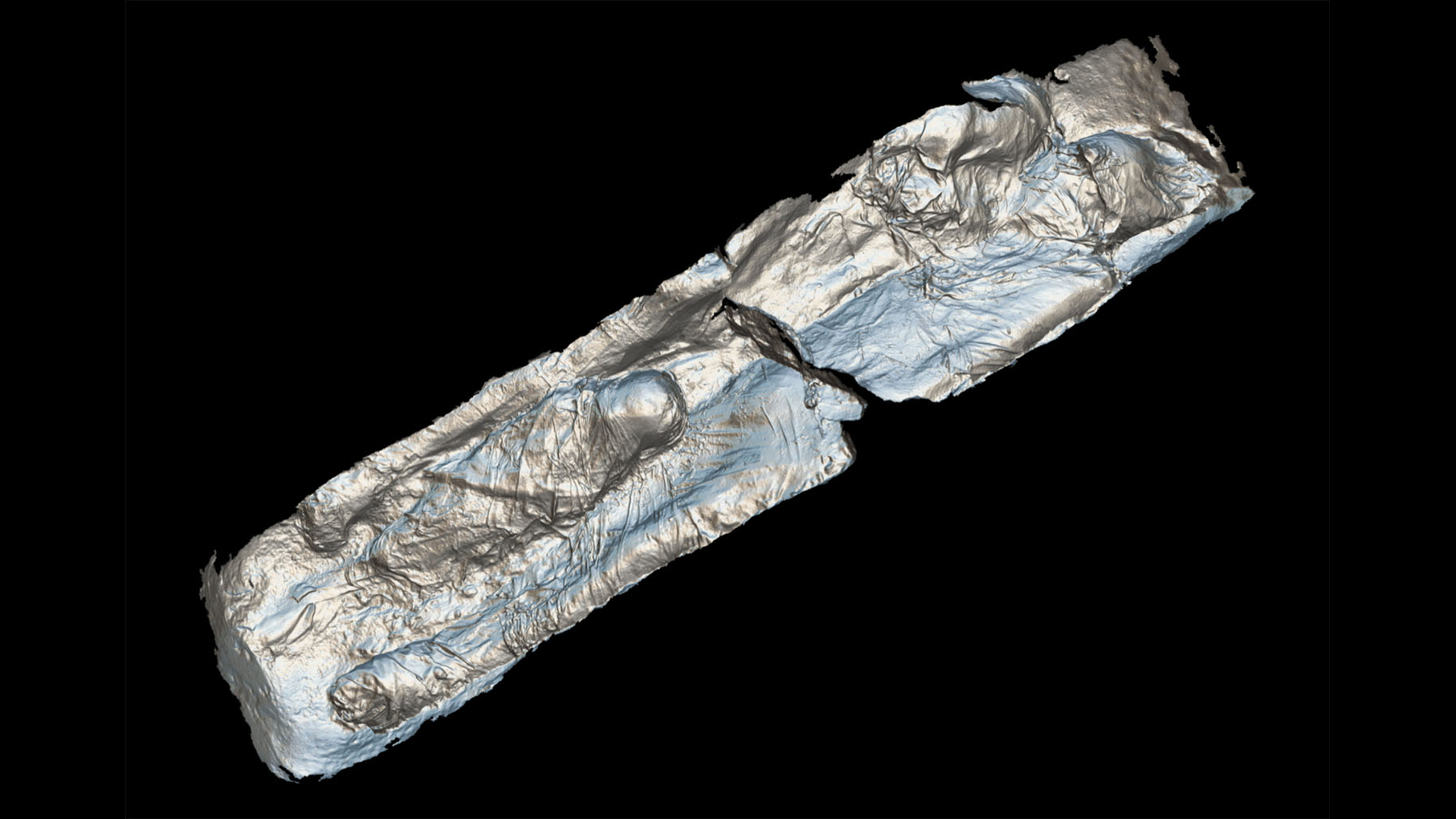
The Roman-era practice of encasing the dead in liquid gypsum wasn’t reserved for adults of high status, as previously believed. Novel research reveals the custom was also performed on infants, some as young as one month aged, challenging historical accounts suggesting such young children weren’t formally mourned.
The findings, published in blog posts by the Seeing the Dead project – a collaboration between the University of York and York Museums Trust – stem from the examination of gypsum burials discovered in and around York, northern England. Liquid-gypsum burials involve covering the deceased in a plaster-like substance that hardens, preserving impressions of clothing and even facial features.
“Infants were the most vulnerable members of Roman society,” explained Maureen Carroll, a Roman archaeologist at the University of York, in a February 18th blog post. “Given the high infant mortality rate, around 30%, historical records indicate that babies under one year old were not to be publicly mourned. However, this restriction applied only to public displays of grief and did not negate the private sentiments of loss felt by families.”
Carroll’s research has identified at least seven children among the more than 70 gypsum burials studied, including three infants under four months old. While typically reserved for the Roman elite, the practice extended to even the youngest members of society. Infants were more commonly buried in amphorae, ceramic tile boxes, or small wooden coffins, making the gypsum burials particularly noteworthy.
One particularly striking discovery, unearthed during the construction of the York Railway in 1892, involved a newborn infant draped in a cloak of purple-dyed wool adorned with gold thread and tassels. The baby was placed in a lead sarcophagus and then covered in liquid gypsum. Though the infant’s bones have since deteriorated, the impressions of the elaborate cloak remain visible.
“This is the only gypsum burial with dyed fabric ever found,” noted Sarah Hitchens, an archaeological textile expert at the University of York, in a February 23rd blog post. “The purple textile was likely made from an animal fibre such as wool and draped over the infant’s body as a burial shroud.”
Researchers are now analyzing the hardened gypsum for traces of aromatic substances like frankincense or mastic, as well as examining the purple dye to determine its origin – potentially from murex snails, a source of reddish-purple dye in ancient Rome. The gold threads are also undergoing analysis.
Another gypsum burial contained a child, approximately four months old, found positioned between the legs of two adults. While it remains unclear if the three individuals were family, Carroll wrote that their proximity suggests a close relationship in life and death. A girl, aged between seven and nine at the time of her death, was buried with an assortment of jewelry crafted from gold, silver, copper, jet, glass, and coral. Two pairs of boots and a pair of sandals were found near her feet, and the remains of a pet chicken were discovered within her coffin.
“The 3D scan of her body visible under a shroud or sheet reveals how frail and thin she was, perhaps pointing to a protracted illness before her death,” Carroll observed.
These discoveries challenge the notion that Roman legal texts, often authored by older men, accurately reflected the lived experiences of Roman Britain. “It all certainly suggests that children this young were valued and cared for, unlike the age-old notion that Romans did not care when their infants died due to the fact that infant mortality was high,” Carroll stated. “Utter nonsense!”
The Arts and Humanities Research Council is funding the three-year “Seeing the Dead” project, which aims to provide insight into the social and cultural context of these gypsum burials. The project team is utilizing 3D imaging to “see” the dead for the first time in almost 2000 years, according to a March 4, 2025, report from the University of York. Public access to exhibitions and videos from the project is planned through collaborations with York Museums Trust, Heritage Doncaster, Wakefield Museum, and MAP Archaeological Practice.
