
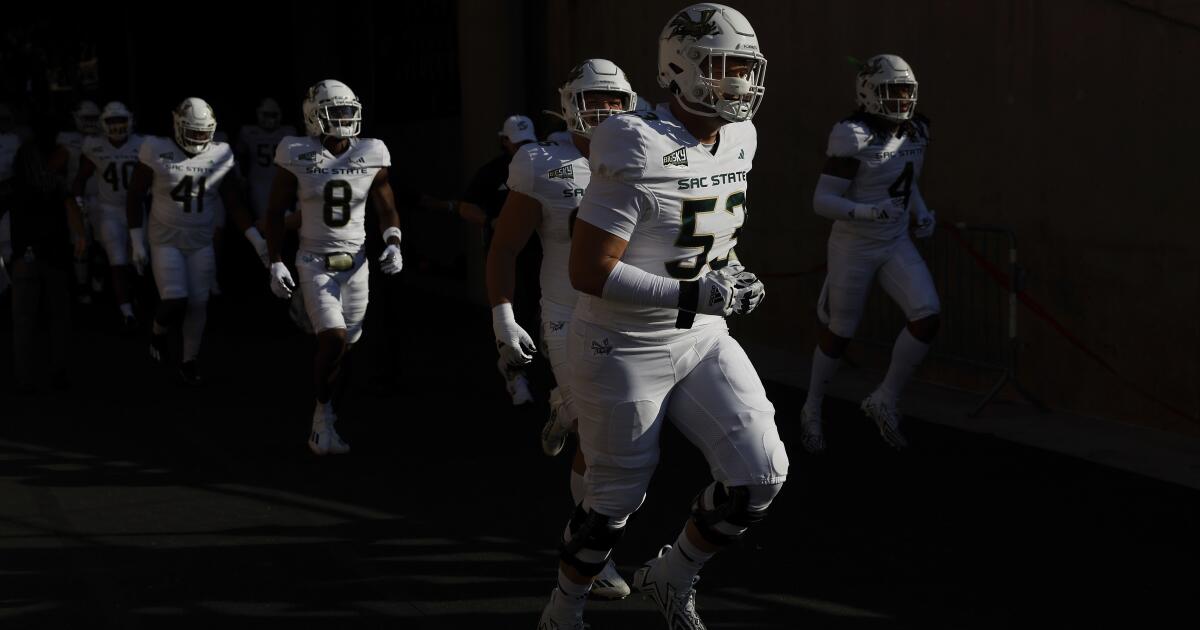
SACRAMENTO, Calif. — Sacramento State University is angling for a lucrative, if likely one-sided, football matchup against the University of Southern California Trojans on August 29th, a game that would mark the Hornets’ debut as a Football Bowl Subdivision (FBS) team. Sacramento State President Luke Wood publicly confirmed the pursuit Monday, framing the potential contest as a high-profile launch for the university’s athletic ambitions.
Wood last week announced Sacramento State’s move to the Mid-American Conference (MAC) in football, touting a projected $975 million in economic impact over the next five years. However, the figure is based on a methodology widely criticized by sports economists as outdated and unreliable. The core of the claim rests on “advertising value equivalency” (AVE), a metric that attempts to assign a monetary value to media exposure, as detailed in a study by Collegiate Consulting, which Sacramento State provided to the Los Angeles Times.
AVE calculates the value of publicity by comparing it to the cost of advertising. “You’re trying to place a dollar value on something you don’t easily have a price tag on,” explained Victor Matheson, an economics professor at Holy Cross and past president of the North American Association of Sports Economists. “The industry moved away from AVE a long time ago,” added Sal Della Monica, of the public relations firm MikeWorldWide, as reported by the Los Angeles Times.
The Hornets’ athletic director, Mark Orr, defended the projections, stating the university anticipates the exposure will translate into increased revenue through corporate sponsorships, ticket sales, and merchandise. However, Matheson countered that simply appearing on television does not equate to a targeted advertising campaign designed to drive economic activity. “They’re conflating appearing on TV and losing 52-7 to Bowling Green with a targeted ad designed to actually bring people to Sacramento to spend money and spend tuition dollars,” he said.
Even Russell Wright, founder of Collegiate Consulting, has publicly questioned the interpretation of his firm’s work. Wright told CBS Sports that Wood’s $675 million estimate for broadcast-related economic impact was “not anywhere in our report,” and that the $975 million total impact figure mischaracterized the study’s findings. Wood, however, maintains he appropriately extrapolated the data, multiplying a one-year estimate to cover the five-year agreement with the MAC.
Sacramento State’s push for athletic prominence comes as other California State University campuses – Long Beach, Fullerton, and Northridge – have discontinued football programs to save money. The university hopes the upgrade will attract out-of-state students who pay higher tuition and engage a region with limited major sports options. Wood described Sacramento as a market with “us and the Kings,” referring to the NBA’s Sacramento Kings.
The university envisions a renovated or latest stadium seating 20,000 fans, with estimated costs ranging from $171 million to $300 million. Sponsorship revenue has reportedly increased by 300 percent, reaching $1.7 million, according to Orr. The Hornets are modeling their ambitions after Boise State and James Madison, not the established powerhouse that is USC.
The immediate financial incentive for Sacramento State is a potential $1 million payday from USC for what would likely be a non-competitive game. The Hornets’ athletic department is already facing a significant financial commitment, with $23 million earmarked over five years for the move to the MAC, including travel expenses for opponents. According to data from the Knight Center, student fees and university funds currently cover 87% of Sacramento State’s athletic budget – a higher percentage than the average MAC school (66%).
As Sacramento State pursues its ambitious vision, skepticism remains. “My usual rule of thumb is, move the decimal point one place to the left,” Matheson said, suggesting a more realistic assessment of the projected economic impact. “But, man, when it comes to this advertising stuff, probably move it two or three.” Wood, however, believes the unique media landscape of Sacramento – a large market without an NFL or FBS team – presents a viable opportunity. The university’s future, for now, hinges on securing that check from USC, and whether the Hornets can translate exposure into tangible economic gains.
