
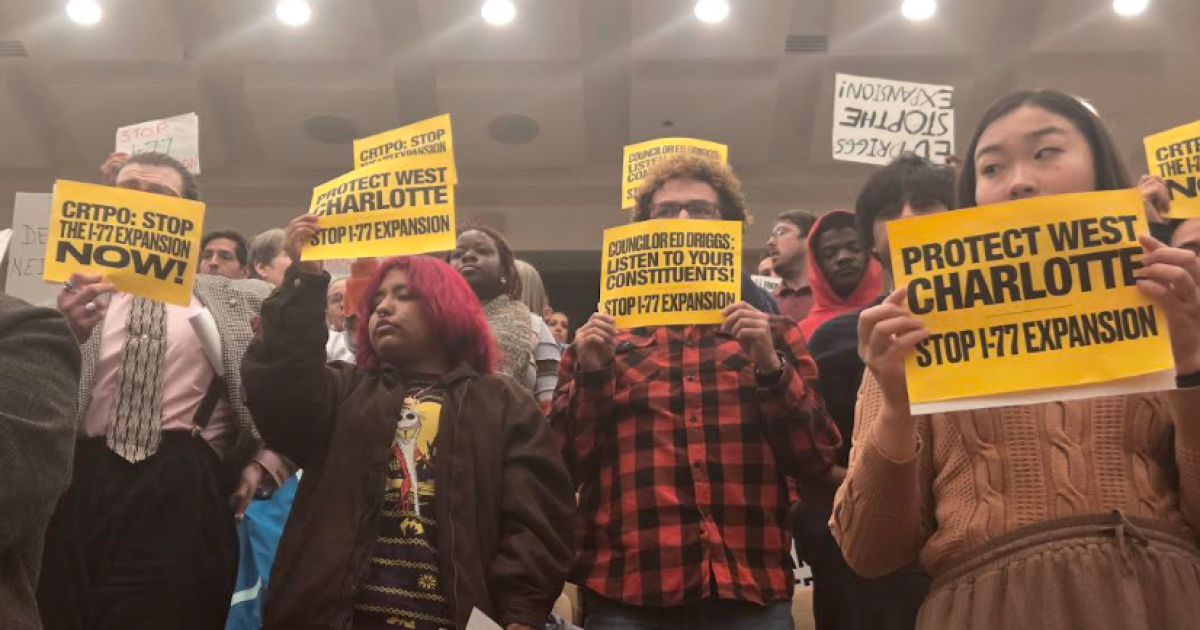
Charlotte City Council members are poised to delay a controversial plan to add toll lanes to Interstate 77 following a packed public hearing Monday night, where residents voiced strong opposition to the project. Ten of the eleven council members signaled support for a pause, a move prompted by growing concerns over the potential impact on west Charlotte neighborhoods.
The shift comes after years of debate over the expansion of I-77, initially approved in October 2024 with the backing of Council member Ed Driggs, the city’s point person on transportation. At that time, Driggs assured colleagues that the council would retain the ability to reverse course, according to reporting from WFAE. However, the timeline for doing so narrowed when the N.C. Department of Transportation issued a Request for Qualifications from contractors in August 2025.
Residents of the McCrorey Heights neighborhood led the charge against the project Monday, urging the Charlotte Regional Transportation Planning Organization (CRTPO) to “STOP the I-77 Expansion now.” Sean Langley, president of the McCrorey Heights neighborhood, stated the community’s simple request: “Pause the project. Let’s have meaningful community engagement.”
The opposition intensified after the DOT released detailed draft maps in the fall of 2025, sparking concerns among west Charlotte residents about potential displacement and decreased property values. Council member Dimple Ajmera questioned the circumstances surrounding the project’s progression, asking, “Who tied our hands and why?”
While the majority of the council now favors a pause, Driggs remained the sole dissenting voice during Monday’s meeting. Council member Renee Johnson attempted to push for an immediate vote on a resolution seeking the delay, but was unable to secure unanimous consent due to Driggs’ opposition.
Mayor Vi Lyles has responded to the growing concerns, stating she has spoken with N.C. Department of Transportation Secretary Daniel Johnson and secured a commitment for him to meet with neighborhood leaders. Lyles has also scheduled a discussion of the toll lanes project for the City Council’s retreat, moving the conversation up from a previously scheduled March 5 committee meeting, according to reporting from WCCB Charlotte.
Despite the council’s desire for a pause, achieving a full stop to the project may require more assertive action, potentially including a resolution directed to the CRTPO. Such a resolution would necessitate support from two or three additional local governments within the CRTPO, according to WFAE reporting.
The debate over the I-77 toll lanes echoes earlier controversy surrounding toll lanes built in north Mecklenburg County, which have been criticized for high costs. Ann Brooks, representing the Charlotte Regional Business Alliance, acknowledged the importance of community input but emphasized the need to move forward with the $3.2 billion expansion project.
The Charlotte City Council is scheduled to discuss the I-77 toll lanes project at its upcoming retreat, the date of which has not been publicly announced.
