
Indiana University’s Common Application portal is displaying a “Program Suspension Notice” for dozens of degree programs, including gender studies and Earth science, informing prospective students that “no new admissions will be offered” as the university restructures programs under a new state law. The notice, initially allowing students to select suspended programs as their “intended major,” was updated on February 11 to a “major interests” option, but continues to state that no new admissions will be accepted.
The changes stem from a state budget bill requiring Indiana universities to eliminate programs with fewer than 15 graduates annually, or seek an exemption from the Indiana Commission for Higher Education (ICHE). Instead of pursuing exemptions, IU voluntarily eliminated, suspended, or merged 249 low-enrollment programs across its campuses on July 1, 2025, impacting 116 degree programs at IU Bloomington. Of those, 22 were eliminated outright, and 31 are slated for suspension after currently enrolled students complete their degrees. Another 63 are suspended pending consolidation or merger, contingent on ICHE approval.
The current portal language has sparked concern among faculty who fear it misleads prospective students and discourages enrollment in humanities and language programs. Deborah Cohn, a Spanish and Portuguese professor at IU, argued the notice should more clearly communicate that affected fields of study remain available, even if undergoing restructuring. “They could have said something more user-friendly, such as, ‘We are currently in the process of applying to offer these, and here’s a contact person,’” Cohn said.
IU spokesperson Mark Bode stated in an email that the application form allows students to express interest in suspended programs and that the admissions team will follow up with alternative options and updates. “At the launch of this year’s admissions cycle, the IU Admissions team worked to craft sure prospective students could indicate areas of interest on their applications, including areas corresponding to suspended programs,” Bode wrote. “The site noted that registering interest in these programs would enable IU to share information on relevant future academic options.”
During a February 10 Bloomington Faculty Council (BFC) meeting, IU Bloomington Chancellor David Reingold acknowledged the confusing language in the Common App application and stated it would be updated “that day or the next.” Reingold also addressed faculty concerns about declining enrollment in affected programs, asserting that applications, admissions, and deposits for those programs were higher than the previous year. Bode later clarified in an email to the Indiana Daily Student on February 19 that overall applications, admits, and deposits for the affected degree programs had indeed increased compared to previous cycles, though a definitive assessment of major-specific enrollment trends will not be available until program and plan codes are updated in student records.
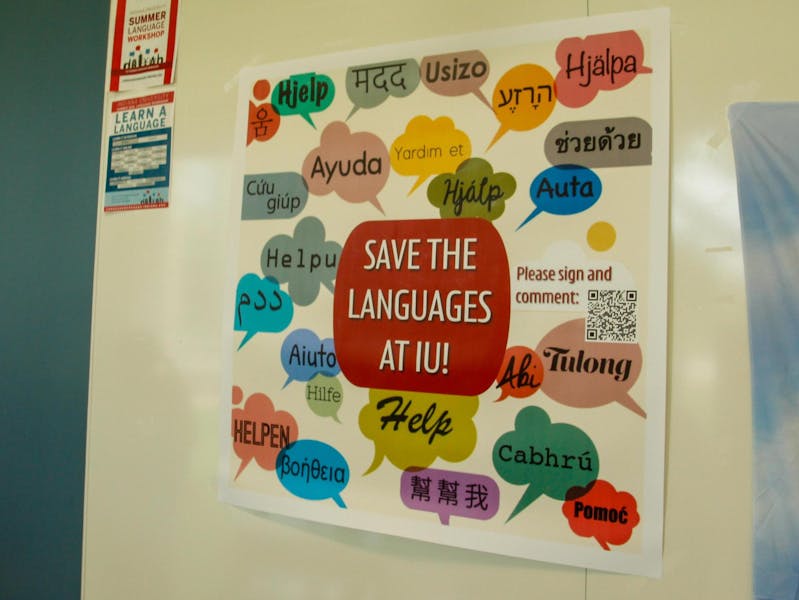
Nicolas Valazza, interim director of undergraduate studies at IU and organizer of the Save the Languages at IU initiative, reported receiving a message from a prospective student’s parent expressing confusion about the application. “The admission application was basically saying that they were suspended and no new student would be admitted,” Valazza said. “So we found this very concerning.”
Valazza fears the portal message may deter students from applying to IU altogether, but acknowledges the difficulty in tracking how many potential applicants have been dissuaded, as those students likely won’t contact the departments. Cohn added that departments have been fielding confused calls from incoming students and their parents since the summer, stating, “The lack of clarification is going to have caused damage to the number of students who were interested in these programs…That were given the sense that they don’t even exist anymore.”
Both Valazza and Cohn urge prospective students and their families not to dismiss IU based solely on the portal language, advising them to contact departments directly for accurate information. “Don’t stop with that information,” Cohn said. “Head and reach out to the departments that you and your children are interested in. Get the information, because the information is out there.”
Valazza emphasized the importance of these programs to IU’s identity and reputation. “The reputation of IU Bloomington is based, on (a) largest extent, on its liberal arts tradition, its humanities, foreign languages, those are our strength,” Valazza said. “I’m still optimistic that the administration has IU in its heart.”
