
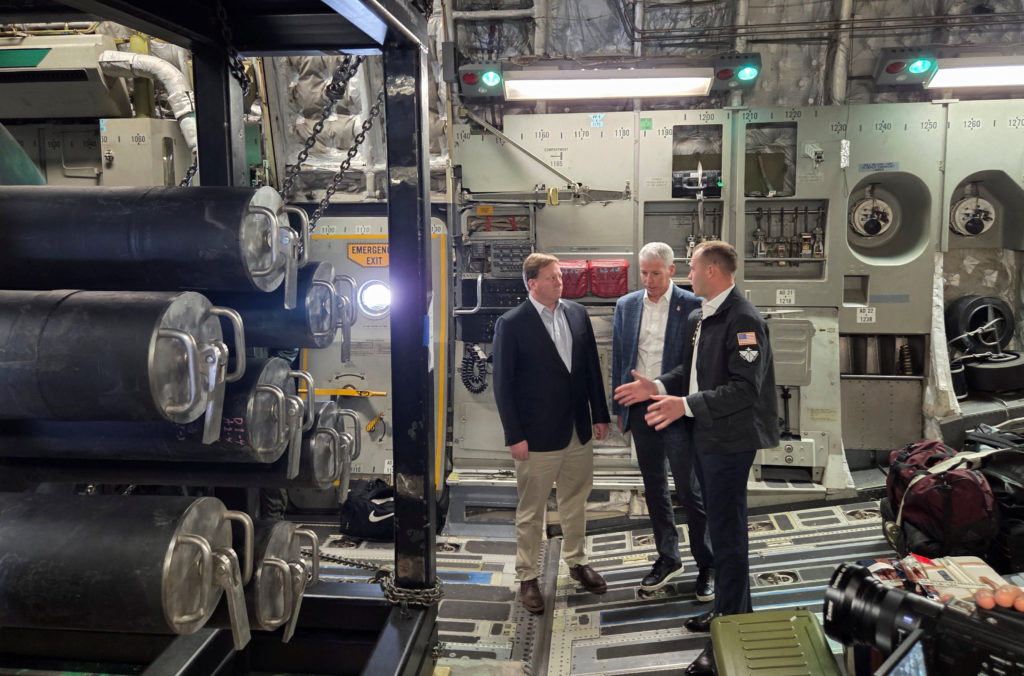
HILL AIR FORCE BASE, Utah (AP) — The Pentagon and the Energy Department transported a 5-megawatt microreactor from California to Utah on February 15, demonstrating the potential for rapid deployment of nuclear power for both military and civilian applications. The flight, conducted via C-17 military aircraft, involved a microreactor without nuclear fuel and underscores the Trump administration’s push to expand nuclear energy capacity amid growing power demands from artificial intelligence and data centers, as well as military needs.
Energy Secretary Chris Wright and Undersecretary of Defense Michael Duffey, who accompanied the reactor on the flight, characterized the event as a breakthrough for accelerating the commercial licensing of microreactors. This initiative is part of a broader effort by the Trump administration to reshape the nation’s energy landscape, as detailed in a White House fact sheet released February 11, 2026.
President Trump has consistently championed nuclear power as a reliable, carbon-free energy source. This support exists alongside his administration’s prioritization of coal and other fossil fuels, a stance highlighted by an executive order directing the Department of War to prioritize power purchase agreements with coal-fired facilities, as reported by The Hill and ABC News. The President has even jokingly mandated the use of the phrase “beautiful, clean coal” when referencing the fuel source.
Despite skepticism regarding the safety and feasibility of microreactors, Wright dismissed concerns, emphasizing the progress made under Trump’s push for nuclear energy expansion. Trump signed executive orders last year granting Wright the authority to approve advanced reactor designs and projects, circumventing the traditional regulatory oversight of the independent Nuclear Regulatory Commission, which has overseen the U.S. Nuclear industry for five decades.
“Today is history. A multi-megawatt, next-generation nuclear power plant is loaded in the C-17 behind us,” Wright stated prior to the two-hour flight from March Air Reserve Base in California to Hill Air Force Base in Utah. He further asserted that at least three microreactors will achieve “criticality” – the point at which a sustained nuclear reaction occurs – by July 4, fulfilling a promise made by Trump.
Currently, the U.S. Operates 94 nuclear reactors, generating approximately 19% of the nation’s electricity, according to the U.S. Energy Information Administration. While the number of reactors has declined from 104 in 2013, two latest commercial reactors in Georgia represent the first large-scale reactors built from the ground up in a generation. Recognizing the lengthy timelines associated with building full-scale reactors, the industry and government have increasingly focused on smaller, more efficient designs, including slight modular reactors proposed by the Tennessee Valley Authority.
Microreactors, designed for portability, are intended to “accelerate the delivery of resilient power to where it’s needed,” Duffey explained. These mobile reactors could potentially provide energy security for military bases independent of the civilian power grid, enhancing operational readiness, as outlined in the CNBC report on the executive order.
The reactor transported to Utah, produced by California startup Valar Atomics, is capable of generating up to 5 megawatts of electricity, sufficient to power 5,000 homes, according to Valar Atomics CEO Isaiah Taylor. The company anticipates beginning test-basis power sales next year and achieving full commercial operation by 2028.
However, concerns regarding safety remain. Edwin Lyman, director of nuclear power safety at the Union of Concerned Scientists, characterized the demonstration flight as a “dog-and-pony present,” arguing it merely demonstrated the Pentagon’s logistical capabilities without addressing fundamental questions about feasibility, cost-effectiveness, or safety. Lyman questioned the administration’s plan for securely transporting microreactors loaded with nuclear fuel to sensitive locations like data centers and military bases.
The administration has also yet to finalize a plan for the disposal of nuclear waste generated by these reactors, although Wright stated the Energy Department is in discussions with Utah and other states regarding potential reprocessing or permanent disposal sites. The microreactor delivered to Utah will undergo testing and evaluation at the Utah San Rafael Energy Lab, with fuel provided by the Nevada National Security Site, according to Taylor.
“The answer to energy is always more,” Wright concluded, framing the initiative as a reversal of restrictions on fossil fuels and other energy sources implemented during the prior administration. “Now we’re trying to set everything free. And nuclear will be flying soon.”
