
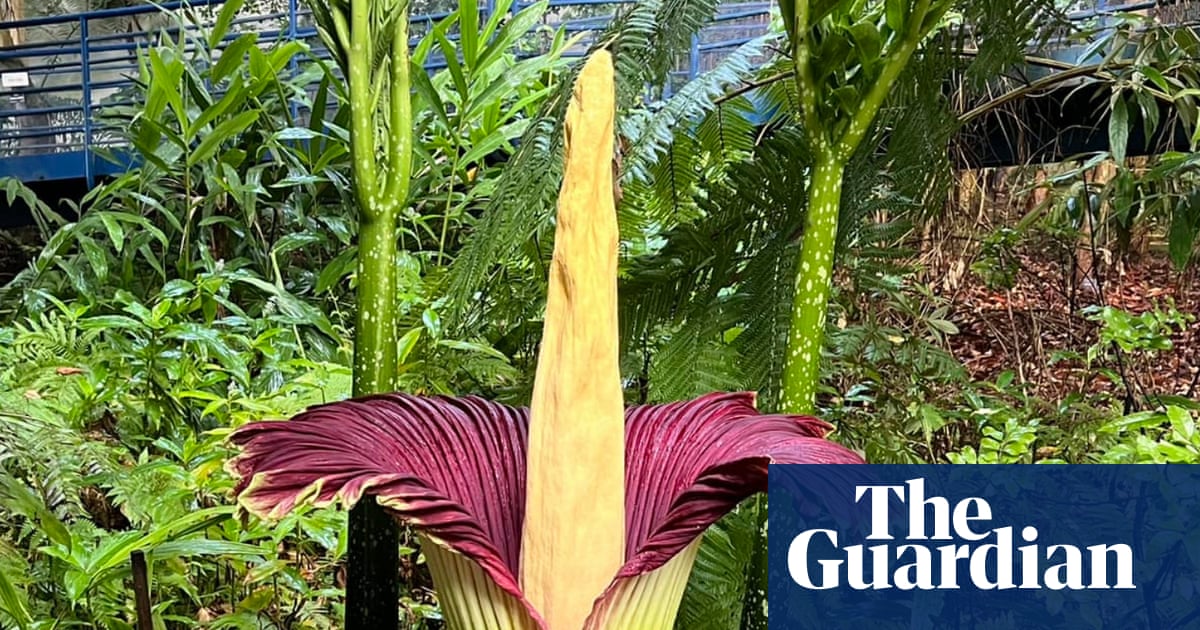
A rare and pungent bloom captivated visitors at the Adelaide Botanic Gardens this week, as Smellanie, a corpse flower, reached its full height of 2.13 meters and released its distinctive odor. The event is part of a growing trend: Australia is experiencing an increasing number of corpse flower blooms, becoming a global hotspot for the notoriously unpredictable plants.
The Amorphophallus titanum, native to the equatorial rainforests of Sumatra, Indonesia, is known for its massive flower spike and the smell of decay it emits to attract pollinators. Matt Coulter, senior horticulture curator at the Botanic Gardens of South Australia, stated that Australia now has “one of the highest flowering events in the world” for these plants. The Adelaide garden’s collection boasts over 250 plants across multiple generations, potentially making it the largest in the world.
The surge in blooms isn’t limited to South Australia. In 2025, more than a dozen corpse flowers flowered across the country, including Putricia in Sydney, Morpheus in Canberra, Big Betty in Cooktown, and a group nicknamed “Spud and co” in Cairns. Putricia, in particular, garnered significant public attention, drawing tens of thousands of visitors and inspiring a wave of online memes, according to the Royal Botanic Garden Sydney.
The popularity of these blooms has prompted botanic gardens to embrace the plants’ unique appeal. John Siemon, horticulture director at the Botanic Gardens of Sydney, noted that giving the plants “personas” like Putricia, Baby Stink, and Stinkerella helped overcome “plant blindness” and engage a new audience with horticulture and science. Nearly 27,000 people visited to experience Putricia’s fragrance, described as resembling “the rich stench of a public bin on a 40 degree day.”
Cultivating corpse flowers is a complex undertaking. Coulter explained that the plants require 10-12 years to mature enough to flower, and even then, blooms are not guaranteed. They rely on storing energy in large underground tubers, or “corms,” which can weigh up to 75kg. The process of determining whether a bud will produce a flower or a leaf isn’t possible until it reaches 10-15cm in length, and even then, the corm may not be strong enough to support a full bloom.
The Royal Botanic Garden Sydney has successfully propagated several clones of Putricia, with three already flowering. Siemon indicated that the fourth clone may bloom within the next 12 months. The garden also features other titan arums, and the Geelong Botanic Gardens recently saw a bloom from Betsy, a plant described as smelling of “decaying possum with overtones of parmesan cheese.”
Australia also has native corpse flower varieties, including the elephant yam and cheeky yam, found in northern Australia. Carol Davis, acting nursery general manager at the Australian National Botanic Gardens in Canberra, explained that these native plants share the same pollination strategy – attracting beetles and flies with a rotting aroma – as their Indonesian counterparts. The ANBG’s titan arum, Morpheus, also flowered in 2025.
While the increasing frequency of blooms is encouraging for conservation efforts, predicting the next flowering remains a challenge. Siemon acknowledged that determining when and where the next corpse flower will bloom requires “a bit of crystal ball, a bit of science and horticulture, and a lot of solid luck.”
