
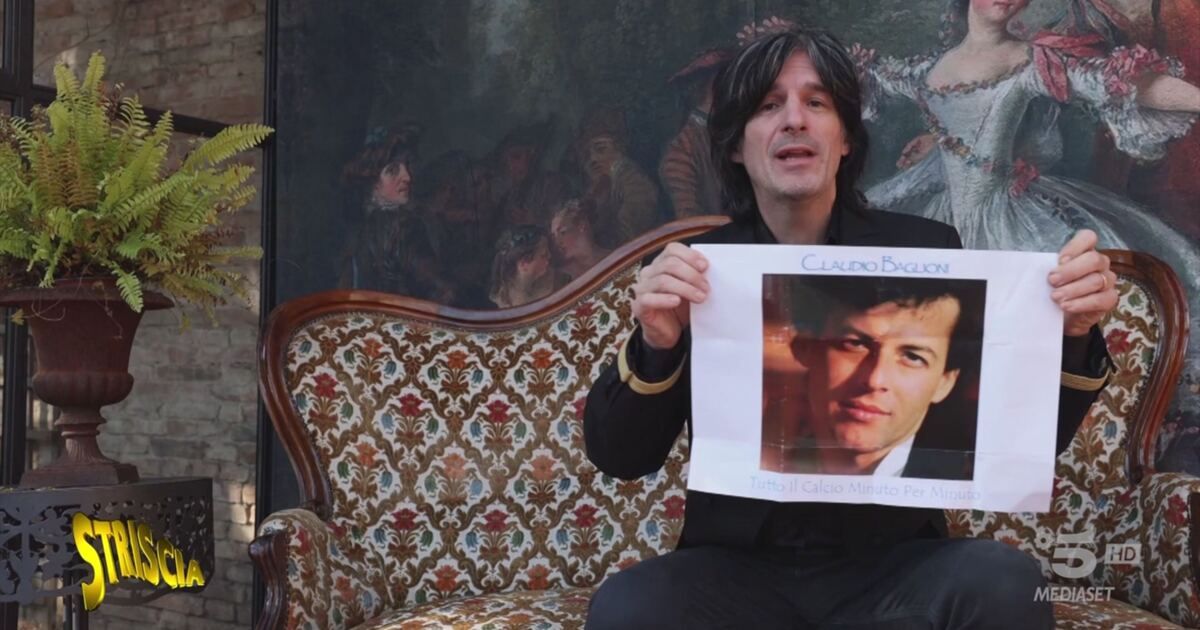
Sanremo, Italy – Investigations into the lyrical sources of Italian singer-songwriter Claudio Baglioni’s operate have resurfaced at the Sanremo Music Festival, with the satirical news program Striscia la Notizia continuing its scrutiny of potential unattributed influences. The program’s reporters, Antonio Casanova and Francesco Mazza, have identified parallels between Baglioni’s song “Tutto il calcio minuto per minuto,” from the album La vita è adesso, and the works of multiple poets and writers.
Striscia la Notizia first raised concerns about Baglioni’s lyrical borrowings in previous years, documented in the volume “Tutti poeti con Claudio Baglioni.” The latest report, previewed on February 5, 2025, and revisited as the festival commenced, focuses on newly discovered similarities between Baglioni’s lyrics and those of Cesare Pavese, Alfonso Gatto, Federico Garcia Lorca, Boris Pasternak, and Vicente Aleixandre, as well as Arthur Schopenhauer and Stanisław Jerzy Lec.
Specifically, the program highlighted a striking resemblance between Lorca’s line, “Chi cammina dimentica e chi si ferma sogna” (He who walks forgets and he who stops dreams), and Baglioni’s lyric in “Avrai,” “Camminerai dimenticando, ti fermerai sognando” (You will walk forgetting, you will stop dreaming). Further comparisons were drawn between Pavese’s “Il mattino si sarà spalancato in un largo silenzio” (The morning will have opened in a wide silence) and corresponding phrasing in Baglioni’s work.
The renewed attention comes as Baglioni participates in the 66th Sanremo Music Festival, where preparations are underway. Carlo Conti, the festival’s conductor and artistic director, was reportedly approached for comment by Striscia la Notizia’s reporters, though his response was not detailed in initial reports.
Striscia la Notizia’s investigation extends beyond Italian authors, previously examining potential influences from Pier Paolo Pasolini, Mark Twain, Emily Dickinson, Oscar Wilde, Francis Scott Fitzgerald, Franz Kafka, Jacques Prévert, and Gabriel García Márquez. The program alleges that Baglioni has incorporated phrases, metaphors, and suggestions from these authors into his songs without providing attribution.
Recent examples highlighted by the program include a comparison between Schopenhauer’s aforism, “La vita e i sogni sono fogli di uno stesso libro. Leggerli in ordine è vivere, sfogliarli a caso è sognare” (Life and dreams are pages of the same book. Reading them in order is living, flipping through them randomly is dreaming), and Baglioni’s lyrics in “E noi due là”: “Se lo leggi in fila vivi storie già sentite. Sogni invece se apri a caso il libro delle vite” (If you read it in a row you live stories already heard. You dream instead if you open the book of lives at random). Another comparison was made between Lec’s “Se si abbattono i monumenti ricordatevi di salvare i piedistalli” (If monuments are torn down, remember to save the pedestals) and Baglioni’s “Si abbattono le statue, i piedistalli no” (Statues are torn down, but not the pedestals).
The program is scheduled to continue its coverage of the matter on Canale 5, with Sergio Friscia and Roberto Lipari hosting the broadcast.
