
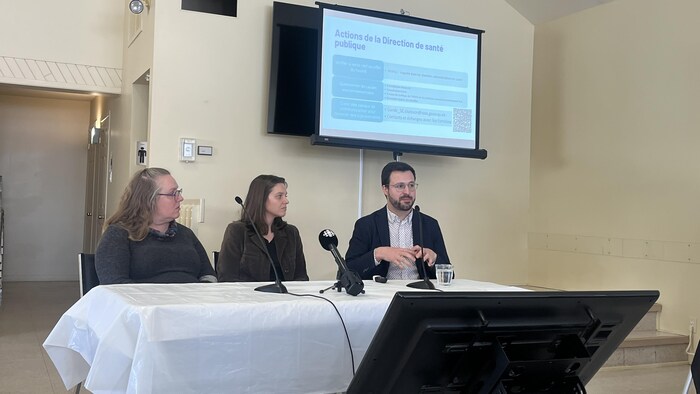
The Public Health Department of the Capitale-Nationale region has concluded that a cluster of amyotrophic lateral sclerosis (ALS) cases in Charlevoix-Est, Quebec, is “probably due to chance,” bringing an end to a five-month investigation launched after concerns were raised about a higher-than-expected incidence of the neurodegenerative disease in the area.
The investigation began in September 2025, following reports from the Québecor media bureau detailing a concentration of ALS cases in the Charlevoix-Est regional municipality dating back to the early 2000s. Then-Minister of Health and Social Services, Christian Dubé, expressed concern and directed public health officials to investigate further.
ALS, also known as Lou Gehrig’s disease, causes the progressive deterioration of nerve cells linked to muscle movement. The disease ultimately weakens voluntary muscles in the arms, legs, face, neck, and tongue. While progression can be slowed, there is currently no cure, and life expectancy typically ranges from two to five years, according to ALS Québec.
The Public Health Department’s mandate was to determine if the number of ALS cases in Charlevoix-Est exceeded that of the rest of Quebec, whether further study was warranted, and if potential environmental exposures should be investigated. The department now states that while the number of reported cases in Charlevoix-Est does appear to be higher than expected, this excess is within the range of statistical variation seen elsewhere in the province.
Analysis conducted in collaboration with the Institut national de santé publique du Québec (INSPQ) examined all ALS cases and projections across Quebec since 2000. The data compared the actual number of cases in Charlevoix-Est with the number expected based on the incidence rate observed in the rest of Quebec. Of the five periods analyzed, from 2000 to 2023, three showed a higher number of observed cases than expected. The period from 2014 to 2018 was particularly notable, with 12 cases recorded, compared to an expected 5.45.
However, the Public Health Department argues that to justify further investigation, the number of observed cases would need to be four times higher than the expected number during those periods. According to Dr. Philippe Robert, Director of Public Health for the Capitale-Nationale, “For example, in 2014-2018, it would have taken around 20 [observed cases] to say that it was so significant that there was a chance of finding a specific cause.”
Dr. Robert also emphasized that ALS cases are generally increasing across Quebec, which could contribute to the observed trend in Charlevoix-Est. “There are necessarily places where there will be more diseases and places where there will be fewer diseases. It is normal that it varies between sectors,” he stated.
The findings have prompted disappointment among residents and advocacy groups. Sylvie Harvey, a resident of La Malbaie, lost both her husband in 2007 and a subsequent partner in 2017 to ALS. “I would have liked to know much more today so that things could move faster… The anxiety develops a lot. You never know who might get it,” she said.
Gilles Martel, Vice-President of the Charlevoix ALS Support Group, expressed similar dissatisfaction. While acknowledging the limitations of the investigation, he noted the proximity of a former paper mill, Donohue (now owned by Domtar), to the residences of some of those diagnosed. “I was disappointed since we were expecting more than that, but I understand the situation. They can’t work a miracle to find a specific cause when there are, for example, 400 or 500 harmful [products] [in the environment],” he said.
Health officials acknowledge that the cause of ALS remains largely unknown. Isabelle Goupil-Sormany, a public health physician specializing in environmental health, stated, “Currently, what experts tell us is that we are far from being able to find a link between the environment and ALS. We are really far away.” She added, “We have nothing to say that people are at very high risk in Charlevoix and that we should be worried on a daily basis. No, certainly not.”
A similar investigation was conducted in the Estrie region of Quebec following concerns about a cluster of approximately 30 cases over a 20-year period. That investigation also concluded that the cases did not represent an excess beyond statistical expectations, and a paper mill was also located nearby in Windsor.
