
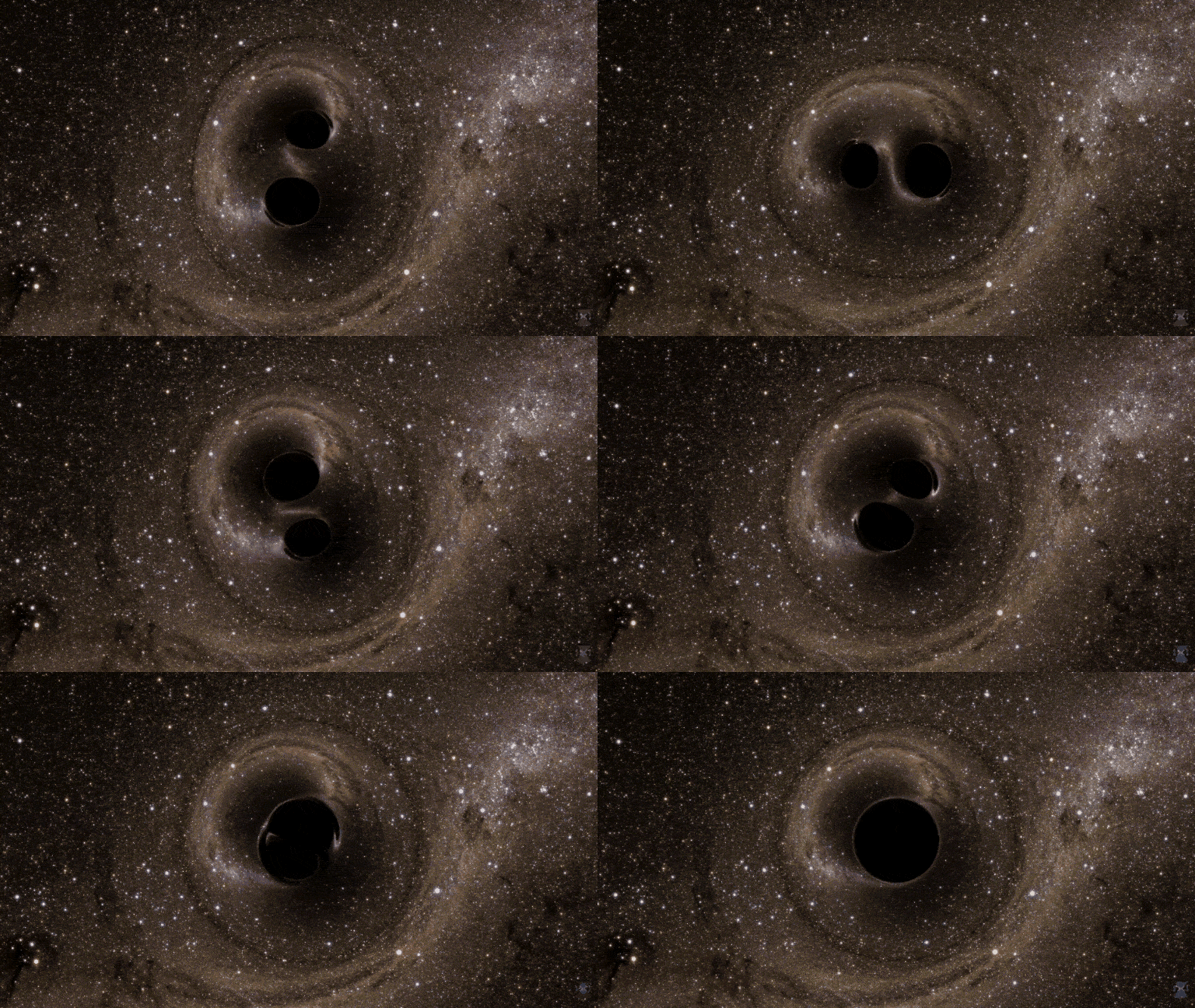
The clearest gravitational wave signal ever recorded has once again confirmed Albert Einstein’s theory of general relativity, providing scientists with an unprecedented opportunity to study the collision of black holes and probe the fundamental laws of physics. The signal, designated GW250114, reached the U.S.-based Laser Interferometer Gravitational-Wave Observatory (LIGO) on January 14, 2025.
The event involved the merger of two black holes, each approximately 30 times the mass of our sun, located roughly 1.3 billion light-years away. Researchers say the characteristics of GW250114 closely mirror those of the first gravitational wave ever detected in 2015, GW150914, suggesting similarities in the black holes’ masses and distances from Earth. However, the recent signal is roughly three times clearer than the initial detection, enabling a more rigorous test of Einstein’s century-old theory.
“It was very clearly the loudest event,” said Keefe Mitman, a postdoctoral researcher at the Cornell Center for Astrophysics and Planetary Science and a co-author of the study published January 29 in Physical Review Letters. “This one event provided more information than everything we’ve seen before regarding certain tests of general relativity.”
The increased clarity is attributed to a decade of improvements to the sensitivity of gravitational wave detectors, including LIGO, the Virgo Collaboration in Italy, and the KAGRA Collaboration in Japan. These upgrades have reduced interference from sources like seismic vibrations and even passing vehicles, allowing the detectors to register the incredibly subtle distortions in spacetime – changes 700 trillion times smaller than the width of a human hair – caused by the black hole merger.
The exceptional signal allowed scientists to analyze the “ringdown” phase following the merger, when the newly formed black hole vibrates and emits gravitational waves in distinct patterns, or “tones.” Researchers detected both the primary tones predicted by general relativity, with each tone independently yielding measurements of the black hole’s mass and spin that were in perfect agreement. They confidently identified a more subtle “overtone” predicted by Einstein’s theory, marking the first time this feature has been definitively observed.
“This event made it very, very obvious that, this prediction of general relativity was present in the signal, which was really exciting,” Mitman told Live Science. Had the measurements deviated from expectations, he added, it would have necessitated a fundamental re-evaluation of our understanding of gravity.
Previous analyses of GW250114, released in September 2025, also confirmed a prediction made by Stephen Hawking more than 50 years ago: that the surface area of a black hole’s event horizon can never decrease, even as energy escapes during a merger. Scientists calculated the combined surface area of the original black holes to be approximately 93,000 square miles, expanding to roughly 155,000 square miles after the merger – consistent with Hawking’s area theorem.
While general relativity has consistently withstood experimental tests, physicists acknowledge it is likely an incomplete description of gravity. The theory struggles to explain phenomena like dark matter and dark energy, and it remains incompatible with quantum mechanics. Scientists hope that future gravitational wave observations will reveal subtle deviations from Einstein’s predictions, potentially pointing towards new physics.
The ringdown phase is considered particularly promising for these tests. Many theoretical extensions to general relativity predict slightly different vibration patterns during this phase, and the ability to measure multiple tones, as achieved with GW250114, helps constrain these alternative theories.
Next-generation detectors, including the planned Einstein Telescope in Europe and the U.S.-based Cosmic Explorer, are expected to be ten times more sensitive than current facilities. These instruments will not only detect more events like GW250114 but also observe lower-frequency gravitational waves, allowing scientists to study more massive black holes. The European Laser Interferometer Space Antenna (LISA), slated for launch in 2035, will observe gravitational waves from supermassive black holes at the centers of galaxies, potentially revealing dozens of distinct tones within a single merger event.
“We’re living in the regime where we don’t have enough data, and we’re kind of just twiddling our thumbs waiting for more data to arrive in,” Mitman said. “Once LISA is online, we’ll be overwhelmed.”
