
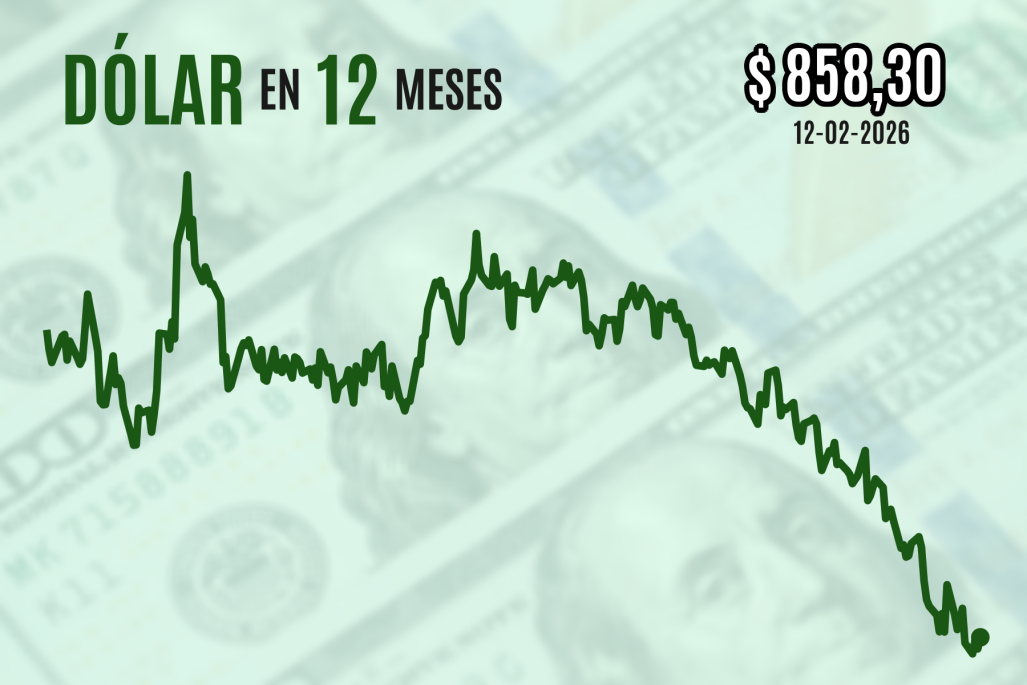
The Chilean peso weakened significantly on Thursday, closing at $858.3 per U.S. Dollar, a rise of $3.6 from the previous day’s trading, as global risk aversion increased and commodity prices declined. The currency’s movement followed renewed concerns surrounding the potential impact of artificial intelligence (AI) on financial markets.
The peso’s depreciation occurred alongside increased demand for U.S. Dollars and U.S. Fixed income securities. The Bloomberg dollar index rose 0.2%, even as yields on two- and 10-year U.S. Treasury notes fell by 4.8 and 8.1 basis points, respectively. Turbulence as well affected the metals market, with copper futures dropping 2.8% to $5.80 per pound, whereas gold and silver experienced losses of 2.9% and 9.5%, respectively.
Wall Street also saw a sell-off of technology stocks, triggered by a downward revision of margin projections from Cisco Systems. This followed a period of strong performance for emerging market equities, which had risen over 30% last year, fueled by Asian markets like Taiwan and South Korea, according to Bloomberg Linea. These regions benefit from high demand for AI-related hardware, including semiconductors, and attract investors seeking diversification away from U.S. Assets.
Recent economic data offered a mixed signal. U.S. Non-farm payrolls for January exceeded market expectations, but failed to sustain a broader dollar rally, providing only a short-term boost to short-term dollar rates. Weekly unemployment claims, released Thursday morning, were slightly higher than anticipated, suggesting some weakening in the labor market.
Market attention is now focused on the U.S. Consumer Price Index (CPI) report, scheduled for release Friday. Consensus estimates predict a monthly increase of 0.3%, matching the underlying series, but representing an acceleration from December’s 0.2% rise.
Foreign positions against the Chilean peso have been unwound rapidly in recent days, totaling approximately $3.7 billion net as of Thursday’s close, representing a shift of over $1.4 billion in just three days. This unwinding coincides with a broader trend of optimism surrounding AI and a weakening dollar, which has boosted emerging market stocks to record highs, as reported by Bloomberg. A recent report from UBS indicated that enthusiasm for AI prompted a revision upwards of their 2025 global technology sector earnings growth forecast.
