
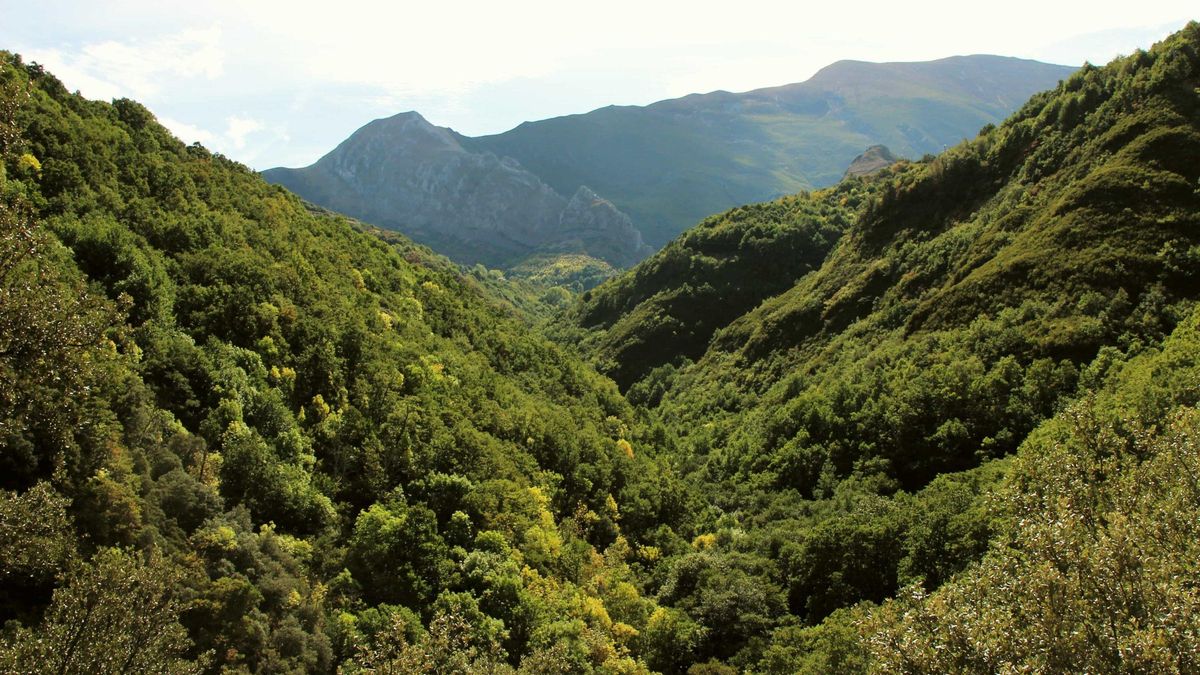
South of the El Bierzo region, in the province of León, just over twenty kilometers from Ponferrada, lies the Valley of Silence. A mountainous area traversed by the Oza River and surrounded by the Aquilian Mountains, it’s accessed via narrow, winding roads.This isn’t a place you pass through; it’s a destination where detours and a slower pace are essential, acknowledging that the journey itself is part of the experience.
This valley belongs to the so-called Tebaida Berciana, a historically isolated territory that for centuries attracted monks and hermits seeking spiritual retreat.This history remains deeply present in the landscape and in the villages scattered throughout the area, where traditional architecture, ancient paths, and the remains of monasteries help to understand why this corner of El Bierzo has maintained such a distinct character.
Currently, the Valley of Silence is an ideal destination for those seeking nature, hiking, and quiet villages free from major crowds. Here, you come to walk, to discover small, well-preserved rural nuclei, and to enjoy the Bercian gastronomy in an surroundings where the landscape sets the rhythm of your journey.
A Valley marked by Silence and Spirituality
The name of the Valley of Silence is linked to a legend starring Saint Genadio, one of the most vital figures in the area’s history. According to tradition, the saint retired to a nearby cave to meditate, but the constant sound of the river’s water prevented him from concentrating. In a moment of frustration, he struck his staff and ordered the river to be silent: “Be quiet!” As then, legend says, silence has taken hold of the valley.
There are several versions of this story, of course, but they all point to the connection between this territory and a contemplative life. Beyond the legend, the valley was chosen from an early time by Christian hermits as a place of retreat. As early as the 4th century, and especially during the High Middle Ages, these mountains welcomed religious communities seeking isolation and tranquility for prayer.
Saint Genadio, bishop of Astorga between 899 and 920 AD, was a key figure in this process.He founded and restored several monasteries in El Bierzo and left a deep mark on the Valley of Silence, especially in Peñalba de Santiago and in the area around Montes de Valdueza. His legacy explains much of the historical heritage that can be visited today.
The current landscape is the result of this long-standing relationship between nature and human presence. Chestnut, oak, walnut, and ash forests cover the slopes, while the Oza River runs along the valley floor. Even though the name suggests complete stillness, the sounds of water and wildlife are a constant part of the environment.
Peñalba de Santiago, the Heart of the Valley
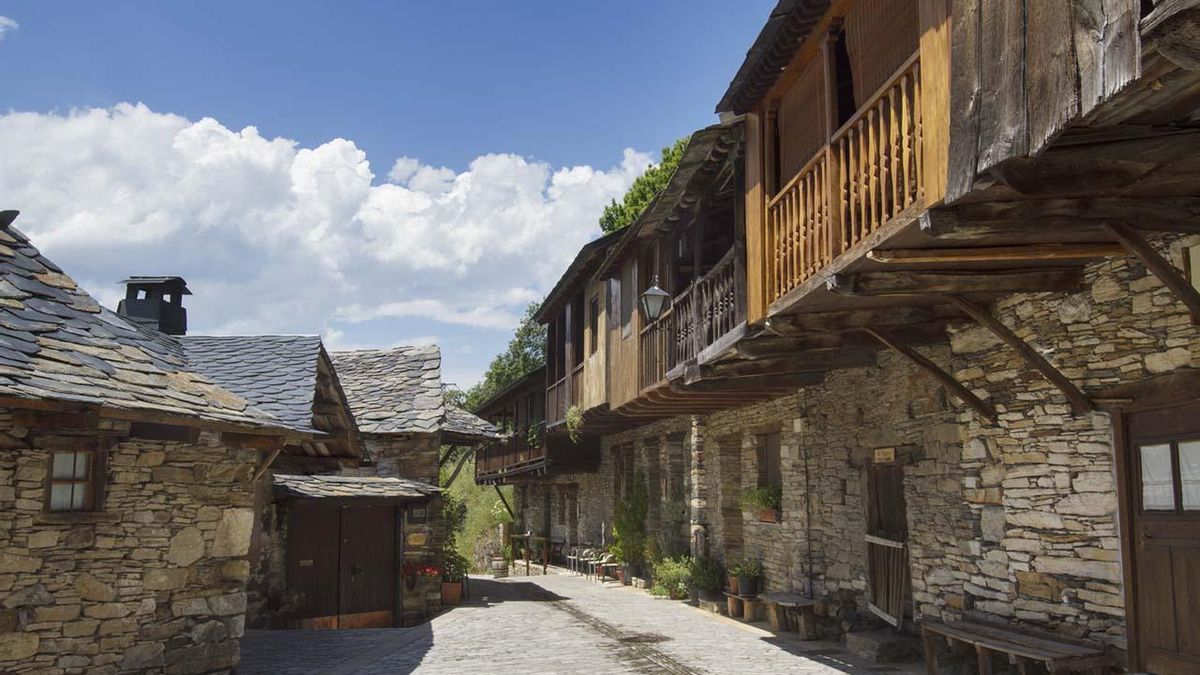
Peñalba de Santiago is the most well-known town in the Valley of Silence and one of the area’s main attractions. Getting here involves traveling along a mountain road with panoramic stretches offering views of the valley’s vastness. Upon arrival, vehicles are parked at the entrance, allowing visitors to explore the town on foot, blissfully traffic-free.
the townscape stands out for its excellent integration into the environment. Stone houses, slate roofs, and narrow streets adapt to the uneven terrain and maintain a homogeneous image. Despite the passage of time and the increase in tourism, Peñalba has preserved its essence, and is widely considered one of the most beautiful towns in Castile and León, and even in Spain.
Many of the houses retain traditional elements such as wooden galleries – used for storage in the past – or ground floors where animals where sheltered. while strolling through its streets, you’ll find the casa de los Diezmos, where peasants delivered part of their harvest to the Bishopric of Astorga. The beauty of the whole is such that it is rightly protected as an Asset of cultural Interest.
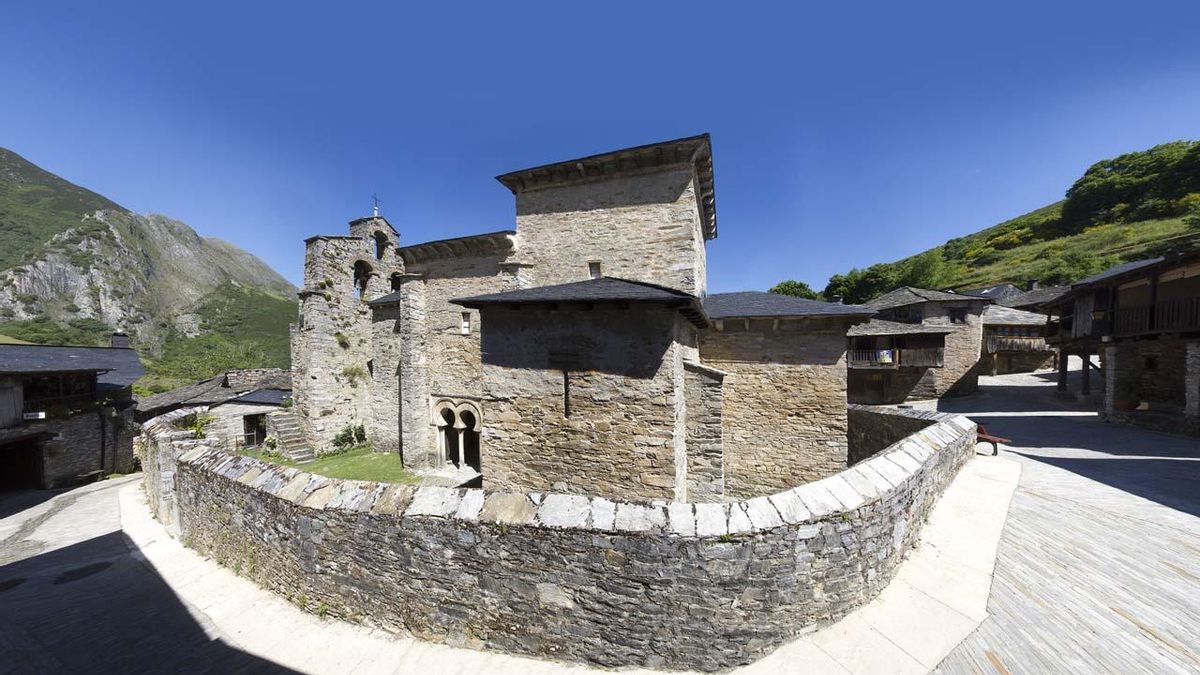
Within the town is the church of Santiago de Peñalba, one of the most critically important Mozarabic temples in the province. It was built in the 10th century by Abbot solomon and its most recognizable feature is the side doorway, formed by two horseshoe arches supported by marble columns with Corinthian capitals. Inside, remains of early medieval paintings are preserved, well worth a visit.Saint Genadio died in Peñalba de Santiago, but his remains were hotly contested (and divided).
Montes de Valdueza and the surrounding towns
Just over five kilometers from Peñalba is Montes de Valdueza, another essential nucleus of the valley. The town is situated next to the Oza River and has a small number of stone houses, reinforcing its quiet and rural character.
The main point of interest is the Monastery of san Pedro de Montes,a temple of Visigothic origin founded in 635 AD by Saint Fructuoso. Centuries later it was rebuilt by Saint Genadio after the Muslim invasion and became one of the most important monastic centers in the region. Today, after decades of abandonment, only the church and some remains of the old complex survive.
despite its state, the monastery is still worth a visit. In its walls one can observe different architectural styles, from Preromanesque to Romanesque and even Baroque elements, reflecting the different stages the building has gone through.
In addition to Peñalba and Montes de Valdueza, the Valley of Silence is dotted with small towns such as Valdefrancos, San Clemente de Valdueza, San Cristóbal de Valdueza, and Manzanedo de Valdueza. Small, little-visited towns that allow you to experience a more everyday and authentic side of the valley.
Hiking Among Mountains, Rivers, and Hermitages
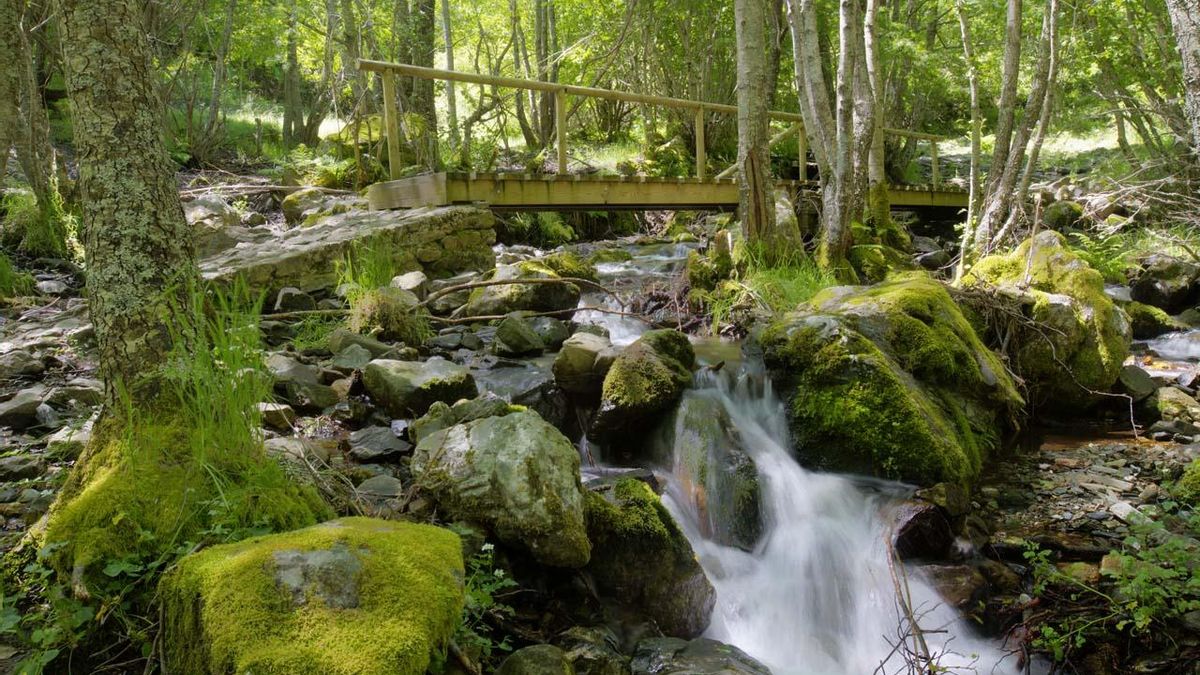
The Valley of Silence is a perfect destination for hiking lovers, both for the variety of routes and for the scenic and historical interest of the trails. There are easy and more demanding options, allowing you to adapt the walks to your time and experience.
One of the most popular routes leads to the Cave of San Genadio. It is indeed a circular trail of about 4.5 kilometers,starting from Peñalba de Santiago and can be completed in approximately an hour and a half.The route is simple and offers good views of the town and the valley. The cave is one of the natural hollows used by the saint during his periods of meditation.If you want to extend the walk a bit more, you can always head to the cascada del Silencio (Silence Waterfall).
For those seeking a more complete route, the sendero de la Tebaida Berciana (Tebaida Berciana Trail) is one of the most recommended options. It is a circular itinerary of about 14.5 kilometers, with an approximate duration of six hours and an accumulated elevation gain of more than 700 meters. Along the way, you pass through chestnut and oak forests, river areas, and natural viewpoints, as well as passing by the Cave of San Genadio and the Monastery of San pedro de Montes.
Another alternative is the Senda de los Monjes (Monks’ Path), a linear trail of almost 20 kilometers that connects Ponferrada with Montes de Valdueza following the course of the Oza River. While not technically challenging, its length requires greater preparation or transport at the ends. It’s also a entirely cyclable route,expanding the possibilities for travelling it.
Beyond these routes, the Aquilian Mountains offer other options for those looking to gain altitude. From the Puerto de los Portillinos, at almost 2,000 meters, you can access peaks like El Morredero or Cabeza de Yegua, from where you get wide views of the valley and the mountains. However, in winter, be sure to check the weather forecast and check for possible snow.
