
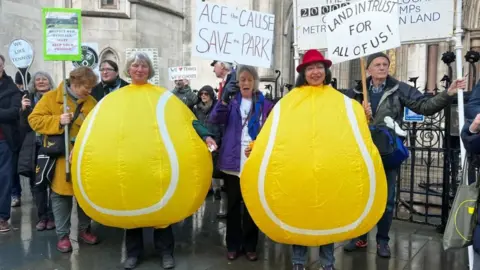
Wimbledon Expansion Plans Face Legal Challenge Over 150-Year-Old Land Trust
A legal battle is underway at the High Court that could substantially impact the All England Club’s ambitious plans to expand the Wimbledon tennis grounds. The dispute centers around a 150-year-old law and whether it restricts the use of land purchased for the expansion. The case, brought by the campaign group Save Wimbledon Park (SWP), argues that the land is protected by a public trust, limiting it’s use to “public walks or pleasure grounds.”
The Expansion Project and its Scope
The All England Club aims to nearly triple the size of its grounds, utilizing the former Wimbledon Park Golf Club site. The proposed advancement includes the construction of 38 new tennis courts and an 8,000-seat stadium. This expansion would allow the club to host Wimbledon qualifying matches on site, alleviating congestion during the main tournament and enhancing the overall Wimbledon experience. The project represents a substantial investment in the future of the tournament and its facilities.
The Core of the Legal Dispute: The Public Health Act 1875
At the heart of the legal challenge lies the interpretation of the Public Health Act 1875. SWP contends that this act established a statutory trust on the land, designating it for public use as recreational space. They argue that this trust has remained in effect despite changes in ownership over the decades, including the transfer to the London Borough of Merton in the 1960s and the subsequent purchase by the All England Club in 1993. the group asserts that any development that restricts public access or alters the land’s character would violate the terms of this trust.
The All England Club’s Defense
The All England Club disputes the existence of a continuing trust. Their legal team argues that the land was never subject to such a restriction and, even if it had been, the 1993 purchase extinguished any prior claim. Jonathan Karas KC, representing the club, emphasized that the land has consistently been treated as private property, leased to a private club, and never developed as a public park. He further stated that the club’s plans would not impede public enjoyment of the wider Wimbledon Park area.
Historical Context and Land Ownership
The history of the land is crucial to the case. Public Wimbledon Park was formally established under a statutory trust in 1927. Though,the All England Club’s legal team maintains that the golf course land remained separate and was not included in this public trust. They point to documentation indicating that the London Borough of Merton was free to dispose of the golf course land as it saw fit, suggesting it was not burdened by the same restrictions as the public park. The club purchased the freehold for approximately £5 million in 1993, believing it had acquired unrestricted ownership.
Previous Legal Challenges and Current Status
This is not the first time SWP has challenged the expansion plans.The group previously lost a High Court case against the Greater London Authority’s (GLA) decision to grant planning permission in July of last year. Though, they are now focusing on the land trust issue, arguing that it overrides planning considerations. The current hearing, which began on January 13th, 2026, is expected to conclude on January 23rd, 2026, and the court’s decision will have important implications for the future of Wimbledon and the surrounding area.
Implications and Future outlook
The outcome of this case will determine whether the All England Club can proceed with its expansion plans as envisioned. If the court rules in favor of SWP, the club may be forced to significantly revise its proposals to comply with the terms of the public trust. This could involve reducing the number of new courts,preserving more open space,or providing greater public access to the land. Conversely, a ruling in favor of the All England Club would clear the way for the project to move forward, possibly transforming Wimbledon into a world-class tennis center capable of hosting even larger events. The case highlights the ongoing tension between private development and the preservation of public spaces, a conflict that is becoming increasingly common in urban areas.
Published: 2026/01/22 14:16:14
