
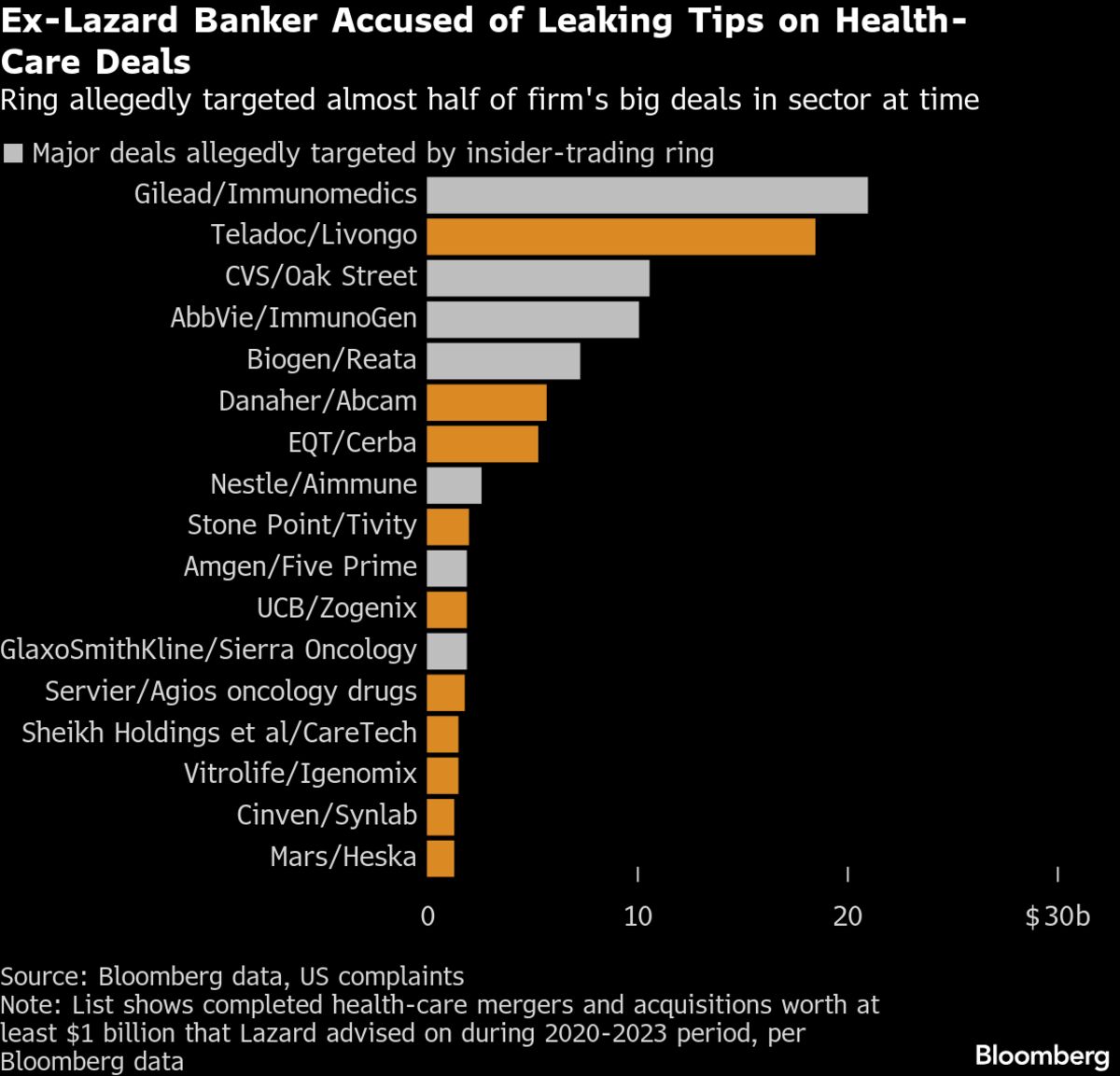
Lazard Banker Accused of Insider Trading in $41 Million Scheme
A former investment banker at Lazard Ltd. is facing serious charges from U.S. authorities for allegedly leaking confidential details about healthcare deals.The Justice Department alleges that the banker provided these tips to a freind, who then shared them with a network of traders, resulting in $41 million in illegal profits. This case highlights the ongoing risks of insider trading on Wall Street and the lengths to which authorities will go to prosecute such offenses.
The Allegations: A Detailed Look
The core of the case revolves around the alleged sharing of non-public, material information concerning mergers, acquisitions, and other notable transactions within the healthcare sector. According to the Department of Justice press release, the former Lazard dealmaker, identified as andrew Shapiro, is accused of providing this information to his longtime friend, Alexander Freund. Freund, in turn, allegedly disseminated these tips to a wider network of traders who then executed trades based on this privileged knowledge.
The indictment details specific instances where Shapiro allegedly tipped Freund about upcoming deals, including potential acquisitions and regulatory approvals.These tips allowed Freund and his network to make considerable profits by trading on the information before it became public. The $41 million in illicit gains represents the total profit generated by the trading activity based on the alleged insider information.
Who is Involved? Key Players in the Case
- Andrew Shapiro: The former Lazard investment banker accused of leaking the confidential information. He held a position where he would have had access to sensitive details about ongoing and potential healthcare deals.
- Alexander Freund: Shapiro’s friend who allegedly received the insider tips and distributed them to a network of traders.
- The Trading Network: A group of individuals who allegedly executed trades based on the illicit information, generating the $41 million in profits.
- Lazard Ltd.: the prominent investment bank where Shapiro was employed. While not accused of wrongdoing, the firm is cooperating with the investigation.
- U.S. Department of Justice: The prosecuting body bringing the charges against Shapiro and Freund.
the Charges and Potential Penalties
Shapiro and Freund have been charged with multiple counts of conspiracy to commit securities fraud and securities fraud.These charges carry significant penalties, including substantial fines and lengthy prison sentences.Securities fraud is a serious federal crime, and prosecutors are expected to pursue the case vigorously.
specifically, each count of securities fraud can carry a maximum sentence of five years in prison and a fine of up to $250,000. Conspiracy charges can carry similar penalties. The actual sentence imposed will depend on a variety of factors, including the extent of the fraud, the defendants’ cooperation with authorities, and their prior criminal history.
Insider Trading: A Persistent Problem on Wall Street
This case is just the latest example of the ongoing battle against insider trading on Wall Street. Insider trading undermines the integrity of the financial markets and erodes public trust. It gives an unfair advantage to those with access to privileged information, while disadvantaging ordinary investors.
The Securities and Exchange Commission (SEC) actively investigates and prosecutes insider trading cases, employing elegant surveillance techniques to detect suspicious trading activity.The SEC frequently enough works closely with the Department of Justice to bring criminal charges against individuals involved in insider trading schemes.
The Role of Investment Banks
Investment banks like Lazard have a critical responsibility to prevent insider trading.They are expected to have robust compliance programs in place to monitor employee trading activity and prevent the misuse of confidential information. These programs typically include restrictions on employee trading, mandatory training on insider trading laws, and procedures for reporting suspicious activity.
While Lazard is not currently implicated in the alleged scheme, the case serves as a reminder of the importance of strong compliance controls within the financial industry. Firms that fail to adequately prevent insider trading can face significant regulatory scrutiny and reputational damage.
What Happens Next?
The case against Shapiro and Freund is still in its early stages. both defendants have pleaded not guilty and are expected to mount a vigorous defence. The government will need to present evidence to prove beyond a reasonable doubt that Shapiro knowingly provided material non-public information to Freund, and that Freund and his network traded on that information.
The investigation is ongoing, and it is indeed possible that additional individuals could be charged in connection with the scheme. The outcome of the case will likely have a significant impact on the way insider trading is investigated and prosecuted on Wall Street.
Key Takeaways
- A former Lazard banker is accused of leaking confidential information about healthcare deals.
- The alleged insider trading scheme generated $41 million in illicit profits.
- Insider trading is a serious federal crime with significant penalties.
- Investment banks have a responsibility to prevent insider trading through robust compliance programs.
- The case highlights the ongoing challenges of policing insider trading on Wall Street.
