
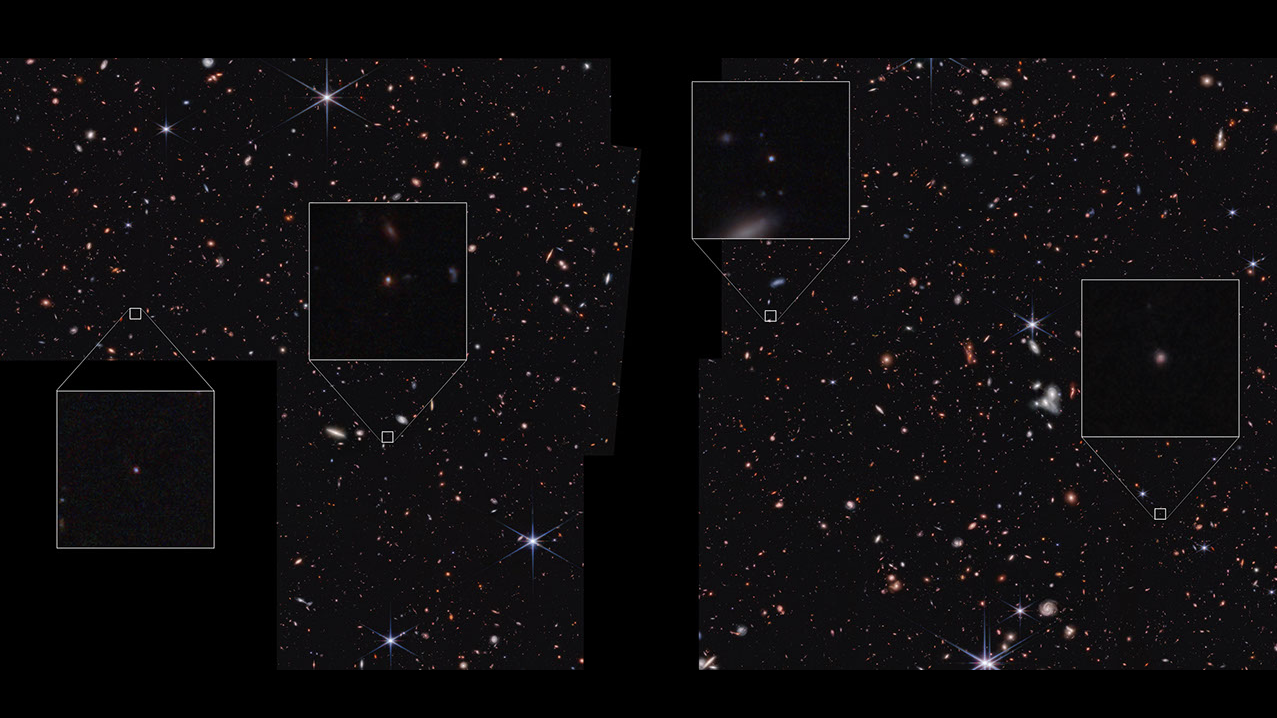
Astronomers Baffled by Newly discovered “Platypus Galaxies”
The universe continues to surprise us. Astronomers have identified a new class of cosmic objects, dubbed “platypus galaxies,” that defy easy categorization. These nine peculiar galaxies, initially spotted in data collected by the James Webb space Telescope (JWST), present a unique combination of characteristics that challenge existing understanding of galaxy evolution. Their revelation raises fundamental questions about how galaxies formed in the early universe.
What Makes Platypus Galaxies So Unusual?
The name “platypus galaxy” is apt.Just as the platypus is a bizarre combination of mammalian,avian,and reptilian traits,these galaxies exhibit a perplexing mix of features. They are compact and relatively small, yet they don’t fit neatly into known categories like quasars or galaxies hosting active supermassive black holes.
“You think that these things should not exist together, but there it is indeed right in front of you, and it’s undeniable,” explained Haojing Yan, an astronomer at the University of Missouri and lead researcher on the project, during a presentation at the 247th meeting of the American Astronomical Society. The team’s findings are currently available as a preprint on arXiv.
Quasars vs. Platypus Galaxies: A key Difference
Quasars are among the brightest objects in the universe, powered by supermassive black holes actively consuming matter. Their spectra – the patterns of light they emit – typically show broad emission lines,indicating rapidly moving gas swirling around the black hole.
in contrast, platypus galaxies exhibit narrow and sharp spectral lines, suggesting that gas within them is moving at a much slower pace. While some galaxies wiht similar narrow-line spectra *do* contain supermassive black holes,the platypus galaxies don’t appear as concentrated “point” sources in images,further complicating their classification. This discrepancy is what makes them so intriguing.
Possible Explanations and the Early Universe
So, what *are* these platypus galaxies? Researchers are exploring several possibilities, with a leading hypothesis suggesting they represent a previously unknown type of star-forming galaxy from the early universe. The JWST is uniquely positioned to observe these distant, ancient galaxies, making this discovery particularly important.
However, even this explanation isn’t straightforward. co-investigator Bangzheng Sun, a graduate student at the University of Missouri, noted, “From the low-resolution spectra we have, we can’t rule out the possibility that these nine objects are star-forming galaxies. That data fits. The strange thing in that case is that the galaxies are so tiny and compact, even though Webb has the resolving power to show us a lot of detail at this distance.”
This compactness is a key puzzle.If they are indeed early star-forming galaxies, they are smaller and more tightly packed than astronomers typically expect. This could indicate that the JWST is observing a population of galaxies even earlier in cosmic history than previously known.
Implications for Galaxy Formation Theories
The discovery of platypus galaxies has profound implications for our understanding of galaxy formation. Current models frequently enough describe galaxy evolution as a process of hierarchical merging, where smaller galaxies collide and coalesce to form larger ones.
Yan suggests these platypus galaxies might represent a different pathway. “I think this new research is presenting us with the question, how does the process of galaxy formation first begin?” he stated. “Can such small, building-block galaxies be formed in a quiet way, before chaotic mergers begin, as their point-like appearance suggests?”
If these galaxies formed in a relatively peaceful manner, it would challenge existing theories and require a re-evaluation of the early stages of galaxy evolution.
The Future of Platypus Galaxy research
Currently, the team has identified nine platypus galaxies, but this is likely just the tip of the iceberg. More data is needed to confirm their nature and determine how common they are. Fortunately,the JWST is still in the early stages of its mission,with an expected lifespan of at least another 15 years. This provides ample chance to gather more data and unravel the mysteries surrounding these enigmatic objects.
As the JWST continues to peer deeper into the cosmos,we can anticipate further discoveries that will refine our understanding of the universe’s origins and the evolution of the galaxies within it. The platypus galaxies, with their peculiar characteristics, serve as a potent reminder that the universe is full of surprises, and that our knowledge is constantly evolving.
key Takeaways:
- New Galaxy Class: Astronomers have discovered a new type of galaxy, dubbed “platypus galaxies,” that don’t fit neatly into existing classifications.
- Unique Characteristics: These galaxies are compact, exhibit narrow spectral lines, and don’t appear to host active supermassive black holes like quasars.
- Early Universe Clues: Platypus galaxies may represent a previously unknown type of star-forming galaxy from the early universe.
- Challenging Theories: their existence challenges current models of galaxy formation, perhaps suggesting a “quiet” formation pathway.
- JWST’s Role: The James Webb Space Telescope is crucial for studying these distant galaxies and furthering our understanding of the early universe.
