
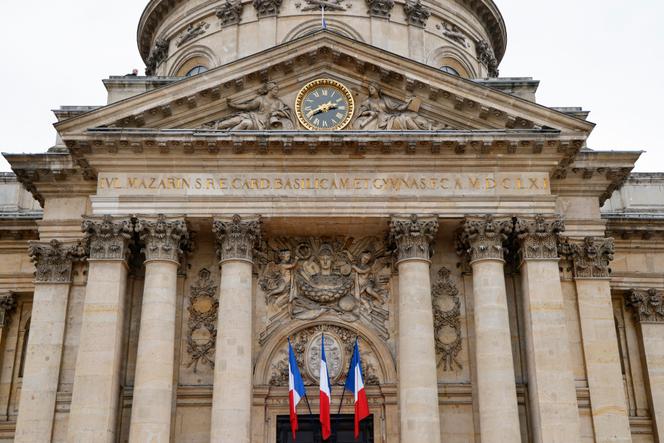
The French Academy has reaffirmed its opposition to inclusive writing,deeming it contrary ”to the spirit of our language,” and has publicly challenged a recent decision by the Council of State on the matter. This dispute highlights a broader cultural debate in France regarding gender equality and linguistic norms.
In a December 31st ruling, the Council of State rejected an appeal from the association *Francophonie avenir*, which sought the removal of two commemorative plaques at Paris City hall that utilize inclusive writing. These plaques specifically read “les président.e.s du Conseil de paris” (the presidents of the Paris Council) and “les conseiller.e.s de Paris ayant accompli plus de 25 ans de mandat” (the councilors of Paris who have served more than 25 years). The use of the point médian to represent both masculine and feminine forms is at the heart of the controversy.
The Core of the Debate: Inclusive Writing Explained
Inclusive writing,also known as *écriture inclusive* in French,aims to represent all genders in language. It typically involves using a point médian (·) to combine masculine and feminine forms of nouns and pronouns. Such as, “les étudiant.e.s” instead of the traditionally masculine “les étudiants” to represent both male and female students.Proponents argue it promotes gender equality and visibility. Though, critics, including the Académie française, contend that it compromises the clarity, elegance, and historical integrity of the French language.
The Académie française, established in 1635, views the point médian as “contrary to readability and the spirit of our language” and believes inclusive writing inflicts “serious damage to the patrimonial dimension” of the French language. In a formal statement, the Academy voiced a “solemn protest” against the Council of State’s decision.
Council of State’s Reasoning and Legal Precedent
It’s crucial to understand that the Council of State’s ruling didn’t address the merits of inclusive writing itself. Instead, it focused on a procedural point. the court determined that the administrative courts below had not made a “legal error” in upholding the city of paris’s right to use inclusive writing on the plaques. The Council of State reasoned that inclusive writing does not constitute the use of a language other than French, but rather a variation in its orthography.
The initial challenge to the plaques dates back to late 2021 when *Francophonie Avenir* requested then-Mayor of Paris, Anne Hidalgo, to remove them.Both the Paris Administrative Tribunal and the Paris Administrative Court of Appeal previously sided with the city, finding no legal basis to prohibit inclusive writing. The council of State’s decision effectively closes the legal avenue for challenging the plaques on these grounds.
A Historical Viewpoint: The Académie Française and Linguistic Purity
The Académie française has a long history of defending what it considers the purity and integrity of the French language. Its mission, as defined by Cardinal Richelieu, is to “give certain rules to our language and to make it pure, eloquent and capable of treating the arts and sciences.” The Academy regularly publishes a dictionary and issues opinions on orthographic rules, often acting as a conservative force in linguistic evolution. This latest statement is consistent with its past opposition to changes perceived as detrimental to the French language.
Broader Implications and Ongoing Debate
This decision arrives amidst a wider societal conversation in France about gender equality and portrayal. While inclusive writing has gained traction in some circles, particularly among younger generations and within academic and activist communities, it remains highly divisive. Many traditionalists view it as an unnecessary and artificial imposition on the language.
The debate extends beyond the use of the point médian. Other proposed forms of inclusive writing include using gender-neutral terms were possible and systematically doubling terms (e.g., ”les citoyens et les citoyennes”). However, these alternatives also face criticism for thier complexity and potential to disrupt the flow of language.
The council of State’s decision, while not endorsing inclusive writing, effectively allows its use in specific contexts, such as commemorative plaques. It’s likely this issue will continue to be debated and contested in France, reflecting the ongoing tension between linguistic tradition and evolving social norms. As Le Monde explored in a 2021 investigation, the quest for a truly egalitarian language is a complex and ongoing process.
