
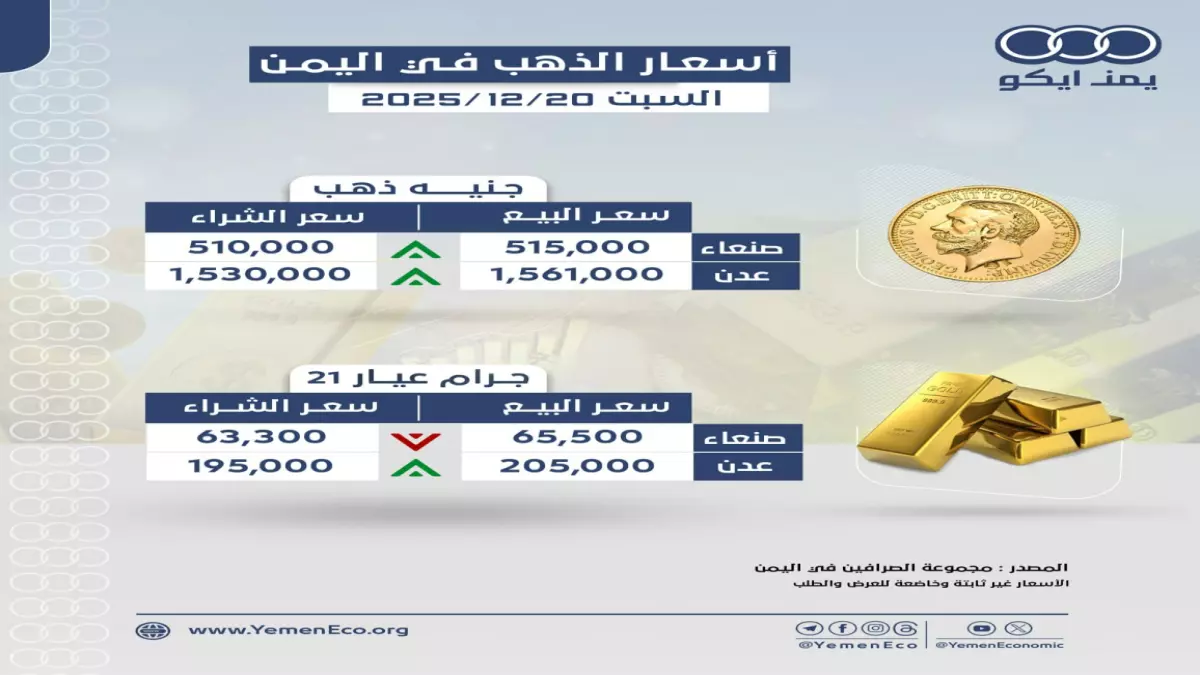
Yemen’s gold market is now at the center of a structural shift involving stark intra‑national price divergence. The immediate implication is amplified arbitrage incentives and heightened pressure on the country’s fragmented monetary framework.
The Strategic Context
Since the outbreak of the Yemeni conflict nine years ago, the nation has evolved into two largely autonomous economic zones: the Houthi‑controlled north centered on Sana’a and the internationally‑recognized south centered on Aden. The split has produced separate fiscal authorities, divergent subsidy regimes, and divergent access to foreign exchange. A chronic liquidity crunch, compounded by sanctions and disrupted import channels, has eroded confidence in the official Yemeni rial. In such an environment, a universally valued commodity-gold-becomes a proxy for regional purchasing power and a de‑facto benchmark for the health of each enclave’s monetary system.
Core Analysis: Incentives & Constraints
Source Signals: The raw report documents a pound of gold priced at 515,000 riyals in Sana’a versus 1,561,000 riyals in Aden-a spread of over 300 %. Similar ratios appear at the gram level (65,500 riyal vs. 195,000 riyal). Local actors describe forced sales at low prices in the north and lucrative arbitrage in the south, while a monetary economist warns of a possible collapse of a single monetary system.
WTN Interpretation: The price gap reflects three intersecting forces. First, divergent liquidity conditions: Aden’s access to port facilities and foreign exchange inflows inflates local demand for gold as a hedge, while Sana’a’s constrained cash flow depresses prices. Second, actors’ incentives: Southern merchants and traders exploit the spread for profit, leveraging relatively safer transport corridors; northern sellers, lacking alternatives, accept lower prices to meet immediate cash needs. Third, structural constraints: Ongoing security risks, checkpoint controls, and the absence of a unified central bank limit the flow of both capital and physical gold, reinforcing the bifurcation. The market thus operates as an informal mechanism for wealth redistribution across contested territories, while together signaling the weakening legitimacy of the national monetary authority.
WTN Strategic Insight
“When a single commodity splits along frontlines, it becomes a barometer of state fragmentation and a catalyst for parallel financial ecosystems.”
Future Outlook: Scenario Paths & Key Indicators
Baseline Path: If the current security stalemate persists and the dual‑economy structure remains unchanged, the gold price differential will likely stabilize at a high‑margin spread. Informal arbitrage networks will expand, prompting a gradual shift toward a shadow foreign‑exchange market anchored by gold. The official rial’s credibility will continue to erode, especially in the north, increasing reliance on hard assets for wealth preservation.
Risk Path: If a major escalation disrupts the aden‑to‑Sana’a transport corridor-or if external sanctions tighten access to foreign currency-the arbitrage channel could collapse.In that scenario, gold demand in both zones may surge, compressing the price gap but also triggering a rapid de‑valuation of the rial and a possible pivot to alternative stores of value such as foreign cash, digital currencies, or commodity contracts.
- Indicator 1: Reports from humanitarian logistics agencies on the operational status of the main road and port routes between Aden and Sana’a (monthly updates).
- Indicator 2: Central monetary authority statements or observable changes in official exchange rates for the Yemeni rial (quarterly releases).
