
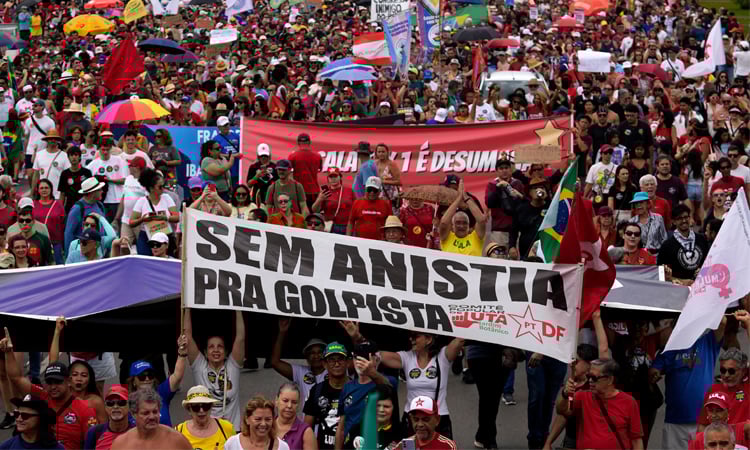
Jair Bolsonaro is now at the center of a structural shift involving the attempted reduction of his prison sentence.The immediate implication is a potential recalibration of Brazil’s democratic equilibrium and the balance of power ahead of the 2026 election cycle.
The Strategic Context
Brazil’s post‑2022 political landscape is defined by deep partisan polarization, an entrenched executive‑legislative rivalry, and a fragile rule‑of‑law framework that has been tested by the 2023 institutional crisis. The conviction of a former president for coup plotting marks an unprecedented legal precedent in Latin America, while the conservative‑controlled lower house retains notable agenda‑setting power.The upcoming 2026 presidential contest intensifies intra‑right competition, especially as Bolsonaro’s son, Senator Flávio Bolsonaro, positions himself as a potential successor. These dynamics intersect wiht broader regional trends of democratic backsliding and the contest between populist forces and institutional resilience.
Core Analysis: Incentives & Constraints
Source Signals: Tens of thousands protested in Rio, São Paulo and Brasília against a bill that would allow Bolsonaro parole after roughly two years of a 27‑year sentence. The measure passed the lower chamber and awaits Senate deliberation. the bill would also benefit imprisoned Bolsonaro supporters. Bolsonaro’s son has signaled willingness to withdraw his candidacy in exchange for amnesty. President Lula retains a veto but Congress could override it.
WTN Interpretation:
The conservative bloc in Congress seeks to preserve its electoral base by offering legal concessions to Bolsonaro and his allies, leveraging the upcoming 2026 race to negotiate political capital. Bolsonaro’s personal leverage is limited by incarceration, but his symbolic stature mobilizes a sizable voter segment, creating a bargaining chip for his son’s ambitions. lula’s constraint lies in maintaining coalition cohesion and avoiding a perception of authoritarian overreach, while also safeguarding Brazil’s democratic credentials to sustain foreign investment and regional leadership. The Senate’s composition and the likelihood of a presidential veto constitute critical checks on the lower house’s agenda.
WTN Strategic Insight
“Brazil’s current legislative tug‑of‑war over Bolsonaro’s sentence is a micro‑cosm of the global contest between populist patronage networks and institutional safeguards.”
Future Outlook: Scenario Paths & Key Indicators
Baseline Path: If the senate rejects the bill or Lula successfully vetoes it,Bolsonaro remains incarcerated,the right‑wing coalition retains its legislative agenda without granting amnesty,and the 2026 electoral calculus proceeds without a major legal concession. Democratic institutions retain credibility, limiting capital flight and preserving Brazil’s standing in multilateral forums.
Risk Path: If the Senate approves the bill and a congressional override neutralizes a presidential veto, Bolsonaro could be released after two years. This would embolden far‑right factions, perhaps trigger renewed street mobilizations, and create uncertainty for investors wary of policy volatility. The precedent of sentence reduction for a convicted coup plotter could weaken judicial independence and encourage similar maneuvers in other Latin American democracies.
- Indicator 1: Senate vote outcome on the sentence‑reduction bill (scheduled for the upcoming Wednesday session).
- Indicator 2: President Lula’s formal decision to veto or not, and any subsequent congressional override motions (to be announced within the next two weeks).
- Indicator 3: Public opinion polling on Bolsonaro’s imprisonment and the right‑wing’s electoral prospects ahead of the 2026 primaries (monthly releases).
- Indicator 4: Activity levels of Bolsonaro supporter groups, measured by arrests or organized protests, especially in the three months following the Senate decision.
