
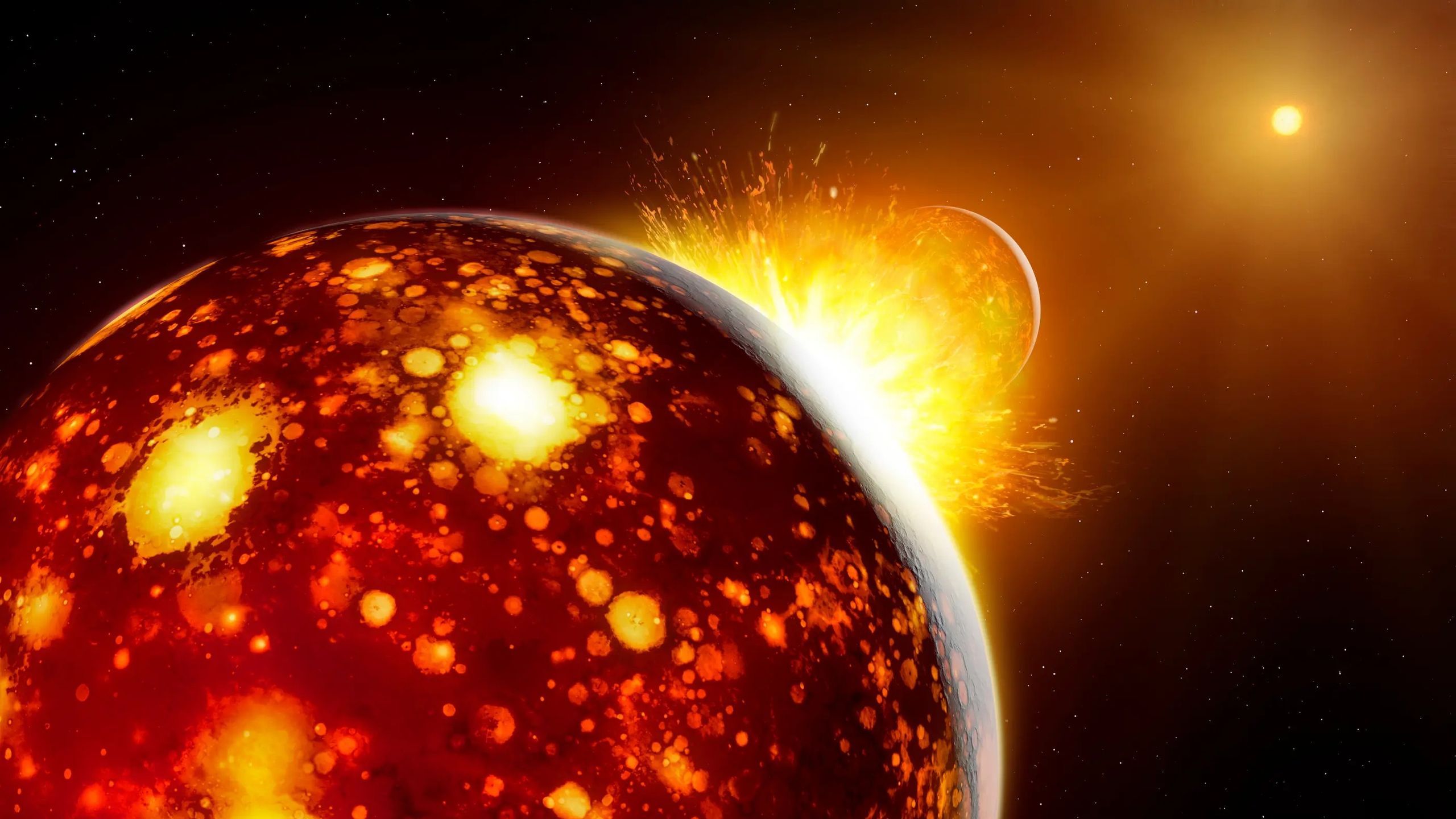
New Research Suggests earth collided with a Neighbour Planet, Forming the Moon
A recent study published in Nature Geoscience provides compelling evidence that Earth wasn’t alone in its early solar system neighborhood and that a collision with a planetary sibling, named Theia, is responsible for the formation of our moon. Researchers analyzed lunar samples from the Apollo 12 and 17 missions, alongside 15 terrestrial rocks – including specimens from Hawaii’s Kīlauea volcano and meteorites from Antarctica – to trace the origins of both Earth and its lunar companion.
the team focused on subtle variations in iron isotopes,utilizing recent research demonstrating their ability to pinpoint material’s formation location relative to the sun. By combining iron isotope measurements with signatures of molybdenum and zirconium, and comparing them to known meteorite compositions, researchers deduced the likely composition of Theia.
Their modeling,encompassing hundreds of scenarios,revealed that the chemical makeup of Earth and the moon is best explained by a collision with Theia,a rocky,metal-cored planet containing roughly 5 to 10% of Earth’s mass,that formed in the inner solar system.
The study also suggests both proto-Earth and Theia incorporated material from an “unsampled” inner-solar-system reservoir – a type of matter not found in existing meteorite collections.This missing component likely originated very close to the sun, potentially consumed by Mercury, Venus, Earth, and Theia, or never surviving as independent bodies.
“It might be only sample bias,” said researcher Hopp, suggesting that samples from Venus or Mercury could one day confirm or refute these findings.
While the study clarifies the likely origins of Earth and Theia as local siblings, the precise mechanics of how the impact thoroughly mixed the two worlds remains a mystery.Unraveling this process could provide the final piece of the puzzle in understanding the moon’s violent birth and the formation of our planet.
