
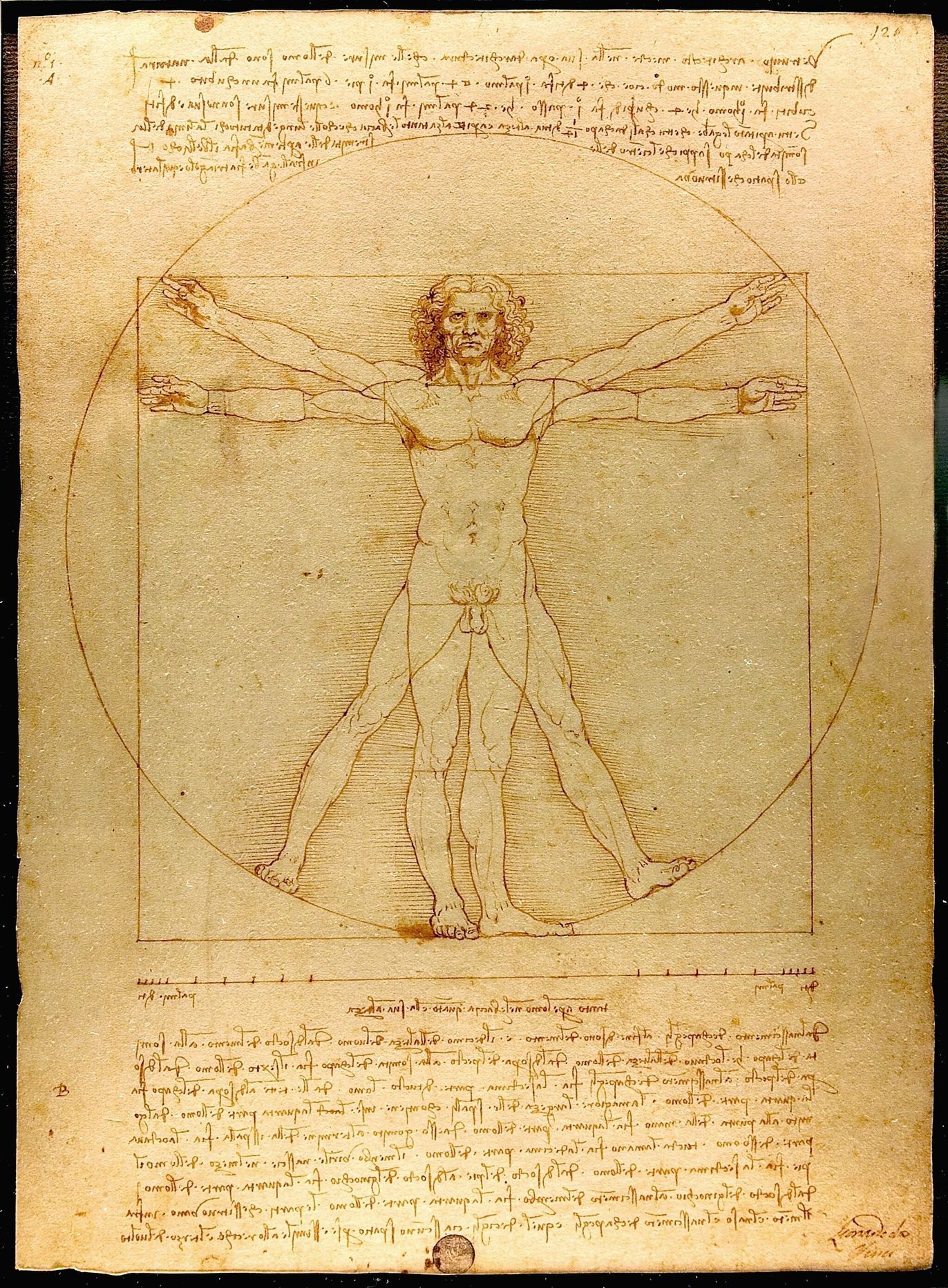
da Vinci’s Vitruvian Man may Hold Key to Universal Geometric Principle, New Research Suggests
London, UK – A centuries-old mystery surrounding the proportions of Leonardo da Vinci’s iconic Vitruvian Man might potentially be closer to resolution, according to a new study suggesting the artwork encodes a essential geometric ratio found throughout nature, from atomic structures to biological systems. Dentist Rory Mac Sweeney proposes that Da Vinci intuitively grasped a principle of spatial efficiency known as the tetrahedral ratio – a geometric relationship of 1.633:1 between height and base distance – and embedded it within his famous drawing.
The tetrahedral ratio,first formally described in 1917,represents an optimal balance between stability and space-saving,and appears repeatedly in the natural world.Researchers have observed it in the arrangement of atoms in diamond crystals and water molecules, as well as in the cellular structures of living organisms where it contributes to maximum strength with minimal material. Even modern architectural designs, like those pioneered by Buckminster Fuller, utilize this principle.
Mac Sweeney’s research highlights a striking parallel: the Bonwill triangle, a principle used in dentistry since 1864 to determine ideal jaw positioning, also exhibits the 1.633 ratio. He posits that if this ratio is consistently present throughout the human body, it could indicate that human anatomy is governed by the same geometric laws as the universe itself.
“If this ratio is repeated in other parts of the body,” Mac Sweeney theorizes, “then it suggests that human anatomy has evolved according to geometric principles that govern the optimal arrangement of space throughout the universe.”
The study points to Da Vinci’s inclusion of an equilateral triangle extending from the figure’s crotch to his feet as a potential key to understanding the artist’s geometrical concept. Mac Sweeney suggests Da Vinci may have unknowingly stumbled upon this universal law centuries before mathematics could formally describe it.
“The same geometric relationships that appear in crystal structures, biological systems, or Fuller’s space models are also encoded in human proportions,” Mac Sweeney writes. “It suggests that Leonardo intuitively understood the very mathematical nature of reality.”
while the scientific community will need to validate these findings, the research offers a compelling new perspective on Da Vinci’s masterpiece and its potential connection to the fundamental building blocks of the universe. The fact that Da Vinci specifically noted an equilateral triangle in his accompanying notes lends credence to the idea that the Vitruvian Man holds a deeper, previously unrecognized geometric importance.
Source: sciencealert.com
