
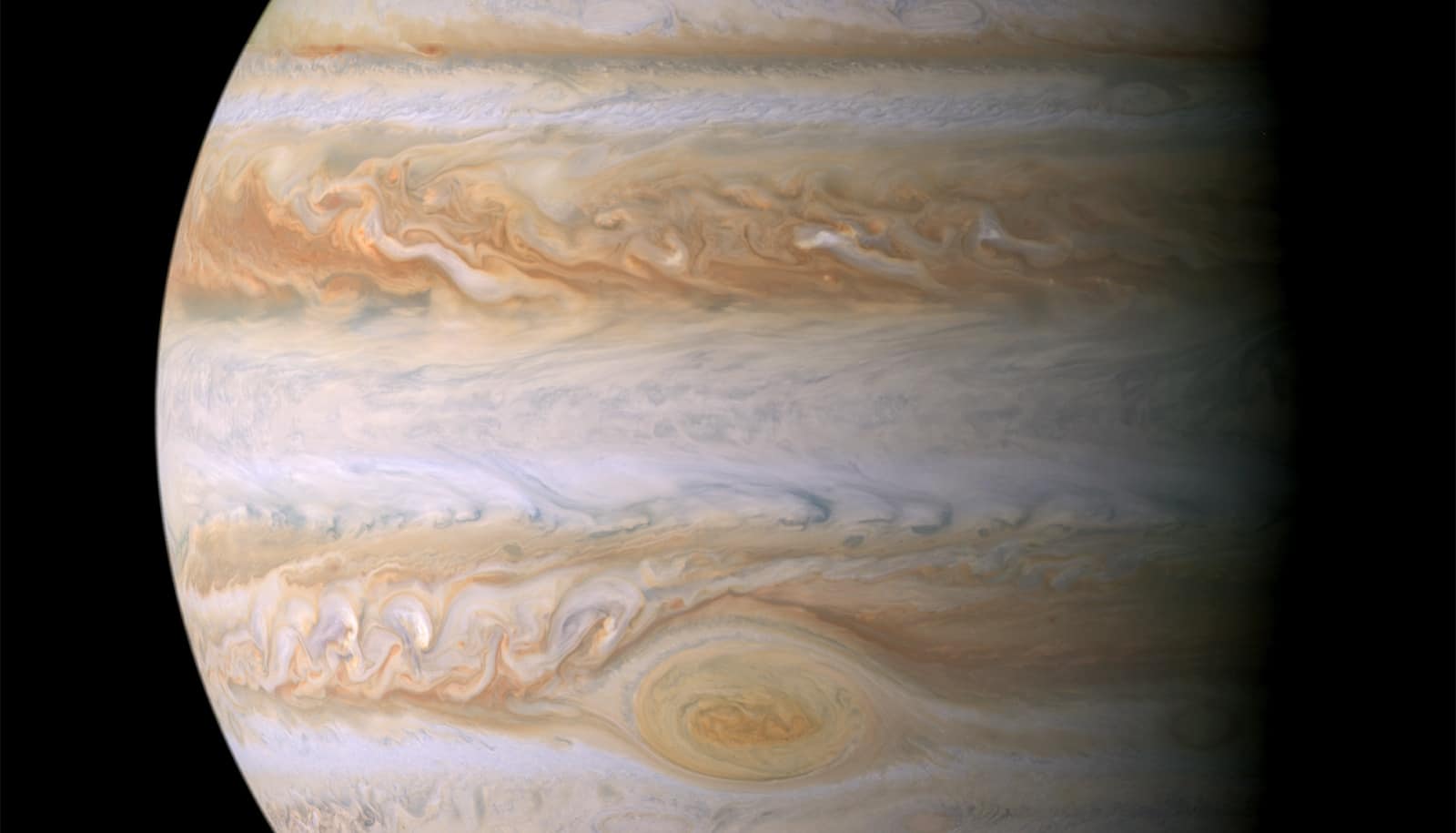
Jupiter‘s Early Growth Key to Earth’s formation, New research Suggests
Recent research from planetary scientists at Rice University reveals a strong link between the early advancement of Jupiter and the formation of Earth and the inner solar system. The study proposes that Jupiter’s rapid growth created “cosmic traffic jams” within the early solar system’s gas disk, ultimately influencing were and when planetesimals - the building blocks of planets – could form.
Traditionally, scientists believed planetesimals formed directly from spiraling particles. However, this new model suggests these initial particles were halted by Jupiter’s gravitational influence, accumulating into dense bands. These bands then became nurseries for a second generation of planetesimals, appearing 2 to 3 million years after the first solids in the solar system. This timing coincides with the formation of many chondrites, a type of stony meteorite considered invaluable “time capsules” preserving materials from the solar system’s earliest stages.
Chondrites are particularly significant as, unlike earlier generation meteorites that underwent melting and differentiation, they retain pristine solar system dust and microscopic molten droplets called chondrules. The delayed formation of these chondrites has long been a puzzle for scientists.
the research team’s model explains this delay by demonstrating how Jupiter’s early growth created a gap in the gas disk, effectively separating inner and outer solar system materials and preserving their unique isotopic signatures. This gap also established new regions conducive to the later formation of planetesimals.
Furthermore, Jupiter’s influence prevented the inward migration of developing planets. Without Jupiter cutting off the flow of gas towards the sun,Earth,Venus,and Mars might have spiraled inward,a fate observed in many extrasolar planetary systems. Instead, Jupiter trapped these worlds in the terrestrial region, allowing them to eventually coalesce into the planets we know today.
“Jupiter didn’t just become the biggest planet-it set the architecture for the whole inner solar system,” explains researcher Izidoro.
These findings align with observations made by the Atacama Large Millimeter/submillimeter Array (ALMA) telescope, which reveals similar ring-and-gap structures in young star systems, demonstrating the reshaping influence of forming giant planets. The isotopic fingerprints found within chondrites, combined with the dynamics of planet formation, provide compelling evidence for jupiter’s pivotal role in shaping our solar system.
The research was supported by the National Science Foundation (NSF), the NSF-funded Big-Data Private-Cloud Research Cyberinfrastructure, and Rice’s Center for Research Computing.
