
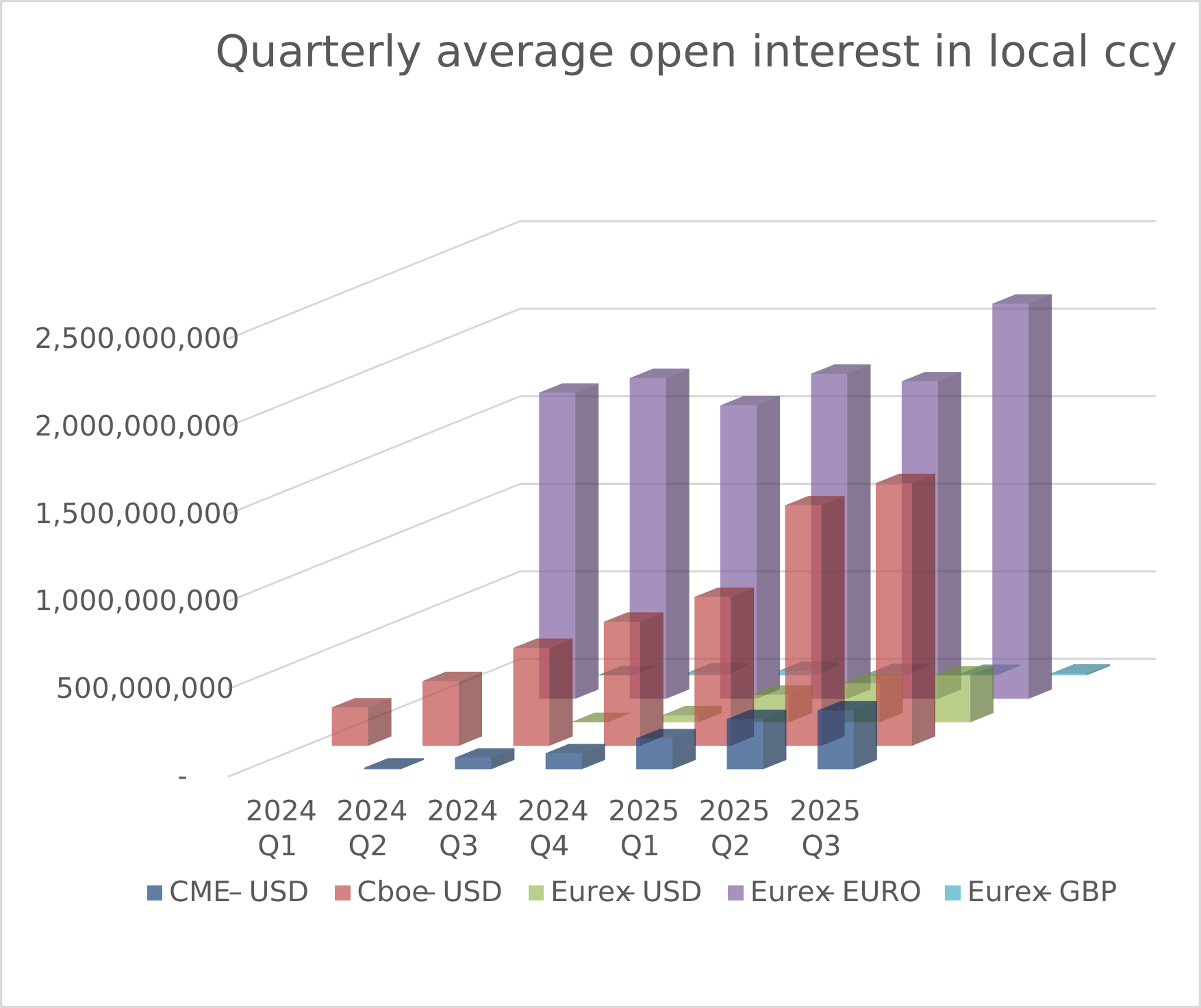
credit Futures Experience Important Growth in Open Interest and average Daily Volume
Credit futures trading has seen substantial growth, particularly in US dollar and Euro-denominated contracts, with open interest (OI) and average daily volume (ADV) increasing significantly year-over-year. This growth is driven by increased participation from both long-term investors and short-term traders, alongside a preference for established platforms during periods of market volatility.
US Dollar Credit Futures Lead the Way
Cboe’s iBoxx suite dominates US$ credit futures activity. In August 2025, the iBoxx US$ investment grade (IG) total-return future (IBIG) recorded an ADV of US$143 million and an OI of US$867 million. Its high yield (HY) counterpart, IBHY, saw an ADV of US$107 million and an OI of US$821 million. Combined, these cboe contracts accounted for approximately US$250 million in daily notional value and US$1.69 billion in OI for the month. Notably, Cboe’s US$ pair maintained volume and OI levels in April and May 2025, unlike Eurex and CME which experienced declines during that period. Market makers reportedly favored the stability of Cboe during volatile times.
According to sources, the direct link between Cboe’s credit futures and ETFs like HYG and LQD allows liquidity providers to view risk exposure consistently, nonetheless of the trading wrapper (ETF, total return swap, or futures). Increased block trades and rising OI indicate growing buy-side participation.
CME also offers US$ credit futures, providing broader exposure to the US$ complex. the Bloomberg US corporate Investment grade total-return contract (IQB) traded US$98 million ADV with US$193 million OI in August 2025. The bloomberg US corporate high yield total-return line (HYB) had US$23 million ADV and US$107 million OI. Duration-hedged contracts – DHB for IG and DHY for HY – saw ADV of US$15 million and US$12 million respectively, with OI of US$75 million and US$27 million respectively, also in August 2025.
European Market Gains momentum
European credit futures trading began to gain traction in June 2024, filling a gap where credit-specific ETFs are less common than in the US. By July 2025, total Euro OI reached approximately €2.26 billion, up from an initial €1.75 billion at launch.the Bloomberg Barclays MSCI Euro IG total-return future (FECX) held the largest share, with FEHY, the Bloomberg Euro HY line, completing the euro complex. While ADV spiked around the launch months, the consistent increase in OI suggests regular use for buy-and-hold hedges and benchmark overlays by European credit investors.Eurex, a key player in the European market, reports participation from both real money investors with long-term strategic allocations and tactical traders with shorter holding periods (around a week). Eurex also lists US$-linked Bloomberg contracts and a GBP line referencing the Bloomberg GBP liquid corporate index,though OI in the GBP line remains relatively small but consistent.
According to lee Bartholomew, co-global head of derivatives products & markets at Eurex, their products attract activity from cash bond traders and ETF market makers who frequently adjust positions based on hedging needs and strategies linked to adjacent markets, often with intraday or even second-by-second holding periods.
©Markets Media Europe 2025.
