
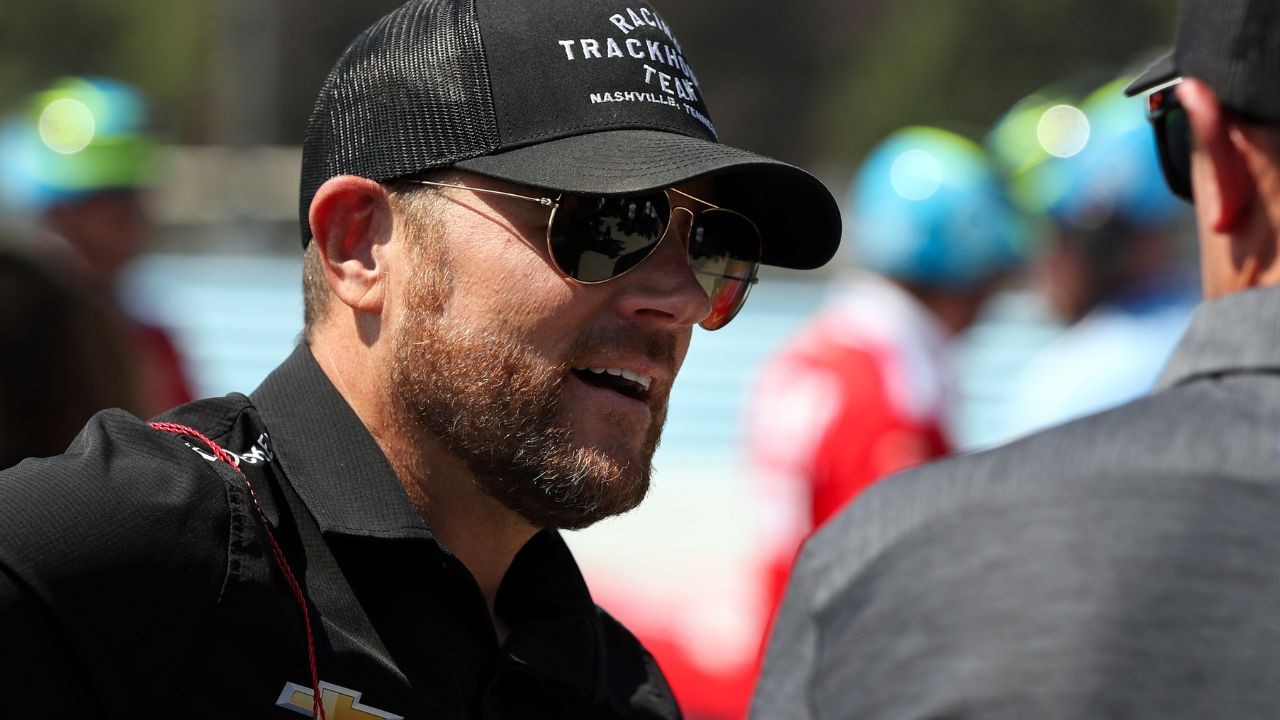
Trackhouse Racing Eyes Championship Return Amidst Evolving Competition
Founder Justin Marks Details Team’s Climb, Stumbles, and New Blueprint
Trackhouse Racing, a NASCAR Cup Series powerhouse, is charting a course back to championship contention after navigating a challenging period. Founder Justin Marks candidly discusses the team’s trajectory, from its rapid ascent to the impact of the Next Gen car’s evolution on their performance.
A Meteoric Rise and Subsequent Plateau
Launched by Justin Marks in 2021 as a single-car entry, Trackhouse Racing experienced swift momentum. By 2022, the team fielded two cars, with Ross Chastain in the No. 1 and Daniel Suárez in the No. 99. That year marked a significant arrival, with Chastain finishing runner-up in the championship and Suárez securing 10th place. However, the team’s progress stalled shortly thereafter. While Chastain continued to secure wins, his championship standing dipped to ninth in 2023, and he missed the playoffs entirely in the subsequent season, finishing 19th. Suárez also faced a winless 2023, ending 19th in points, before improving to 12th the following year.
New Talent Sparks Renewed Hope
Despite moments of speed, both drivers frequently encountered near misses, prompting the team to seek solutions. A pivotal shift occurred this season with the addition of Supercars champion Shane van Gisbergen. His remarkable four road course victories, coupled with Chastain‘s win at the Coca-Cola 600, have propelled Trackhouse back into the competitive forefront.
Navigating the Next Gen Car’s Learning Curve
Reflecting on the team’s journey, Marks acknowledged the natural cycles of peaks and valleys inherent in any racing organization, emphasizing the critical role of knowledge, technology, and process. He attributed the team’s 2022 surge to the early days of the Next Gen car.
“When the car first came out and the teams didn’t really know how to fully exploit the Next Gen car,”
—Justin Marks
“And we were going to the races in 2022 and 2023, it was really just kind of like an execution game of just getting the car on the racetrack and executing well, and we’re a great team at execution. That really fell into our wheelhouse, so we had a lot of success in ’22 and ’23.”
—Justin Marks
Marks observed a shift as more established teams, such as Hendrick Motorsports, Joe Gibbs Racing, and Penske, began to leverage their extensive resources and expertise to master the new platform.
“Then you have the normal players, your Hendrick Motorsports, Gibbs, and Penske, that over time really start to activate the depth in their organizations and the tools and technology they have to really understand what makes the car go fast, and so it’s a different ballgame now than it was in ’22.
—Justin Marks
“As that knowledge center around the cars has developed, that’s where we have found where it’s been more difficult for us because, as an organization, we’re not as big as Penske and Gibbs and all that.”
—Justin Marks
A Clear Vision for Championship Aspirations
Marks conceded that competition has intensified, with top organizations naturally excelling. However, he remains confident that the team’s current strategy provides a solid foundation for a return to championship contention. He has meticulously studied the plan’s methodology and underlying principles, deeming it a genuine championship framework. Achieving this goal will require substantial funding, personal sacrifice, patience, and persistent effort, but Marks now possesses a precise vision for strategic investment and focus areas to elevate Trackhouse Racing to the sport’s elite tier.
Trackhouse Racing’s Role as Chevrolet’s Third Major Force
As Chevrolet’s premier NASCAR Cup Series teams, Trackhouse Racing stands alongside Hendrick Motorsports and Richard Childress Racing, with Kaulig Racing, Legacy Motor Club, Spire, and Hook Motorsports also campaigning Chevrolets. Marks firmly believes Trackhouse has the potential to ascend to the pinnacle of this manufacturer group. He highlighted that his team receives equivalent support and equipment to Hendrick Motorsports through their crucial technical alliance, though he readily acknowledges Hendrick’s significantly greater organizational depth. Nevertheless, Marks maintains an optimistic outlook, citing the current race car as the primary reason for his entry into the sport.
“You’re only as good as what you can do with that support and what you can do with that access and that data,”
—Justin Marks
Marks pointed out that the competitive landscape would be far more challenging in an era where teams were still designing and building their own chassis. In the current spec-car era, success hinges on maximizing performance within defined parameters and mastering the execution strategy. While appreciating Chevrolet’s backing and the access to data it provides, Marks stressed that the ultimate differentiator lies in how effectively a team utilizes that information. This utilization is currently the central focus at Trackhouse. Confident in their path forward, Marks envisions Trackhouse developing a business model capable of consistently competing for championships.
In 2023, Chevrolet-powered teams accounted for 15 of the 16 playoff spots, demonstrating the manufacturer’s overall strength in the Cup Series. This statistic underscores the potential for a well-executed strategy within the Chevrolet ecosystem, a fact Marks is keenly aware of as he drives Trackhouse’s ambitious future.
