
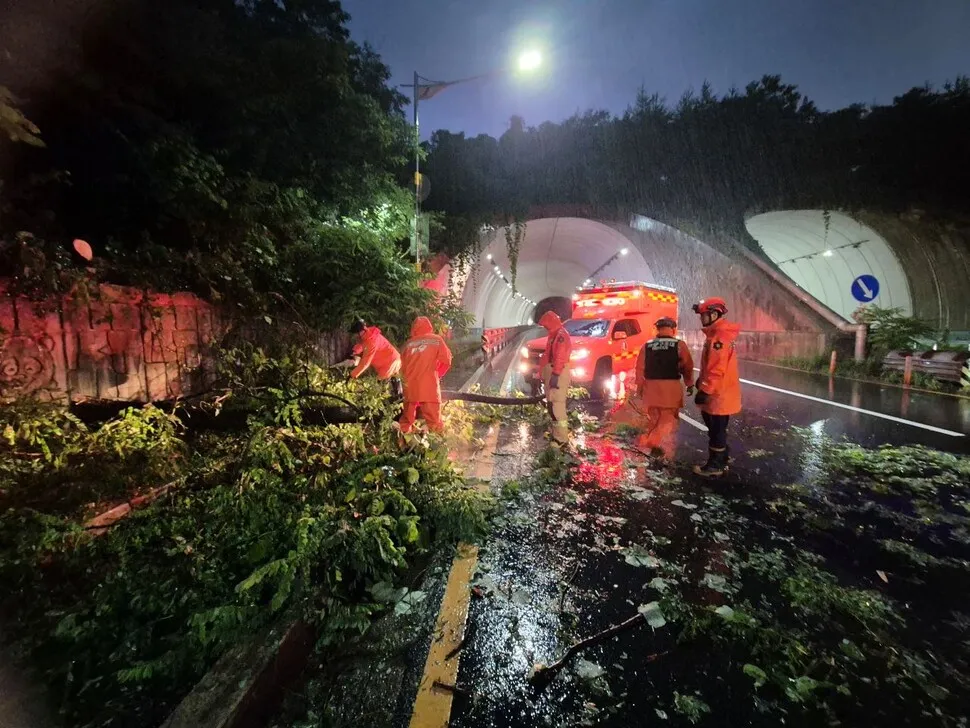
South Korea Gripped by Extreme Rainfall, Warnings Issued
Heavy downpours inundate central regions, threatening widespread flooding
Torrential rains are lashing South Korea, triggering “extreme heavy rain” advisories and warnings across the central and western coastal areas. Authorities are on high alert as hourly rainfall rates exceed critical thresholds, raising concerns of severe flooding and infrastructure damage.
Record Rainfall Rates Trigger Alerts
On the afternoon of the 16th, Seocheon, Chungnam, experienced a staggering 86.5 millimeters of rain in just one hour. This intense downpour led to the issuance of “extreme heavy rain characters,” officially defined by the Korea Meteorological Administration as exceeding 72 mm per hour, in multiple locations within Seocheon-gun and Boryeong-si.
Widespread Warnings Blanket Central Regions
As of 11 PM, heavy rain advisories were in effect for Gyeonggi-do, including Pyeongtaek and Hwaseong, and several areas in Chungnam and Jeonbuk. A heavy rain warning, signifying expected rainfall of over 90 mm or 180 mm within 12 hours, covered most of the central regions, encompassing Seoul, Gyeonggi, Gangwon, Chungbuk, Chungnam, and Jeonbuk.
Understanding the Rainfall Impact
The sheer volume of rain is emphasized by the comparison that 20 mm per hour is equivalent to pouring ten 2-liter bottles of water onto a single square meter. Hourly rates exceeding 50 mm can submerge roads, hindering traffic and pedestrian movement. When rainfall surpasses 70 mm per hour, vehicles near rivers and in low-lying areas face significant flood risks. At over 100 mm per hour, vehicles on roads become susceptible to submersion, and lower levels of buildings and facilities are likely to be inundated.
Forecast Predicts Continued Heavy Rainfall
The Korea Meteorological Administration forecasts continued heavy precipitation, anticipating over 200 mm of rain by July 17th in southern Gyeonggi and the west coast of Chungnam. Inland and southern areas of Gangwon, along with western Jeonbuk, are expected to receive upwards of 150 mm, while Seoul, Incheon, Gyeonggi, and Chungcheong (excluding southern Chungnam) could see 50 to 150 mm.
Atmospheric Conditions Fueling the Storms
This persistent rain is attributed to a narrow band of clouds formed by dry air colliding with abundant southern tropical moisture, a phenomenon intensified by a low-pressure system moving from the west. The Meteorological Administration notes that strong winds are accompanying the storms, with storm and strong wind warnings in effect for the west coast.
Southern Regions Brace for More Deluge
Starting July 17th, a southwest wind is predicted to draw significant moisture from the North Pacific High Pressure system. This influx of water vapor is expected to bring substantial rainfall to southern regions, with Jeonnam and Jeonbuk potentially experiencing up to 150 mm, and the Gyeongsang area facing up to 200 mm. In comparison, Seoul experienced a 24-hour rainfall of 70 mm on July 16th, contributing to localized flooding in subway stations and roads, highlighting the impact of such weather events on urban infrastructure.The Korea Times, 2024
