
Webb Telescope Unveils intricate Details of Dying Star in NGC 1514
A New Perspective on a Celestial Demise
Astronomers, leveraging the unparalleled observational capabilities of the James Webb space Telescope (JWST), have achieved unprecedented insight into the planetary nebula NGC 1514. This includes detailed observations of a dying star at its heart, a feat previously unattainable.
Planetary nebulae, despite their name, are not related to planets.Rather, they represent the final stages of life for stars with masses similar to our Sun. As these stars exhaust their nuclear fuel, they expel their outer layers into space, forming intricate and often stunning structures.
Infrared Vision Reveals Hidden Structures
A recent NASA press release highlighted that the JWST’s mid-infrared light data has allowed scientists to focus intently on the gas and dust ejected by the dying star residing within NGC 1514. The telescope’s ability to detect infrared light has been crucial in revealing the nebula’s ring-like structure,wich remains largely hidden from other telescopes.
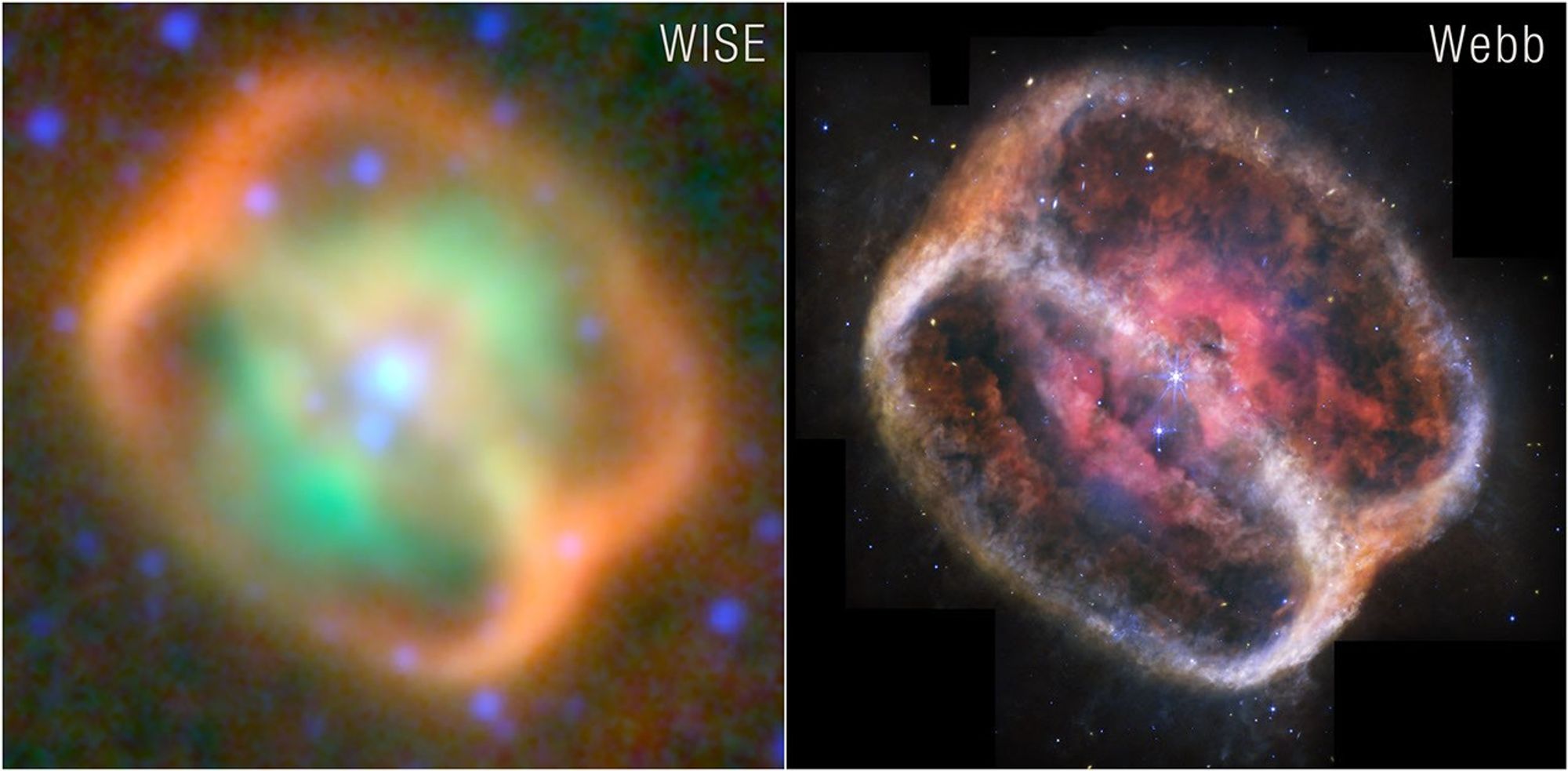
Mike Ressler, a researcher and project scientist at NASA’s Jet Propulsion Laboratory working with the Mid-Infrared Instrument (MIRI) on the JWST, emphasized the significance of this new data: We could not detect most of this substance until the Weber Space Telescope, let alone observe them so clearly.
Ressler initially identified the halo surrounding NGC 1514 while examining images captured by NASA’s wide-field Infrared survey Explorer (WISE) in 2010. Though, the JWST provides a far more detailed and complete view.
With MIRI data, we can now fully study the complex characteristics of this nebula.
Mike Ressler, NASA Jet Propulsion Laboratory
The Evolution of NGC 1514
The spectacle unfolding within NGC 1514 has been evolving for at least 4,000 years and is expected to continue changing for thousands more. At the heart of the nebula lie two stars. One of these stars, once several times the mass of the Sun, played a pivotal role in shaping the nebula’s current form.
David Jones, a senior scientist at the Canary Islands Institute of Astrophysics in Spain, explained the process: As the star evolves, it will continue to expand, throwing layers of gas and dust out of vrey slow and dense stellar winds.
Once the star expels its outer layers,it leaves behind a hot,dense core known as a white dwarf. The stellar winds from this white dwarf accelerate and weaken, possibly compressing the ejected material into a thin shell.
Unveiling the Nebula’s Shape and Composition
Observations from the JWST indicate that NGC 1514 is tilted at a 60-degree angle, giving it the appearance of a jar pouring. However, scientists believe the nebula is more likely an hourglass shape truncated at both ends.
The images released by NASA reveal orange-hued dust near the upper left and lower right corners of the nebula, drifting into a shallow V-shape.
The formation of these structures is linked to the interaction between the central stars. Jones elaborated: When the star’s material ejection reaches its peak, the companion star may be very, very close. This interaction may form a shape you wouldn’t expect. this interaction may form a ring-like structure, not a sphere.
The brightness of the two annular structures within NGC 1514 is uneven, with the lower left and upper right sides appearing blurred. Ressler suggests that these ring-like structures are primarily composed of very small dust particles. When these particles are exposed to UV light from white dwarfs, they warm up slightly, which we think makes them just enough to be detected by the Weber Space Telescope in mid-infrared light.
Chemical Composition and Stellar Interaction
In addition to dust, the JWST detected oxygen in the nebula’s center but found no traces of carbon or more complex compounds, such as polycyclic aromatic hydrocarbons (PAHs), which are similar to smoke.
The absence of complex molecules may be due to the mixing of ejected matter caused by the orbits of the two central stars. This mixing may prevent the formation of larger molecules. The simpler composition also allows the light emitted by the stars to travel farther, resulting in the blurry, cloud-like halo observed.
NGC 1514: A Cosmic Neighbor
NGC 1514 resides in the constellation Taurus, approximately 1,500 light-years from Earth. Astronomers have been studying this planetary nebula as the late 18th century. With the advent of the James Webb Space Telescope, the clarity and detail of these observations have been dramatically enhanced, providing new insights into the life cycle of stars.
