
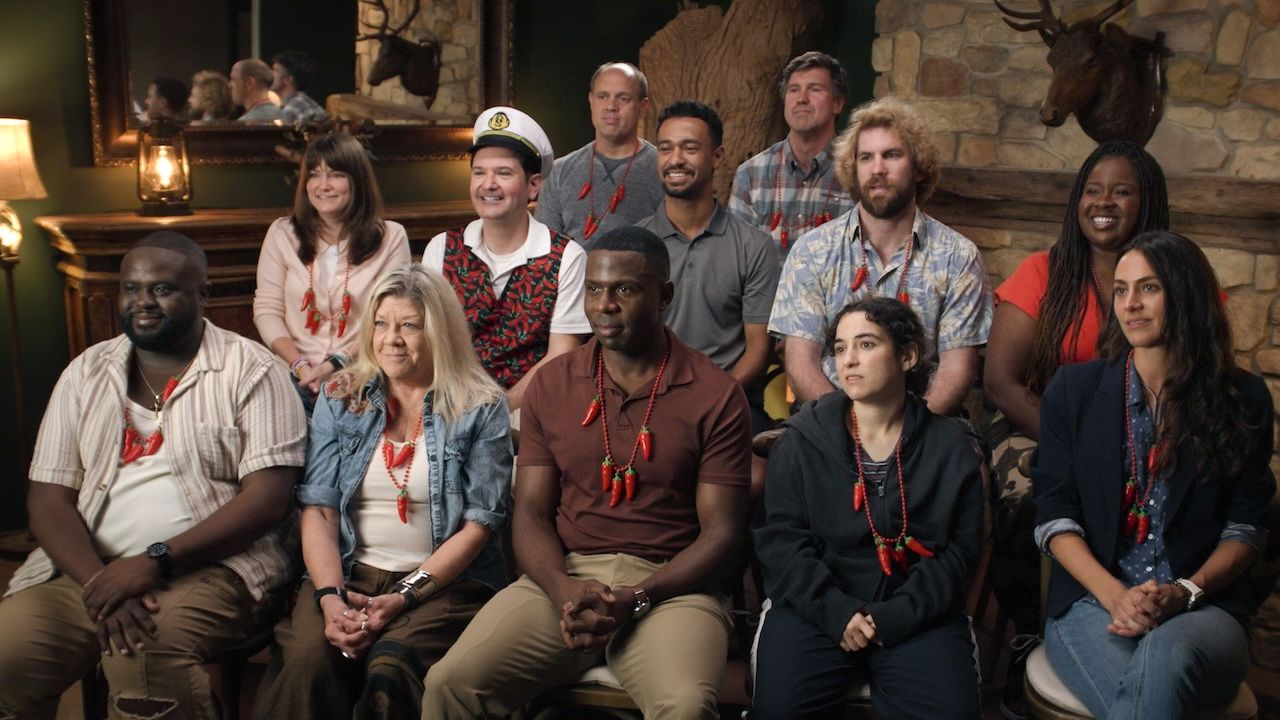
Jury Duty Presents: Company Retreat faced a critical reality breach when cast member Marc-Sully Saint-Fleur appeared in a national GEICO commercial during filming. Production teams scrambled to prevent the unknowing “hero,” Anthony Norman, from spotting the ad, which would have exposed the show’s fictional premise and collapsed the entire narrative architecture of the Amazon Prime Video hit.
The Fragility of the “Reality Contract”
In the high-stakes ecosystem of unscripted television, the most valuable asset isn’t the budget or the celebrity cameos; it is the suspension of disbelief. For the cast and crew of Jury Duty Presents: Company Retreat, the production of the first five episodes—now streaming—hinged on a single, precarious variable: the media blackout of the “unknowing” participant, Anthony Norman. Even as the showrunners, including James Marsden, meticulously scripted the chaos surrounding the “Rockin’ Grandma’s Hot Sauce” employees, they could not control the external broadcast schedule of national television.
The crisis emerged not from a leak within the production office, but from the sheer ubiquity of modern advertising. Marc-Sully Saint-Fleur, who plays receptionist PJ Green, found himself in a precarious position when a GEICO commercial he filmed began saturating sports broadcasts just as production ramped up. For a show reliant on the illusion of a mundane corporate retreat, a actor appearing on national television is a catastrophic continuity error.
According to industry standards for unscripted programming, the “Reality Integrity” of a show is its brand equity. If the “hero” of the show sees a co-worker on TV, the contract of reality is broken. There is no post-production fix for a participant who realizes they are the only one not in on the joke. This specific incident highlights a growing logistical nightmare for reality TV producers managing talent with existing commercial obligations.
Logistical Contingencies and Brand Risk
The timing was, as Saint-Fleur described, “wild.” With Anthony Norman identified as a massive baseball fan, the production team faced a scenario where the very content meant to entertain the public could dismantle the show’s core premise. The cast and crew were forced into a state of high-alert contingency planning, monitoring sports broadcasts to gauge the risk level.
“Very, very huge commercial that was running and grateful – Oh, god is good. But it was running like crazy, and it was running on all the sports shows… And we were nervous and we came up with contingency plans to be like, ‘How do we explain this? How do we make it make sense and I can also still be here in this world?'”
This scenario underscores the necessity for robust crisis communication firms and reputation managers within the entertainment directory. When a production faces a potential narrative collapse due to external media exposure, standard PR statements are insufficient. The strategy requires immediate, on-the-ground damage control to preserve the “magic circle” of the production environment.
The stakes for Jury Duty are particularly high in the 2026 streaming landscape. Following the critical acclaim of the original series, Amazon Prime Video is banking on this sequel to drive subscriber retention during the Q2 lull. Per internal streaming metrics shared at recent industry summits, unscripted comedies with high “binge-completion rates” are currently outperforming traditional sitcoms in the SVOD (Subscription Video on Demand) sector. A breach of trust with the audience—or the participant—could have severely impacted the show’s long-term syndication value.
The Legal and Talent Management Intersection
Beyond the immediate panic on set, this incident reveals a complex layer of contract law often overlooked by the general public. When an actor signs on for a “reality-adjacent” scripted show, their existing commercial contracts can create immediate conflicts of interest. This is where the role of specialized talent agencies becomes critical. Agents must negotiate “exclusivity windows” or “blackout periods” to prevent exactly this type of collision between a client’s day job and their breakout role.

To understand the legal gravity of such a breach, we spoke with Elena Ross, a Senior Partner at a leading Los Angeles entertainment law firm specializing in unscripted television.
“In the world of Jury Duty, the Non-Disclosure Agreement (NDA) is the most important script page. If a participant discovers the ruse due to external media, it doesn’t just ruin the episode; it opens the production up to potential litigation regarding ‘fraudulent inducement.’ The production must prove they took every reasonable step to maintain the illusion, which includes monitoring the public footprint of their supporting cast.”
The fact that the production team had “backups in store” suggests a level of preparedness that separates top-tier productions from amateur attempts. However, the reliance on luck—hoping Anthony Norman didn’t watch that specific baseball game—remains a vulnerability in the genre.
The Future of Unscripted Narratives
As the final three episodes of Jury Duty Presents: Company Retreat prepare to drop on April 3, the industry is watching closely. The success of the series proves that audiences are hungry for benevolent deception, provided the execution is flawless. However, as the media landscape becomes more fragmented and omnipresent, maintaining that secrecy requires an army of professionals.
From the Hollywood Reporter analysis of the trend, we are seeing a shift toward “fortress productions,” where digital silence is enforced as strictly as physical security. The next evolution of this genre will likely involve even tighter integration between legal teams and production managers to scrub the digital footprint of cast members during filming windows.
For the World Today News Directory, this story serves as a prime example of the invisible infrastructure supporting our favorite entertainment. It isn’t just about the jokes or the celebrities; it is about the event security and logistics providers and legal experts who ensure the show goes on without the curtain being pulled back too soon. As we move deeper into 2026, the line between reality and performance will only blur further, demanding sharper minds and tighter contracts to keep the magic alive.
Disclaimer: The views and cultural analyses presented in this article are for informational and entertainment purposes only. Information regarding legal disputes or financial data is based on available public records.