
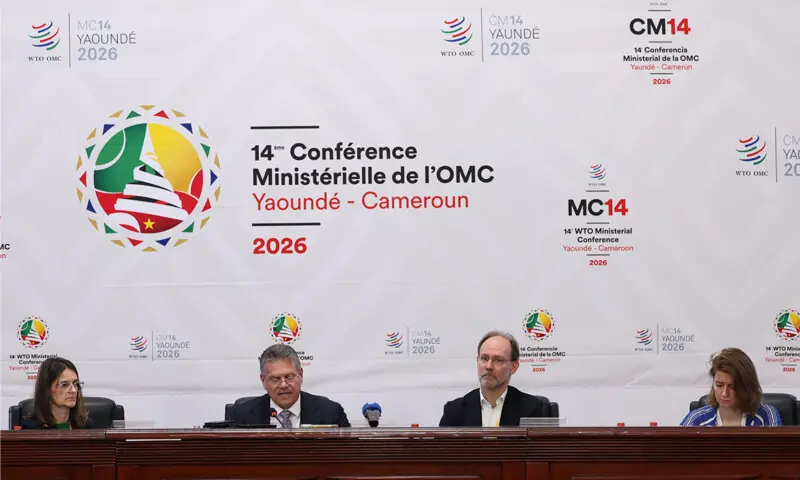
Trade ministers convened in Yaounde on March 29, 2026, to address critical WTO deadlocks in agriculture and fisheries. Geopolitical strain and protectionism hinder progress on food security and subsidy bans. Corporate stakeholders face heightened supply chain volatility without regulatory clarity. Immediate risk mitigation strategies are essential for global agribusiness margins.
Global commerce stands at a precipice. The World Trade Organisation ministerial meeting in Cameroon exposes deep fractures in the multilateral trading system, creating tangible liability for multinational corporations reliant on cross-border food supply chains. While diplomats debate sovereignty, CFOs calculate the cost of uncertainty. Tariff volatility directly侵蚀 s EBITDA margins for import-dependent entities. The failure to agree on a programme of work signals a prolonged period of regulatory ambiguity. Companies cannot hedge against policy stagnation using traditional derivatives.
Data from the WTO Agriculture Negotiations indicates a massive expansion in trade value alongside decreasing tariffs, yet the political will to sustain this framework is crumbling. The divergence between trade volume growth and negotiation progress creates a risk premium that capital markets are beginning to price in. Investors demand clarity on subsidy structures before committing long-term capital to agricultural infrastructure.
| Metric | 2000 Baseline | 2024 Status | Financial Implication |
|---|---|---|---|
| Ag Trade Value | $300 Billion | $1.49 Trillion | Increased exposure to jurisdictional risk |
| Avg. Agriculture Tariff | 13.0% | 5.7% | |
| Fisheries Subsidy Deal | N/A | Partial Agreement | Compliance costs rising for marine logistics |
India’s stance on public food stockpiles exemplifies the conflict between domestic stability and free trade principles. New Delhi demands permanent measures to hold food reserves, a position fiercely opposed by export-oriented economies fearing market distortion. This deadlock forces agribusinesses to operate in a fragmented regulatory environment. Procurement teams must now diversify sourcing to mitigate the risk of sudden export bans. Reliance on single-origin commodities becomes a balance sheet liability. Corporate treasurers are increasingly consulting with Trade Compliance Specialists to model scenarios where WTO protections vanish entirely.
Market volatility in edible oils and pulses reflects this geopolitical friction. When trade rules weaken, basis risk widens. Hedging strategies develop into less effective when policy shifts occur overnight. The cost of carrying inventory rises as companies buffer against potential supply shocks. Financial analysts note that protectionism acts as a hidden tax on operational efficiency. U.S. Treasury financial market data often reflects these strains through currency fluctuations in emerging markets. A stronger dollar combined with trade barriers squeezes dollar-denominated debt holders in developing economies.
“Trade fragmentation is no longer a theoretical risk; it is a line-item expense. Companies must budget for higher logistics costs and redundant supply chains as multilateral safeguards erode.” — Senior Economist, International Food Policy Research Institute
The fisheries negotiation stalemate presents a different set of compliance hazards. A historic agreement to ban harmful subsidies exists, but the second phase regarding overcapacity remains unfinished. If no deal is reached by 2029, the initial agreement expires. This cliff edge creates uncertainty for maritime logistics firms and seafood processors. Capital expenditure on fleet modernization stalls when regulatory endpoints are unclear. Insurance premiums for vessels operating in disputed waters climb. Procurement officers are scrambling to verify the subsidy status of their suppliers to avoid reputational damage and potential sanctions.
Operational resilience requires external expertise. Navigating the intersection of environmental regulation and trade law demands specialized knowledge. Corporations are engaging Corporate Law Firms to audit supply chains against evolving WTO standards. Legal due diligence now extends beyond contracts into geopolitical risk assessment. The cost of non-compliance exceeds the investment in advisory services. Firms that proactively adjust their sourcing strategies gain a competitive advantage in margin preservation. Waiting for consensus is a strategy for obsolescence.
Supply chain bottlenecks exacerbate the issue. World Bank trade logistics data shows that non-tariff barriers now outweigh traditional duties in cost impact. Delays at borders due to inspection disputes inflate working capital requirements. Cash conversion cycles lengthen. Finance directors must account for these inefficiencies in quarterly guidance. The lack of a unified digital trade framework further complicates documentation. Automation tools fail when regulatory inputs change constantly. Investing in Supply Chain Logistics providers with geopolitical intelligence capabilities becomes a priority.
Investopedia defines financial markets as mechanisms for efficient capital allocation, yet policy deadlock introduces friction that impedes this function. Capital flows away from regions with high trade uncertainty. Investment in agricultural technology slows when export markets are unreliable. The opportunity cost of stalled negotiations measures in billions of lost productivity. Shareholders expect management to navigate these headwinds without sacrificing growth. Passive exposure to trade policy is no longer acceptable.
The path forward requires private sector agility. Public sector negotiations may remain deadlocked for years. Businesses cannot pause operations waiting for Yaounde to yield results. Diversification of supplier bases reduces concentration risk. Localizing production where feasible hedges against cross-border disruption. Financial hedging instruments must be updated to reflect political risk rather than just currency fluctuation. The market rewards those who treat trade policy as a core operational variable.
Regulatory clarity may not arrive by the next ministerial meeting in two years. Companies must assume the current fragmented environment is the new baseline. Strategic planning cycles should incorporate worst-case trade scenarios. The cost of resilience is high, but the cost of failure is existential. Investors will scrutinize exposure to single-jurisdiction supply chains during earnings calls. Management teams need robust answers on contingency planning. The directory offers vetted partners to assist in building this defensive infrastructure.
Global trade architecture is bending under pressure. The WTO’s weakened state transfers risk from governments to corporations. Financial leaders must internalize this shift. Protecting margins requires active management of regulatory exposure. The firms that thrive will be those that treat trade compliance as a strategic asset rather than a back-office function. Navigate the uncertainty with partners who understand the stakes.