
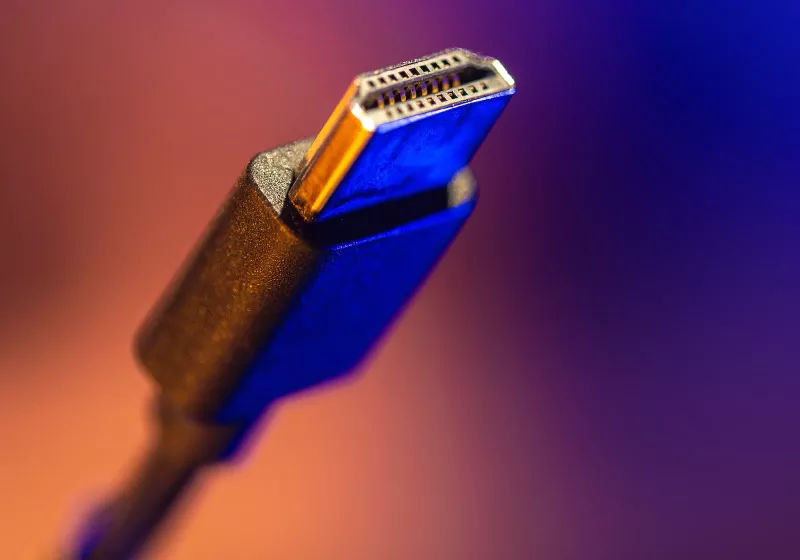
The Physical Layer Bottleneck: Why Copper HDMI Finally Died in Enterprise Deployments
Copper HDMI cables have hit a hard physical wall. Signal attenuation and electromagnetic interference (EMI) build maintaining 48Gbps bandwidth over standard twisted pair impossible beyond 25 feet. The industry shift toward Active Optical Cables (AOC) isn’t just about distance; it is a necessary architectural pivot for any enterprise scaling 8K digital signage or secure command centers. While marketing materials promise “limitless creativity,” the engineering reality focuses on signal integrity and latency overhead introduced by electrical-to-optical conversion.
The Tech TL;DR:
- Distance vs. Integrity: Fiber HDMI maintains full 48Gbps bandwidth up to 990 feet, eliminating the signal degradation inherent in copper runs over 50 feet.
- Security Implication: Optical strands do not emit electromagnetic signals, making them immune to van Eck phreaking and harder to tap than copper equivalents.
- Deployment Reality: Requires active power at endpoints; not a passive drop-in replacement for legacy infrastructure without endpoint validation.
Standard High-Speed HDMI relies on Transition Minimized Differential Signaling (TMDS) or Fixed Rate Link (FRL) over copper. As frequency increases to support 8K at 60Hz with HDR, the skin effect and dielectric loss in copper become prohibitive. The new generation of fiber-optic HDMI solutions converts electrical signals to light pulses immediately at the source connector. This bypasses the resistance limitations of copper conductors. Still, this introduces active components into the cable assembly itself, requiring power delivery usually drawn from the HDMI source port or an external USB injection.
For large-scale deployments, such as stadium displays or distributed corporate command centers, the risk profile changes. A copper run acting as an antenna can leak data or suffer from external interference. Fiber removes this vector. Organizations managing sensitive visual data should treat cabling infrastructure as part of their broader security posture. This often necessitates engaging cybersecurity audit services to validate that physical layer upgrades comply with internal data leakage prevention policies. The shift isn’t merely about resolution; it is about securing the transmission medium against interception.
Specification Breakdown: Copper vs. Active Optical
Understanding the trade-offs requires looking at the hard numbers. Passive copper is cheaper but fails at scale. Active Optical Cables introduce latency due to serialization and deserialization (SerDes) processes, though typically negligible for visual data. The table below outlines the architectural differences relevant to system designers.
| Feature | Passive Copper HDMI 2.1 | Active Optical HDMI (Fiber) |
|---|---|---|
| Max Bandwidth | 48 Gbps (up to 5m) | 48 Gbps (up to 300m) |
| Signal Type | Electrical (TMDS/FRL) | Optical (Multi-mode Fiber) |
| EMI Susceptibility | High (Requires heavy shielding) | None (Immune to EMI/RFI) |
| Latency Overhead | Negligible | ~1-2ms (Conversion overhead) |
| Power Requirement | None (Passive) | Required (Active electronics) |
Deployment teams must account for the power requirement. If the source device cannot supply sufficient voltage over the HDMI pinout, the optical converter at the display end may fail to initialize. This is a common failure mode in legacy projector setups. IT teams should verify power delivery specifications before bulk purchasing. For complex integrations, partnering with enterprise IT infrastructure providers ensures that power budgets and signal paths are validated during the design phase rather than during troubleshooting.
From a security architecture perspective, fiber offers a distinct advantage. Copper cables radiate electromagnetic energy that can theoretically be intercepted. Optical fibers do not radiate. For government or high-security corporate environments, this reduces the attack surface for physical layer eavesdropping. However, the active electronics embedded in the cable connectors introduce a new supply chain risk. Compromised firmware in the cable converter could theoretically manipulate EDID data. Security leaders, similar to the roles described in Director of Security postings, are increasingly scrutinizing hardware supply chains for embedded firmware vulnerabilities.
Implementation and EDID Validation
When integrating fiber HDMI into a Linux-based AV control system, verifying the Extended Display Identification Data (EDID) is critical. The active conversion process can sometimes corrupt or truncate EDID blocks, causing handshake failures. Engineers should use command-line tools to inspect the handshake before finalizing installation.
# Install edid-decode utility on Ubuntu/Debian based AV controllers sudo apt-get install edid-decode # Extract EDID from the connected display interface sudo cat /sys/class/drm/card0/card0-DP-1/edid | edid-decode # Verify checksum and timing support for 8K FRL modes edid-decode --check-features /sys/class/drm/card0/card0-DP-1/edidThis workflow ensures the display correctly advertises its capabilities to the source. If the fiber converter fails to pass the full EDID block, the source may default to 1080p, negating the bandwidth advantage of the cable. Persistent handshake issues often indicate insufficient power delivery or incompatible FRL training sequences.
Organizations scaling these deployments should consider the long-term maintenance lifecycle. Unlike passive copper, active optical cables can fail due to electronics degradation rather than physical wear. Including these assets in regular cybersecurity risk assessment and management services ensures that hardware failures are tracked alongside software vulnerabilities. The convergence of physical infrastructure and digital security requires a holistic view of the technology stack.
The Trajectory of Physical Connectivity
As wireless standards like WiGig attempt to catch up, fiber remains the only proven method for reliable, uncompressed 8K transmission over distance. The industry is moving toward hybrid solutions where fiber backbones connect to local wireless nodes. For now, the cable remains king for critical paths. The focus must shift from mere connectivity to verified integrity. As we move deeper into 2026, the definition of “network security” expands to include the optical strands running through our walls. Ignoring the physical layer is a vulnerability no amount of software patching can fix.
Disclaimer: The technical analyses and security protocols detailed in this article are for informational purposes only. Always consult with certified IT and cybersecurity professionals before altering enterprise networks or handling sensitive data.