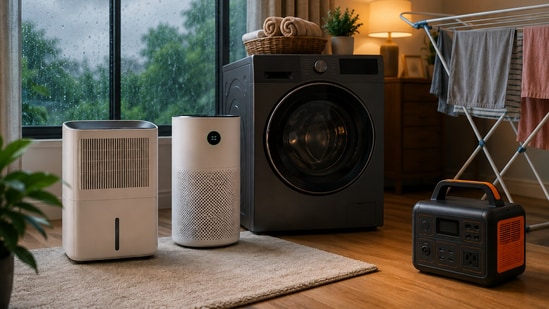
5 Essential Gadgets to Keep Your Home Dry and Comfortable During Monsoon
Monsoon Hardware Mitigation: Engineering Dry Environments
As the monsoon season reaches its peak, residential humidity levels frequently exceed the 60% threshold, triggering secondary hardware failures and microbial growth in high-density living spaces. While consumer-grade dehumidification is often treated as a lifestyle convenience, it is fundamentally an exercise in environmental control and thermal management. Maintaining optimal humidity is critical not only for comfort but for the operational longevity of internal electronics and the structural integrity of residential IoT ecosystems.
The Tech TL;DR:
- Active Humidity Control: Peltier-based and compressor-driven units now integrate with local MQTT brokers for precise RH (Relative Humidity) monitoring.
- System Reliability: Lowering ambient humidity prevents moisture-induced corrosion on PCB traces and reduces the risk of short circuits in high-voltage home appliances.
- Infrastructure Triage: Integration of smart hygrometers with automated relays allows for sub-millisecond response times to moisture surges, bypassing manual intervention.
Framework A: Hardware Architecture and Thermal Efficiency
To mitigate high humidity, the market has bifurcated into two primary architectural approaches: thermoelectric (Peltier) cooling and compressor-based refrigeration. According to data from the American Society of Heating, Refrigerating and Air-Conditioning Engineers (ASHRAE), compressor-based units remain the gold standard for high-volume water extraction due to their superior COP (Coefficient of Performance) compared to solid-state Peltier modules. While Peltier units are silent and compact, they are inefficient for environments where the dew point must be shifted rapidly.
| Feature | Peltier (Thermoelectric) | Compressor-Driven |
|---|---|---|
| Efficiency | Low (High power/water ratio) | High (Rapid extraction) |
| Noise Floor | <30 dB | 45-60 dB |
| Ideal Use Case | Small closets/Server cabinets | Living areas/Full-home HVAC |
For users attempting to automate their humidity logs via Raspberry Pi or similar edge devices, the implementation of a DHT22 or BME280 sensor is standard practice. The following Python snippet demonstrates how to poll an environmental sensor and trigger a relay if the humidity exceeds 55%:
import Adafruit_DHT

import RPi.GPIO as GPIO
sensor = Adafruit_DHT.DHT22
pin = 4
GPIO.setmode(GPIO.BCM)
GPIO.setup(17, GPIO.OUT)
humidity, temperature = Adafruit_DHT.read_retry(sensor, pin)
if humidity > 55:
GPIO.output(17, GPIO.HIGH) # Activate Dehumidifier
else:
GPIO.output(17, GPIO.LOW)
The IT Triage: Protecting the Home Network
Humidity is not merely a comfort issue; it is a vector for hardware degradation. High moisture content significantly increases the risk of dendrite growth on exposed copper leads, a phenomenon documented extensively in IEEE reliability standards. When residential environments become saturated, the resulting latency spikes in Wi-Fi signal propagation—caused by the increased dielectric constant of humid air—can destabilize sensitive smart home gateways.
If you are experiencing recurring network instability or hardware failure during the monsoon, it is advisable to consult with a Professional Home Automation Systems Integrator to audit your environment. For critical infrastructure, consider deploying Specialized Environmental Control Consulting to ensure your server closets maintain a stable 40-50% RH range, preventing the catastrophic failure of high-density compute nodes.
Integration and Scalability
Modern dehumidification units increasingly rely on Tuya or Matter-compliant APIs, allowing for deep integration into Home Assistant or OpenHAB environments. As noted by lead maintainers in the Home Assistant GitHub repository, the ability to correlate humidity data with local weather APIs enables predictive run-cycles, reducing total power consumption by up to 20% compared to static “always-on” configurations. This is a shift from reactive hardware usage to proactive environmental orchestration.
“The objective is to treat the home as a data center,” says Marcus Thorne, a lead systems engineer at a boutique smart-home firm. “If you aren’t monitoring your dew point, you’re essentially running your hardware in a high-risk, unmanaged zone. Automation isn’t a luxury; it’s a mitigation strategy.”
As we look toward the next iteration of climate-controlled residential tech, the focus is shifting toward energy-recovery ventilation (ERV) systems that integrate directly into the home’s existing ductwork, managed by AI-driven PID controllers. Relying on standalone gadgets is a tactical move, but for long-term stability, structural environmental management remains the endgame.
*Disclaimer: The technical analyses and security protocols detailed in this article are for informational purposes only. Always consult with certified IT and cybersecurity professionals before altering enterprise networks or handling sensitive data.*