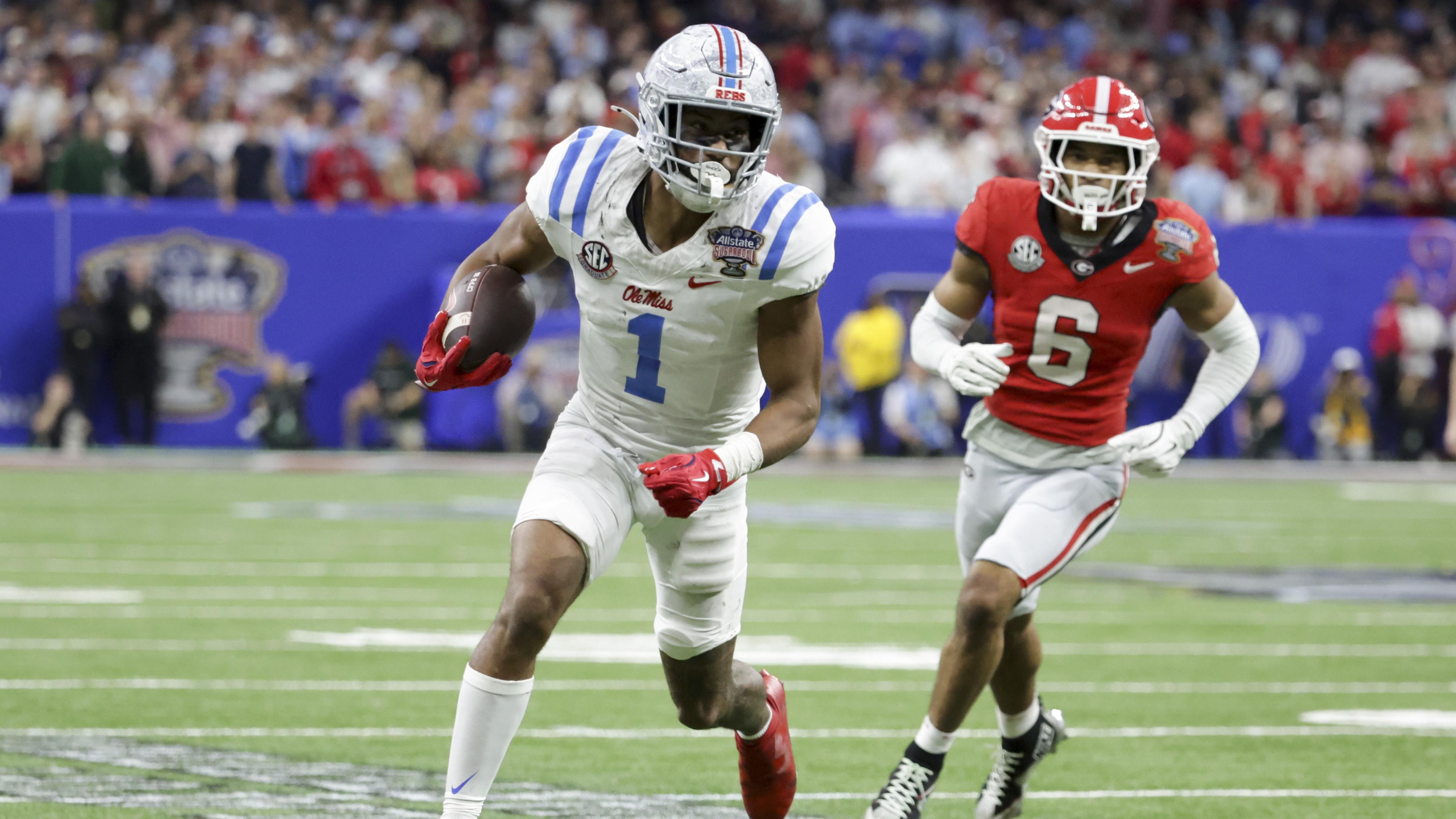
49ers draft De’Zhaun Stribling at No. 33 despite low mock rankings
The Mock Draft Fallacy
The second round of the NFL Draft is where consensus goes to die. Public big boards had De’Zhaun Stribling slotted anywhere from 60th to 151st overall. The Athletic’s Dane Brugler ranked him 67th. Yet when the 49ers stepped to the podium at No. 33, the selection surprised many fans and analysts, who quickly labeled it a potential misstep.
But mock drafts are not team drafts. They’re aggregations of public scouting reports, media rankings, and speculative evaluations—none of which fully capture a franchise’s scheme, culture, or internal board. The Jaguars took a tight end in the second round who was ranked 151st on the consensus big board. The Texans traded up for a guard ranked 49th. The Super Bowl champions drafted a safety earlier than projected. These examples illustrate how teams often prioritize their own evaluations over public rankings.
John Lynch, the 49ers’ general manager, addressed the skepticism by emphasizing the team’s internal process. He noted that while external opinions vary, the organization’s consensus was clear. His comments underscored a broader truth: NFL front offices don’t draft for public approval. They draft for fit, and Stribling’s selection reflected that approach.
The ‘F’ Position and the Shanahan Blueprint
Stribling’s tape reveals attributes that mock drafts may have overlooked. At 6-foot-2 and 207 pounds, he combines size with 4.36-second speed, a blend that aligns with the league’s growing emphasis on contested catches and physicality. His performance in Georgia’s playoff game against Georgia Tech demonstrated skills that align with Kyle Shanahan’s offensive priorities: downfield receiving, precise route-running, and, notably, blocking.
The 49ers’ offense has long relied on the “F” position—a versatile receiver who can line up in the slot, block effectively, and win in one-on-one situations. Jauan Jennings previously filled this role, but as the team’s core ages, Shanahan has emphasized the need for younger contributors. Head coach Kyle Shanahan has previously noted that some of last season’s run-game challenges stemmed from inconsistent blocking by wide receivers. Stribling’s tape shows a willingness to engage defenders, sustain blocks, and create additional yardage through physical play.
These traits don’t always stand out in mock drafts, but they address specific needs within the 49ers’ system. Team officials reportedly viewed Stribling as a player who could contribute immediately, particularly in areas where the offense had struggled. His selection highlights how franchises often prioritize scheme-specific roles over broader consensus rankings.
The Risks of Drafting for Fit Over Consensus
There’s a reason most teams don’t draft this way. When a pick defies public expectations, the burden of proof shifts to the team. The 49ers have faced this before. In 2021, they traded up for Trey Lance, a quarterback who was widely debated as a reach at No. 3. The pick, now often cited as a cautionary example, illustrates the risks of prioritizing potential over proven production.
Stribling’s case differs in key ways. He isn’t viewed as a developmental project but as a player ready to contribute in areas critical to the 49ers’ offense. However, skepticism remains justified. The team’s recent draft history under Lynch and Shanahan has shown mixed results. Kaelon Black, a running back taken in the third round, was described by some analysts as a potential practice-squad candidate. While the 49ers’ front office may have confidence in Stribling, external evaluations remain uncertain.
What’s evident is that the 49ers are relying on their own process. Lynch’s pre-draft remarks—that the team didn’t have many pressing needs—suggested a willingness to take calculated risks. Stribling represented one such risk. The outcome won’t be clear for years, but the pick already underscores a broader reality: the gap between public perception and team strategy is often wider than it appears.
What This Pick Says About the Draft
The Stribling selection reflects a larger truth: the NFL Draft is not a meritocracy. It’s a marketplace of competing evaluations, where scheme fit, character assessments, and internal projections frequently outweigh public consensus. The 49ers didn’t draft Stribling because they ignored mock drafts. They drafted him because they identified attributes that aligned with their system—traits that external rankings couldn’t fully capture.
This approach doesn’t guarantee success. But it explains why the draft remains so unpredictable. Teams aren’t drafting for the internet’s approval. They’re drafting for their own playbooks, their own locker rooms, and their own long-term plans. In that context, Stribling may have been the ideal choice—even if the public didn’t anticipate it.
The next phase will test that vision. Stribling’s rookie season will provide opportunities to demonstrate his skills within Shanahan’s offense, particularly his blocking and ability to win contested catches. If he succeeds, the 49ers’ decision will be validated. If he struggles, critics will have ample material. Either way, the pick has already highlighted the limitations of mock drafts—and the enduring influence of team-specific priorities.