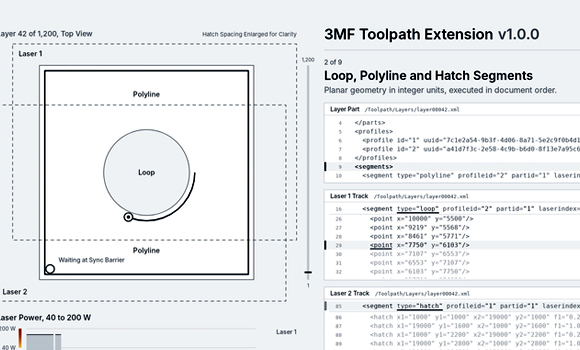
3MF Consortium Releases Open Toolpath Extension for Additive Manufacturing
Headquartered in San Francisco, California, the 3MF Consortium released the 3MF Toolpath Extension v1.0.0 to provide an open, machine-independent format for toolpath data in additive manufacturing, Metal Additive Manufacturing reported.
-
The Tech TL;DR:
- The 3MF Consortium released version 1.0.0 of its Toolpath Extension for additive manufacturing.
- The new format is developed primarily for Laser Beam Powder Bed Fusion and directed energy deposition.
- Developers aim to add the format to the existing ISO/IEC 25422 specification suite.
Industrial build files for powder bed fusion typically rely on proprietary formats tied to individual machine manufacturers. According to the consortium, this software restriction complicates traceability and limits the use of common simulation tools.
The new extension defines laser power, marking and jump speeds, focus offset, and spot radius through toolpath profiles. It also enables parameter modulation along individual scan vectors, microsecond-precision wait times, and multi-laser build synchronization.
“I see the 3MF Toolpath Extension doing for LPBF what G-code did for CNC,” said Hunter Taylor, CTO of Tailored Alloys.
“A non-proprietary toolpath format for LPBF will enable inspection to begin before the build, because digital inspection tools will no longer need to be built for machine-specific formats,” Taylor told Metal Additive Manufacturing. He added that removing format barriers between slicer and machine will unlock software innovation.
Alexander Oster, technical director of the 3MF Consortium, described the release as a response to the rapid growth of industrial LPBF. He said that the industry needs a standardized way to represent laser build data without relying on vendor-locked ecosystems.
“It provides a standardised way to describe exactly what the laser does, from power, speed, focus, and beam shape to microsecond timing and multi-laser synchronisation, while keeping the toolpath linked to the original part geometry,” Oster told Metal Additive Manufacturing.
| Extension Feature | Technical Capability |
|---|---|
| Process Parameters | Laser power, marking/jump speeds, focus offset, spot radius |
| Timing Control | Microsecond-precision wait times before and after individual segments |
| Data Handling | Per-layer packaging for random access and streaming of large builds |
The consortium previously standardized its core 3D Manufacturing Format under ISO/IEC 25422:2025, according to Metal Additive Manufacturing. Organizers intend to add the new Toolpath Extension to that same specification suite, as detailed on the 3MF Consortium website.
The 3MF Consortium was formed in 2015 by a core group including Microsoft, HP, Dassault Systèmes, and Netfabb to create a universal additive manufacturing format. Autodesk, Shapeways, and SLM Industries joined as founding members just before the public announcement, followed shortly by Materialise, GE, and Siemens.
The consortium operates as a Joint Development Foundation project under the Linux Foundation and reported 16 steering members and over 20 associate members as of June 2026. Its base specification became an ISO standard in 2025.
Always consult with certified IT and cybersecurity professionals before altering enterprise networks or handling sensitive data.