
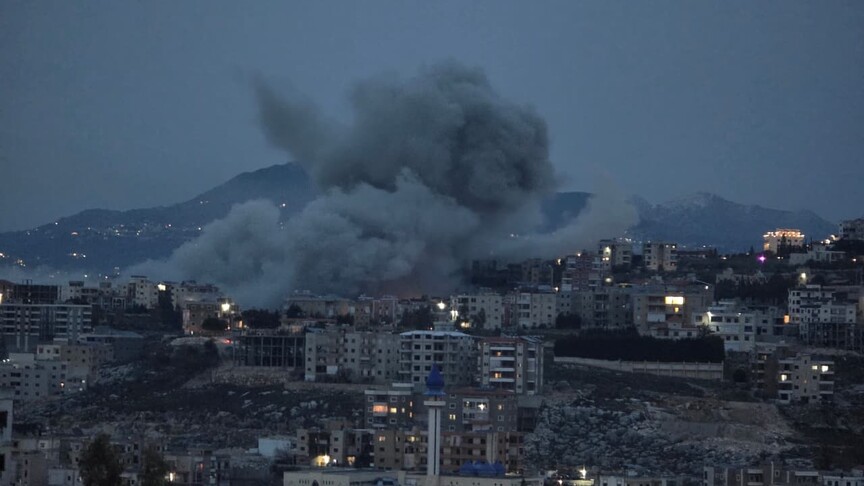
3 Israeli Airstrikes on Deir Amss Village in Southern Lebanon
On April 24, 2026, Israeli forces conducted three airstrikes on the village of Deir Aamss in southern Lebanon, escalating cross-border tensions amid ongoing regional instability and raising urgent humanitarian and legal concerns for civilians caught in the conflict zone.
The strikes, reported by Anadolu Ajansı and corroborated by multiple regional monitors, targeted what Israeli defense officials described as Hezbollah infrastructure near the Litani River basin—a zone long marked by intermittent violence despite the 2006 UN-brokered ceasefire. Even as no immediate casualty figures were released by Lebanese authorities, local residents reported damage to residential structures and agricultural land, disrupting livelihoods in a community already strained by economic collapse and limited state presence.
This latest round of violence is not isolated. Since late 2023, southern Lebanon has witnessed a cyclical pattern of cross-border exchanges, with Israeli strikes often responding to rocket fire or alleged militant activity, and Hezbollah retaliating in kind. What distinguishes the April 24 incident is its proximity to Deir Aamss—a village of approximately 8,000 inhabitants located just 15 kilometers north of the Israeli border, within the Nabatieh Governorate. The area’s rugged terrain and limited access have historically complicated emergency response and humanitarian aid delivery, making timely intervention critical.
“These strikes aren’t just military actions—they fracture daily life. When your olive groves are bombed and your water lines rupture, you’re not thinking about geopolitics. you’re thinking about how to feed your children and rebuild what’s left.”
The humanitarian toll extends beyond immediate physical damage. Displacement risks are rising, particularly among elderly residents and families with limited mobility. In recent months, the Lebanese Ministry of Displaced Persons has reported a 22% increase in internal displacement from southern border villages compared to the same period in 2025, citing both conflict-related insecurity and deteriorating economic conditions as primary drivers.
Infrastructure degradation compounds the crisis. The Litani River, a vital water source for agriculture and domestic use in the region, has faced pollution and diversion concerns for years. Airstrikes near its tributaries risk damaging aging irrigation channels and groundwater wells—systems already under strain from neglect and illegal diversion. According to the Lebanese Agricultural Research Institute, over 40% of southern Lebanon’s farmland relies on gravity-fed irrigation from the Litani watershed, making any disruption a direct threat to food security.
“We’re seeing a dangerous convergence: military violence weakening civilian resilience, while state institutions lack the capacity to respond. Without functional local governance and reliable basic services, recovery becomes nearly impossible.”
Legally, the strikes raise questions under international humanitarian law. The principle of distinction—requiring parties to conflict to differentiate between combatants and civilians—is enshrined in Additional Protocol I to the Geneva Conventions, to which both Israel and Lebanon are bound. Any attack causing disproportionate civilian harm relative to anticipated military advantage may constitute a violation. The UN Interim Force in Lebanon (UNIFIL) has increased patrols along the Blue Line in response, though its mandate remains limited to monitoring and de-escalation, not enforcement.
For residents and local leaders navigating this volatile environment, access to verified, on-the-ground expertise is essential. Municipal officials seeking to assess structural damage and coordinate repairs should consult licensed building inspectors and civil engineers familiar with conflict-affected zones. Families facing displacement or property loss may benefit from counsel with international humanitarian law attorneys who can document losses and pursue accountability through regional or international mechanisms. Meanwhile, agricultural cooperatives aiming to restore irrigation networks and protect livelihoods can turn to watershed management specialists trained in rehabilitating conflict-damaged water systems.
The pattern is clear: each round of violence erodes not just physical infrastructure, but the social and economic foundations that allow communities to endure. In southern Lebanon, where state services are fragmented and external aid often delayed, resilience depends on local knowledge, professional readiness, and the quiet persistence of those who refuse to let their villages vanish from the map.
As the sun sets over the Jabal Amel hills and the call to prayer echoes over damaged rooftops, the true measure of this conflict isn’t found in military briefings or satellite imagery—it’s in the quiet determination of a mayor checking on his neighbors, a farmer salvaging what he can from his land, and a doctor treating wounds with dwindling supplies. Their endurance is the real frontline. And for those seeking to support them—not with rhetoric, but with reliable, vetted expertise—the path forward begins in the directory.