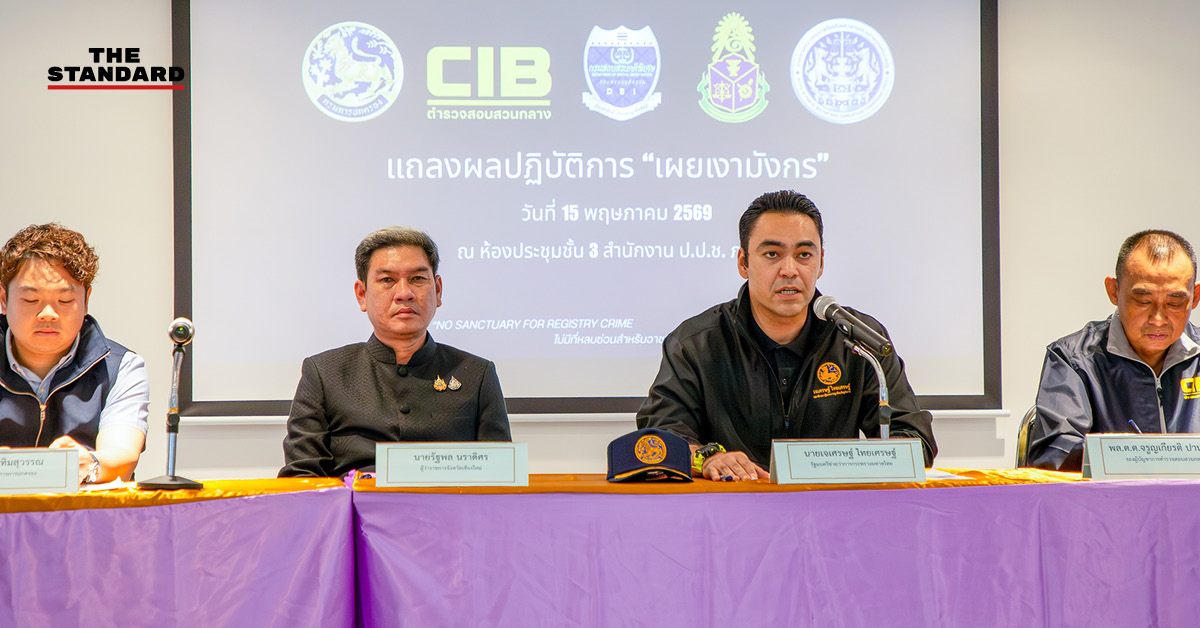
รวบอดีต ปลัดอำเภอเชียงดาว เอี่ยวทำทะเบียนเท็จช่วยผู้ต้องหาจีนคดีอาวุธสงคราม – thestandard.co
Thai authorities arrested a former Chiang Dao district officer and a registration employee on May 15, 2026, for forging residency documents for Ming Chen Sun. The Chinese national, linked to a weapons cache in Chonburi, used these fraudulent papers to obtain VIP business status and residency in Thailand.
This is not a simple case of administrative negligence. It is a calculated infiltration of the state’s identity management system.
When a high-ranking local official sells the legitimacy of the state to a foreign national, the problem extends far beyond a single forged document. It creates a “ghost” identity that allows individuals linked to organized crime to move capital, establish businesses, and store weaponry with a shield of official legality. For the residents of Chiang Mai and the broader Thai public, this breach represents a systemic vulnerability where the very tools designed to protect ethnic minorities are being weaponized by international syndicates.
The “Dragon’s Shadow” Operation: Deconstructing the Arrest
The crackdown, dubbed Operation “Dragon’s Shadow,” was the result of a coordinated effort involving five major agencies: the Ministry of Interior, the National Anti-Corruption Commission (NACC), the Anti-Corruption Division (P.P.P.), the Public Sector Anti-Corruption Commission (PACC), and the Central Investigation Bureau (CIB).
The investigation was triggered by a separate, high-stakes raid on May 9, 2026, in Chonburi. During that operation, police apprehended Ming Chen Sun, a Chinese national found in possession of military-grade weapons and C-4 explosives. While the weapons were the immediate threat, the “pink card”—a residency permit typically reserved for recognized ethnic minority groups—found in Sun’s possession provided the lead that exposed the corruption in Chiang Dao.
Investigators discovered a staggering discrepancy: Ming Chen Sun had never set foot in the Chiang Dao district of Chiang Mai. Yet, in October 2022, his name was officially added to a house registration in the area. This fraudulent move allowed him to claim ethnic minority status, granting him a level of residency and business freedom that would have been impossible under standard immigration laws.
The architects of this deception were the former district officer and a registration employee. These officials didn’t just overlook a mistake; they actively prepared and approved the false documentation required to “insert” a foreign national into the local census.
The Mechanics of Administrative Forgery
To understand how this happened, one must understand the vulnerability of the residency registration process in border regions. The “pink card” system is designed to provide legal status to displaced persons and ethnic groups who have lived in Thailand for generations but lack formal citizenship. Because these processes often rely on local verification and witness testimony, they are susceptible to “insider” manipulation.
In this instance, the corrupt officials bypassed standard verification protocols. By fabricating the entry of Ming Chen Sun into the house registration, they effectively laundered his identity. He was no longer a foreign national subject to strict visa renewals and work permits; he was a recognized resident with “VIP” access to the Thai economy.
This creates a nightmare for national security. When identity documents are compromised at the source, standard border checks and police screenings become useless. The individual exists on paper as a local, while operating as an agent of a foreign entity.
For businesses and investors operating in these regions, this instability is a significant risk. Ensuring that partners and land titles are legitimate now requires more than just a glance at a government ID. Many are now turning to specialized immigration attorneys and forensic auditors to verify the provenance of residency claims before entering into high-value contracts.
The “Grey Capital” Connection and Macro-Economic Risk
This case is a textbook example of “Grey Capital”—the influx of foreign funds, often from illicit sources, used to buy influence and infrastructure in Southeast Asia. The goal is rarely just a residency permit; the permit is a tool used to facilitate larger operations, such as money laundering, illegal gambling, or, as seen in the Chonburi raid, the stockpiling of weaponry.
The Prime Minister has already ordered an expansion of the investigation. The focus has shifted from the individual officials in Chiang Dao to the broader network that facilitated Ming Chen Sun’s entry. Central to this effort is the Anti-Money Laundering Office (AMLO), which is currently tracing the financial trail to determine who paid the bribes and where the “VIP” business funds originated.

The socio-economic impact on the Chiang Mai region is twofold:
- Erosion of Trust: The exploitation of ethnic minority status undermines the legitimate struggle of actual displaced persons seeking legal recognition.
- Market Distortion: When “Grey Capital” enters a local economy, it often drives up real estate prices and pushes out legitimate local businesses through predatory pricing and political protection.
As the government tightens its grip on these networks, the demand for transparency is peaking. Organizations are increasingly relying on government transparency monitors to hold local administrations accountable and ensure that residency permits are not being sold to the highest bidder.
The Legal Fallout and Future Implications
The former district officer and his accomplice now face a barrage of charges related to the falsification of official documents and malfeasance in office. Given the link to military-grade explosives, the prosecution is likely to seek maximum penalties to serve as a deterrent to other officials in border districts.
However, the legal cleanup will be extensive. Every “pink card” issued in the Chiang Dao district during the tenure of the accused officials will likely come under scrutiny. This could potentially displace legitimate residents who were caught in the same administrative window, creating a secondary humanitarian crisis.
The Thai government’s use of AMLO to track the money trail suggests that this is only the tip of the iceberg. If the funds used to bribe the officials can be linked to international syndicates, this local corruption case could evolve into a major diplomatic and criminal investigation involving multiple jurisdictions.
Navigating the aftermath of such systemic fraud is a logistical minefield for those caught in the crossfire. Whether it is a business owner discovering their partner’s residency was forged or a landowner dealing with fraudulent titles, the solution lies in professional verification. Securing vetted compliance consultants is no longer an optional luxury—it is a necessity for survival in an era of “Grey Capital.”
The “Dragon’s Shadow” operation reveals a sobering truth: the most dangerous weapons are not always the C-4 explosives found in a warehouse, but the pens of corrupt officials who can rewrite a person’s identity with a single stroke. As Thailand scrubs its registries of these “ghosts,” the challenge will be to rebuild a system where legitimacy cannot be bought, and where the law applies equally to the local official and the foreign VIP.