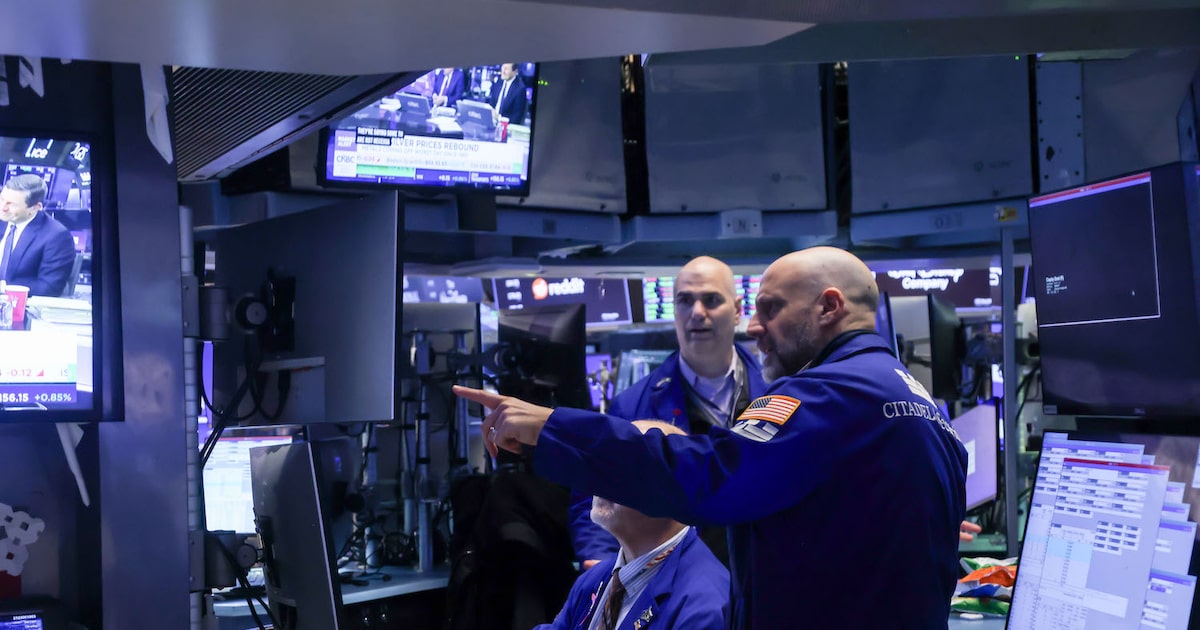
Wall Street closed Wednesday with broad losses, as markets tilted back toward caution amid escalating geopolitical tensions in the Middle East and a more measured tone from the Federal Reserve. The S&P 500 fell roughly 1.36%, snapping a two-session rally, whereas rising Treasury bond yields reflected a recalibration of monetary policy expectations. The Dow Jones Industrial Average shed 1.63% and the Nasdaq Composite lost 1.46%.
The market’s movement was closely tied to a surge in Brent crude oil prices, which solidified above $107 per barrel following an escalation of conflict between Iran and Israel. This has begun to affect key energy infrastructure and threaten critical routes like the Strait of Hormuz, fueling inflation concerns and diminishing bets on near-term interest rate cuts.
Iran warned that energy assets in the Gulf are now “legitimate targets,” raising the risk of prolonged disruptions to global supply. Partial shutdowns of crude oil production in countries including Saudi Arabia, the United Arab Emirates, and Qatar, coupled with damage to strategic facilities like the South Pars field, reinforced the perception of a supply shock driving oil prices.
Federal Reserve Chairman Jerome Powell’s remarks following the Federal Open Market Committee (FOMC) meeting further contributed to the negative tone. While the central bank held its benchmark interest rate steady in a range of 3.5% to 3.75%, Powell’s message was interpreted as less dovish than anticipated. He acknowledged that progress in moderating inflation has been slower than expected, stating, “the forecast is that we will be making progress on inflation, not as much as we had hoped, but there will be progress.”
Powell also emphasized the complexity of the current economic landscape, describing an economy caught between competing pressures. “We are balancing these two objectives in a situation where the risks to the labor market are to the downside, which would call for lower rates, and the risks to inflation are to the upside, which would call for higher rates or no cuts,” he said. He added, “we are in a difficult situation… feel like we are right at that upper bound of restrictive versus not restrictive.”
The market reacted by adjusting its expectations. While the Fed maintains a path for one rate cut in 2026 and another in 2027, operators significantly reduced the probability of monetary easing this year. Luis Alvarado of Wells Fargo Investment Institute summarized the shift, stating, “the balance of risks has changed and the bar for cutting rates has risen significantly.”
Powell also sought to allay fears of a stagflation scenario, dismissing parallels with the 1970s. “I always have to point out that was a term from the 70s, when unemployment was in double digits and inflation was really high,” he explained. “I would reserve the term stagflation for a much more serious set of circumstances.”
Macroeconomic data reinforced the narrative of persistent inflationary pressures. The Producer Price Index surprised to the upside in February, rising 0.7% month-over-month, indicating that cost pressures were building even before the recent oil price surge. Thomas Ryan of Capital Economics noted this confirms that “stronger inflationary pressures were already filtering through supply chains.”
In commodity markets, gold extended its negative streak, logging its sixth consecutive decline, pressured by a strengthening dollar and rising real yields. The metal fell more than 3% during the session, a move some analysts attributed to liquidations to cover losses in other assets amid the risk-off environment.
Cryptocurrencies also followed the downward trend. Bitcoin retreated nearly 4%, moving away from recent six-week highs, in line with broader weakness in risk assets and the adjustment in rate expectations.
The dollar had moderated its earlier bullish momentum following last week’s rally, but concerns surrounding the conflict in Iran and the wholesale inflation data renewed its strength against major peers. Francesco Pesole, an analyst at ING, warned that markets are also focused on the reaction of central banks, amid “few signs of an imminent de-escalation” in Iran.
Latin American currencies fell in response. The Chilean peso, the Brazilian real, and the Mexican peso all weakened, as did the Colombian peso, the Peruvian sol, and the Argentine peso. BBVA’s currency strategy team noted that “LatAm FX continue to take direction from broader market sentiment, which in turn is linked to the outlook for the Iran conflict.”
BBVA anticipated that “markets may be sensitive to the U.S. FOMC decision on Wednesday, as well as headlines related to Iran,” while cautioning that the impact on Latin American currencies will be reflected with a lag due to regional market closing times.
On the corporate front, the European Union unveiled the “EU Inc.” plan, a Commission-led initiative to simplify the creation and expansion of startups within the bloc, aiming to close the competitive gap with the United States and China. The program proposes a single company formation framework valid across all 27 countries, allowing companies to be created in under 48 hours digitally, with no minimum capital requirements and simplified tax and governance rules.
Macy’s shares rebounded after issuing a quarterly sales forecast above expectations, projecting up to $4.63 billion in revenue and comparable growth of up to 1.5%, driven by resilient spending among middle- and high-income segments, though lower-income consumers remain weak. Despite a strong start to the year and results exceeding estimates, the company adopted a cautious tone for the remainder of 2026.
General Mills reported quarterly results below Wall Street expectations, impacted by a 3% decline in organic sales, deeper than anticipated, and adjusted earnings below consensus, amid weaker demand and price pressure from more cautious consumers. The company has reduced prices on nearly two-thirds of its North American portfolio to stimulate sales, but the impact remains limited.
Geely reported record profits for 2025, surpassing market estimates, with earnings of 16.85 billion yuan ($2.40 billion) and a 25% increase in revenue, driven by strong performance of models like the EX2 and Zeekr SUVs, allowing it to gain market share and approach BYD in sales, even surpassing it globally in early 2026.
Leave a Reply