
Astronomers Witness the Birth Shape of a Supernova for the First time
An international team of astronomers has, for the first time, directly observed the shape of a star exploding in its earliest moments. the groundbreaking observation, made possible by the rapid response of multiple observatories adn a sophisticated instrument, is reshaping our understanding of how massive stars die and the mechanisms powering supernovae.
The research, a collaboration between the Carnegie Institution for Science (CIERA), the National Institute for Astrophysics (INAF), the International Gemini Observatory, the Institute for Frontier in Astronomy and Astrophysics (IFAA), and several universities, was published recently in Science Advances on May 17, 2024.
The team focused on supernova SN 2024ggi, first detected on the evening of April 10th, 2024. Utilizing the Very Large Telescope (VLT) and its FOcal Reducer and low dispersion Spectrograph 2 (FORS2) instrument, astronomers were able to employ a technique called spectropolarimetry. This method combines spectroscopy and polarimetry to measure the polarization of light across different wavelengths, revealing details about the explosion that are otherwise unachievable to discern due to the incredibly small scales involved.
While supernovae appear as single points of light, the polarization of the emitted photons can reveal the shape of the event. Typically, the polarization of individual photons cancels out, resulting in zero net polarization. Though, a non-zero net polarization indicates a defined shape. FORS2 is currently the only instrument capable of making these crucial measurements.
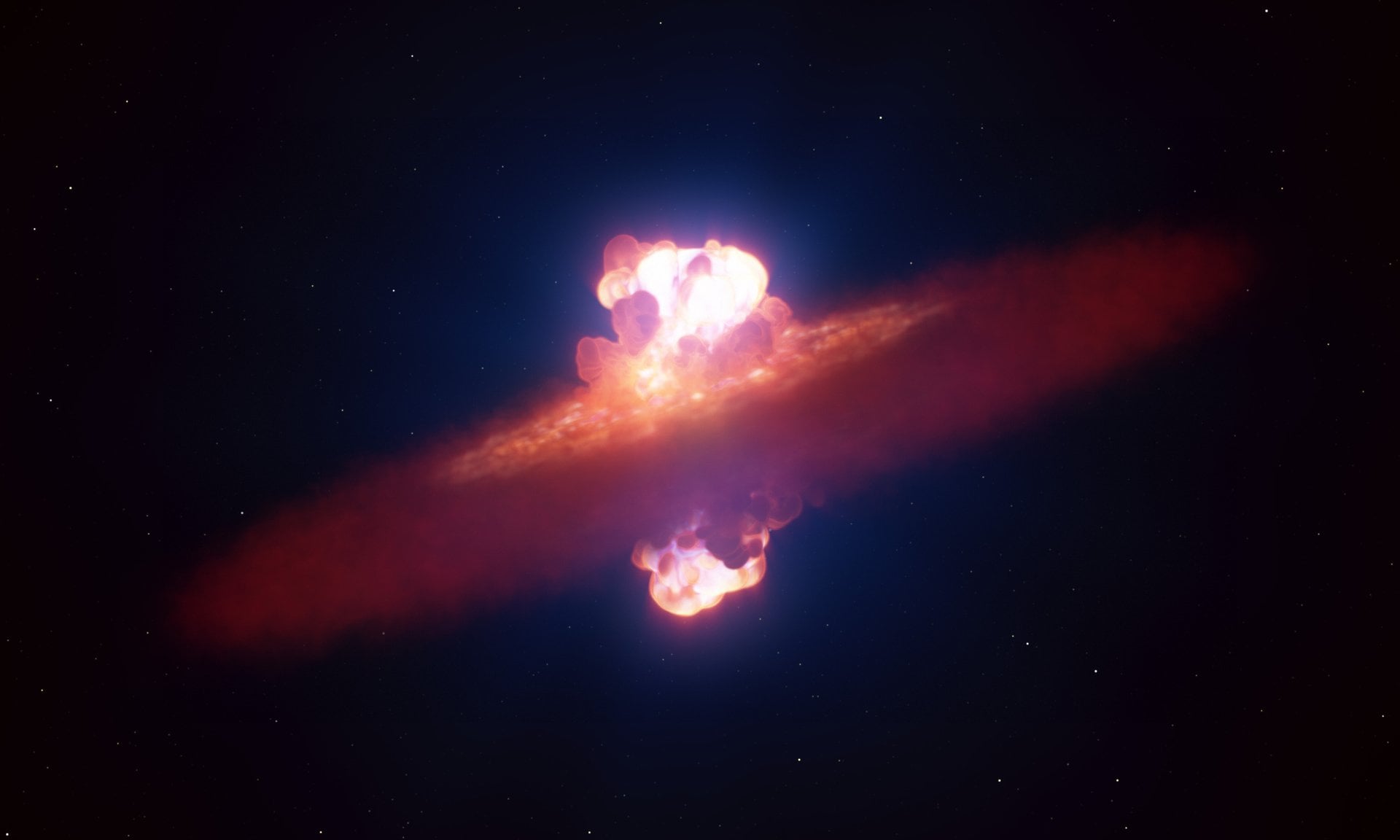
Observations revealed that the initial blast from SN 2024ggi, originating from a red supergiant star approximately 500 times the radius of the Sun and 12 to 15 times its mass, was olive-shaped. This shape subsequently flattened as the explosion expanded, but the axis of symmetry of the ejected material remained consistent.
“The geometry of a supernova explosion provides essential information on stellar evolution and the physical processes leading to these cosmic fireworks,” explained lead researcher Yang in an ESO press release. “These findings suggest a common physical mechanism that drives the explosion of many massive stars, which manifests a well-defined axial symmetry and acts on large scales.”
co-author Dietrich Baade, an ESO astronomer, added, “The first VLT observations captured the phase during which matter accelerated by the explosion near the center of the star shot through the star’s surface.For a few hours, the geometry of the star and its explosion could be, and were, observed together.”
This finding allows astronomers to refine existing supernova models and rule out others, furthering our understanding of stellar evolution and the dramatic deaths of massive stars. The success of this observation highlights the power of international collaboration and advanced astronomical instrumentation.
