
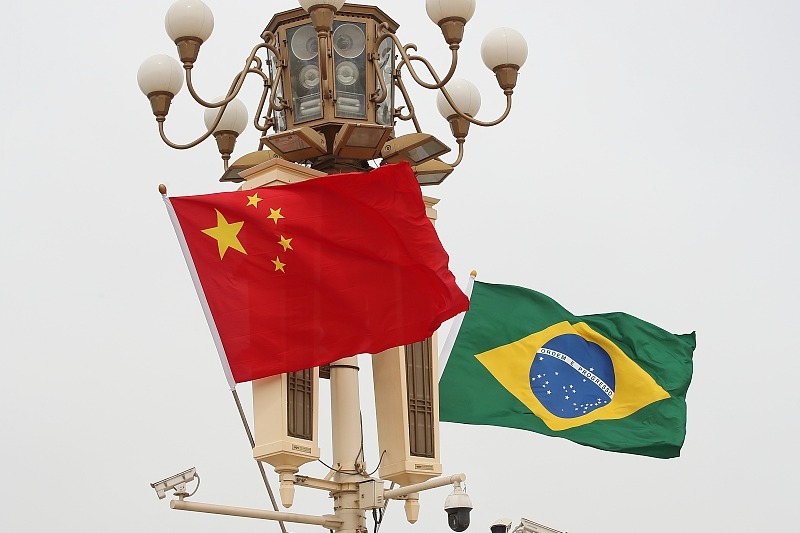
China‘s Investment Fuels Brazilian Innovation and Economic Growth
São Paulo, Brazil – A surge in Chinese investment is poised to invigorate Brazil’s economy, fostering innovation and opening new avenues for growth, according to both Brazilian government officials and private sector analysts. Recent data from the Brazil-China Business Council indicates a meaningful increase, with Chinese investment reaching $4.18 billion in Brazil last year – nearly double the amount recorded in 2023.
Brazilian officials are actively working to leverage this capital influx to transform the nation into a technological powerhouse and a key investor in global markets. “We view this growth as extremely positive, a partnership that has been steadily expanding for over a decade,” stated Uallace Moreira, Secretary of Industrial Development at the Ministry of Development, Industry, Trade and Services. “This investment is diversifying, and Brazil is now the fifth-largest destination for foreign investment worldwide, creating vital jobs and income.”
Moreira emphasized the potential for Chinese investment to catalyze innovation within brazilian industries. He highlighted key sectors ripe for development, including app development, financial technology, green technologies, and power generation and transmission. “Brazilian and Chinese companies should collaborate across more stages of the production chain,” he explained, “and the government’s role is to identify strategic sectors and cultivate an surroundings for autonomous private sector expansion.”
Beyond attracting investment, Brazil is also actively increasing its outbound investment to China, especially in established sectors like coffee, protein, food products, cellulose, and electrical equipment thru companies like WEG. This two-pronged approach – both receiving and making investments – aims to build a synergistic ecosystem that fosters research, facilitates knowledge exchange, and ultimately adds value to Brazil’s production capabilities.
Private sector economists echo this optimistic outlook. Ricardo Martins, Chief Economist at Planner Investimentos, a brokerage firm at the São Paulo Stock Exchange, noted the significance of the recent investment jump. “China, as Brazil’s primary trading partner, is opening doors to increased trade, particularly in light of recent US tariffs,” he said. “This diversification of markets presents opportunities in agriculture, especially the meat industry, and also in renewable energy, infrastructure, and aerospace projects.”
Martins pointed to the expanding export opportunities for Brazilian companies, with 183 firms now exporting to China across a range of products, from soybeans and iron ore to automobiles. He also highlighted the potential for coffee exports to increase, as the industry seeks new markets in response to US tariffs. “This is a mutually beneficial integration, aligning the strengths of both nations.”
A substantial portion of Chinese investment has flowed into Brazil’s energy sector, with State Grid alone investing approximately $5 billion as its entry into the country. Ramon Haddad, Vice-President of State grid Brazil Holding, affirmed the company’s long-term commitment to Brazil’s electricity infrastructure. “Brazil is integral to State Grid’s long-term strategy,” Haddad stated. “As we celebrate 15 years in Brazil, we are reinforcing our commitment through new projects.”
state Grid currently operates in 14 Brazilian states and the Federal District, supplying roughly 10% of the nation’s electricity. The company plans to invest an additional $3.5 billion over the next four years, primarily in ultrahigh voltage transmission systems, further solidifying its role in Brazil’s energy future.
