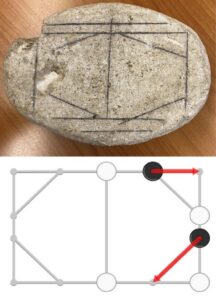
An international team of researchers has used artificial intelligence to decipher the rules of an ancient board game played during the Roman era, a discovery published this week in the journal Antiquity. The game, etched onto a limestone tablet discovered in Heerlen, Netherlands, had baffled archaeologists for over a century.
The stone, found in what was once the Roman town of Coriovallum, features a grid of intersecting lines. Researchers at Maastricht University and Leiden University in the Netherlands, along with collaborators from Flinders University in Australia, the Université Catholique de Louvain in Belgium, and the Het Romeins Museum and Restaura restoration studio in Heerlen, employed AI to simulate gameplay and determine likely rules. The object’s discovery dates back approximately 100 years, with the stone initially displayed at the Het Romeins Museum despite a lack of historical documentation confirming its purpose.
“The stone shows a geometric pattern and visible wear that are consistent with sliding game pieces across the surface, which point strongly to repeated play rather than another purpose,” said Dr. Walter Crist, an archaeologist at Leiden University and lead author of the study. The wear patterns on the stone suggested repeated use, but the rules remained elusive.
To unlock the game’s secrets, the team utilized the AI-driven play system Ludii, developed by Dennis Soemers at Maastricht University. Ludii was programmed with the rules of numerous ancient games from Europe, including haretavl from Scandinavia and gioco dell’orso from Italy. The AI then played the game against itself, simulating countless scenarios to identify rule sets that would produce wear patterns matching those observed on the limestone tablet.
Dr. Matthew Stephenson, a computer scientist at Flinders University, explained that the simulations focused on identifying movements that would cause the same concentrated friction seen on the original stone. “We ran the simulations repeatedly, adjusting rules each time,” he said. “The simulations pointed strongly to a type of strategy game known as a blocking game. In blocking games, players try to trap their opponent’s pieces by preventing movement rather than capturing them.”
The findings suggest that blocking games may have a longer history than previously thought, as such games were not widely documented before the Middle Ages. The research demonstrates the potential of AI to analyze archaeological artifacts and reconstruct lost cultural practices. “This is the first time that AI-driven simulated play has been used together with archaeological methods to identify a board game,” Dr. Crist stated. “It offers archaeologists a promising new tool for understanding ancient games that don’t resemble those known from surviving texts or artworks.”
The research was funded by the European Research Council as part of the Digital Ludeme Project, which aims to create reliable reconstructions of ancient games using artificial intelligence. The project also received support from the Dutch national e-infrastructure and European Cooperation in Science and Technology (COST) Action #CA22145 ‘Computational Techniques for Tabletop Games Heritage (GameTable)’.
Researchers say the success of this approach suggests that other mysterious artifacts may hold hidden stories waiting to be uncovered with the help of modern technology. Dr. Stephenson added, “It shows how AI can contribute to our understanding of materials that would otherwise be demanding to interpret.”
Leave a Reply