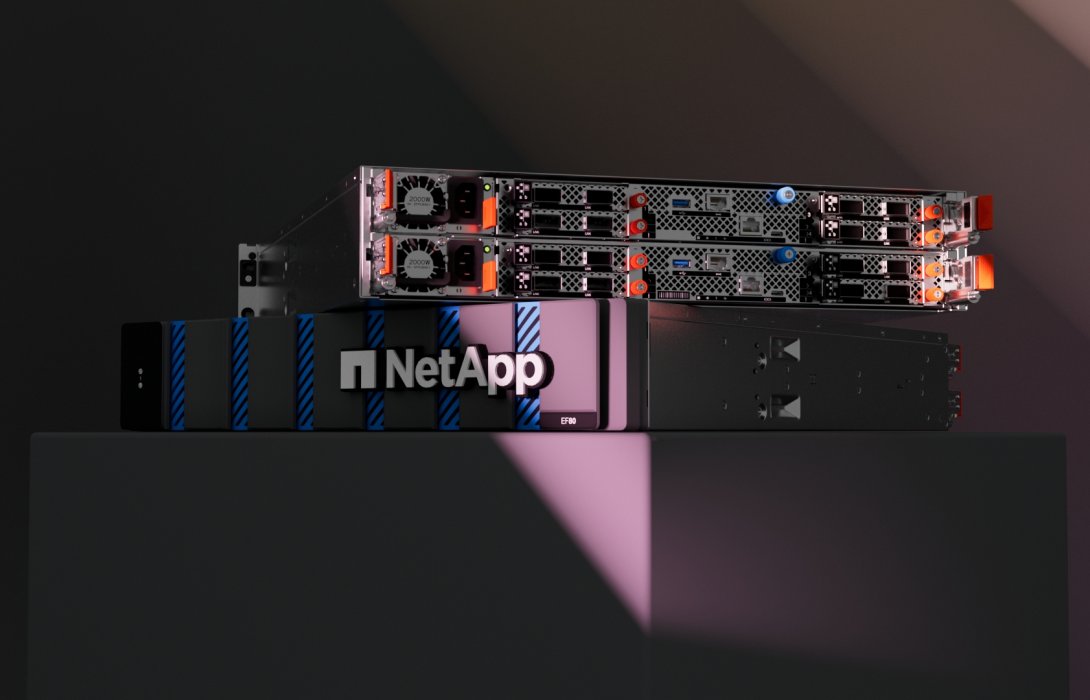
NetApp unveiled its next-generation EF-Series storage systems, the EF50 and EF80, designed to address the growing demands of artificial intelligence, high-performance computing, and transactional databases. The announcement, made today, positions the new systems as a solution for enterprises and “neoclouds” seeking performance improvements for data-intensive workloads, including emerging applications like sovereign AI clouds and AI-powered manufacturing.
According to NetApp, the EF50 and EF80 deliver over 110 gigabytes per second of read throughput and 55 gigabytes per second of write throughput – a 250 percent increase in performance compared to previous generations. The systems are engineered to provide high rack density, offering 1.5 petabytes of storage within a 2U chassis, whereas maintaining power efficiency at 63.7 GBps per kilowatt.
“Data is the key component to delivering business value for enterprises, underpinning performance-hungry workloads like AI or databases,” said Sandeep Singh, Senior Vice President and General Manager of Enterprise Storage at NetApp. “As businesses contend with ever-increasing data volumes and performance-intensive applications such as AI model training, AI inferencing and high-performance computing, they need infrastructure that delivers speed, scalability and efficiency without added complexity.”
The new EF-Series systems are designed to work with high-performance parallel file systems such as Lustre and BeeGFS, accelerating HPC simulations and maximizing GPU utilization with high-performance scratch space. NetApp highlighted the ability of the EF50 and EF80 to accelerate GPU-driven workloads, enabling organizations to unlock new value and competitive advantages.
NetApp’s EF-Series focuses exclusively on block storage for maximum performance, differentiating it from the company’s AFF and ASA systems, which offer unified file, block, and object storage. The company recently expanded its block storage portfolio with the ASA A20, A30, and A50. In October 2025, NetApp introduced the AFX, a disaggregated storage solution targeted at AI inference workloads. The EF50 and EF80 address a distinct category: high-throughput environments requiring maximum bandwidth for GPU clusters, without the need for unified storage.
Leave a Reply