More than 30 years after his death, Thom McGinty, known to generations of Dubliners as “The Diceman,” remains a potent symbol of a changing Ireland. The street performer, who died on February 20, 1995, from complications related to AIDS, was a fixture on Grafton Street throughout the 1980s and early 1990s, captivating audiences with his mime and static performances.
Born Thomas McGinty in Glasgow, Scotland, on April 1, 1952, he was the son of Irish parents – his father, Thomas, hailed from Donegal, even as his mother, Mary (née O’Hara), was from Baltinglass, County Wicklow. McGinty spent childhood summers in his mother’s hometown, fostering a strong connection to Ireland. He initially pursued accountancy at Strathclyde University, but left to study theatre, training with Hugo Gifford at the Strathclyde Theatre Group and honing his mime skills under Lindsay Kemp, a renowned teacher who also worked with David Bowie and Kate Bush.
McGinty arrived in Dublin in 1976, initially seeking perform at the National College of Art and Design. When that opportunity didn’t materialize, he began performing as “The Dandelion Clown” in the Dandelion Market area, near St. Stephen’s Green. His character, a “colourful pseudo-beggar,” held a sign requesting donations due to unemployment, offering a quick wink to those who contributed. This early persona foreshadowed the playful interaction with the public that would become a hallmark of his work.
The character of The Diceman emerged from an association with The Diceman Games Shop on South Anne Street. McGinty was employed to advertise the shop, adopting a white-faced, shrouded appearance. The name, bestowed by Dubliners, quickly stuck. For three years, he embodied the shop’s identity, becoming a recognizable presence on the city’s streets.
Throughout the 1980s and 1990s, McGinty’s talents were sought after by a diverse range of clients. He performed for the Rose of Tralee festival, the British Tourist Board, the Irish Motor Show, and John Player Tops of the Town, as well as for established Dublin businesses like Bewley’s Café. His versatility extended to theatrical performances, including roles in Operating Theatre’s production of Garcia Lorca’s The Love of Don Perlimpin in 1984, and Frank McGuinness’ monologue The Glass God in 1982. He also appeared in Steven Berkoff’s production of Oscar Wilde’s Salomé at the Gate Theatre, which later toured to the Edinburgh Festival in 1989.
The pedestrianisation of Grafton Street in 1982 provided a new stage for McGinty’s art. He became known for his “human statue” performances, standing motionless for extended periods, drawing crowds of onlookers. He observed that some viewers became so captivated they themselves would freeze, mirroring his stillness. To circumvent Gardaí enforcement of loitering laws, he developed a deliberately slow “Zen walk,” appearing to float rather than walk, a tactic that paradoxically drew even larger crowds.
His performances often involved elaborate costumes. One of his most famous characters was “Mona McGinty,” a playful take on Leonardo da Vinci’s Mona Lisa, where he framed his upper body in a wooden box, adopting the painting’s iconic pose and expression. However, his artistic expression sometimes led to legal challenges. In 1991, he was charged with a breach of the peace for wearing a provocative costume while advertising a production of The Rocky Horror Picture Show, though the Probation Act was applied and no conviction was recorded. Speaking outside the court, McGinty expressed feeling “vilified and censored,” arguing that his artistic taste and physical form were being deemed indecent.
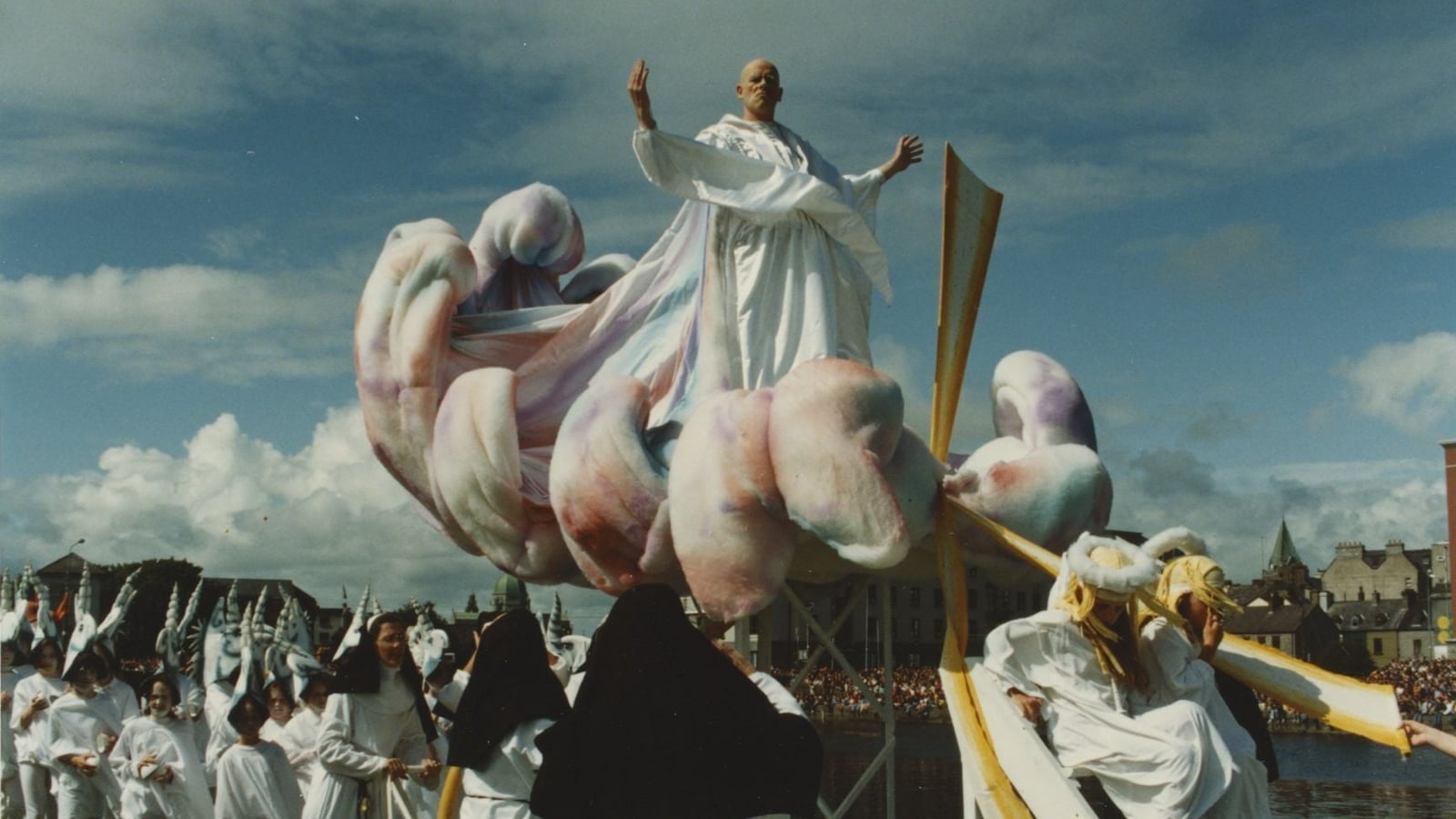
McGinty’s activism extended beyond artistic expression. In 1993, he portrayed “God” in the Macnas parade, Noah’s Ark, during the Galway Arts Festival. For a gay man in a country where homosexuality was still criminalized, this role carried significant political weight. In November 1994, just months before his death, McGinty publicly revealed his HIV diagnosis on The Late Late Show, describing the experience as “like being hit by a sledgehammer.” He expressed a willingness to support others facing similar diagnoses.
Following his death, a procession carrying McGinty’s coffin through Grafton Street drew over 2,000 mourners, including Dublin’s Lord Mayor, in a final public tribute. Dermot Bolger described McGinty as “the High King of all the diversity without which any society cannot grow.” His legacy endures as a testament to his artistic contribution and his courageous stance on social issues.
Leave a Reply