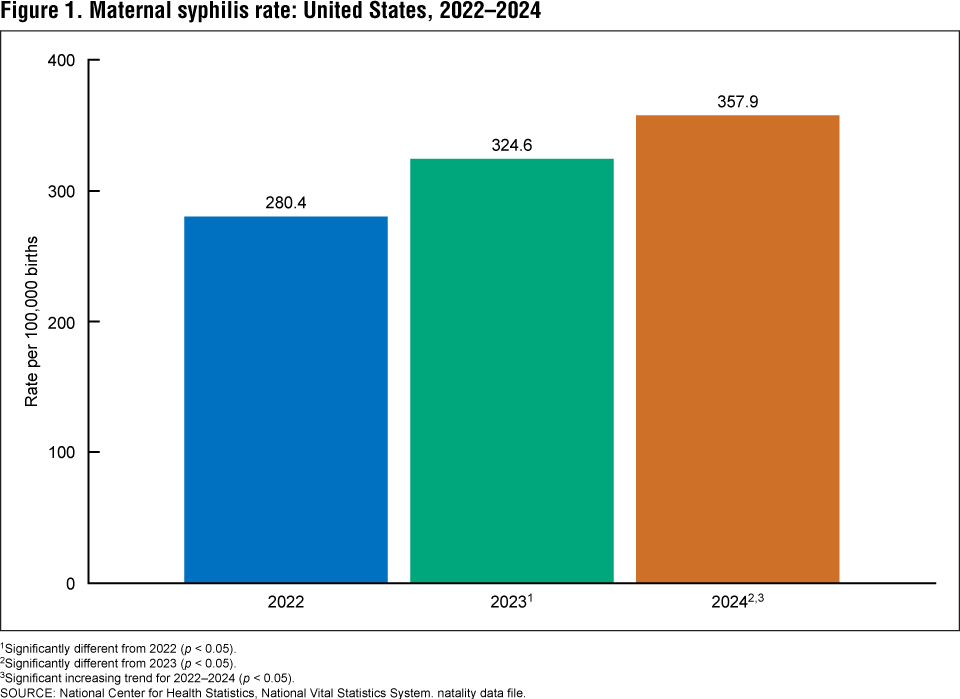
The United States recorded 357.9 cases of maternal syphilis per 100,000 births in 2024, the highest number since 1992, according to a new report from the National Center for Health Statistics (NCHS).
The rate represents a 28% increase from 2022, when 280.4 cases were reported per 100,000 births. Between 2016 and 2022, the maternal syphilis rate had already increased by 222%, rising from 87.2 to 280.4 cases per 100,000 births.
Syphilis is a sexually transmitted infection caused by the bacterium Treponema pallidum and can be passed from a mother to her baby during pregnancy or childbirth, resulting in congenital syphilis. Congenital syphilis can lead to miscarriage, stillbirth, infant death, and lifelong medical problems for surviving infants.
Early-stage syphilis often presents no symptoms, making testing the primary method of detection. A simple blood test can identify the infection. While most states mandate syphilis screening at the first prenatal appointment, some also require testing during the third trimester and at delivery, even if not legally required, healthcare providers often recommend it.
Access to prenatal care remains a significant barrier to preventing congenital syphilis. Financial constraints, including lack of insurance or high deductibles, can prevent women from seeking care. Transportation difficulties and work commitments also pose challenges. The closure of maternity wards in rural hospitals and a general lack of maternal health providers in rural areas further exacerbate the problem. Approximately 35% of women of reproductive age in the U.S. Live in areas with limited access to maternal health services.
Disparities in maternal syphilis rates are pronounced across racial and ethnic groups. From 2022 to 2024, rates among American Indian and Alaska Native mothers increased by 52%, rising from 1,410.5 to 2,145.4 cases per 100,000 births. Hispanic mothers experienced a 31% increase (from 313.8 to 411.1), Black non-Hispanic mothers saw a 30% increase (from 684.7 to 887.6), and White non-Hispanic mothers experienced a 23% increase (from 152.8 to 188.2). Rates also changed for Asian and Native Hawaiian/Pacific Islander mothers, though the report does not indicate whether these changes were statistically significant.
Congenital syphilis is almost entirely preventable with timely screening and treatment of pregnant women with penicillin. Though, a recent report found that a lack of timely testing and adequate treatment contributed to nearly 90% of congenital syphilis cases in 2022.
Leave a Reply