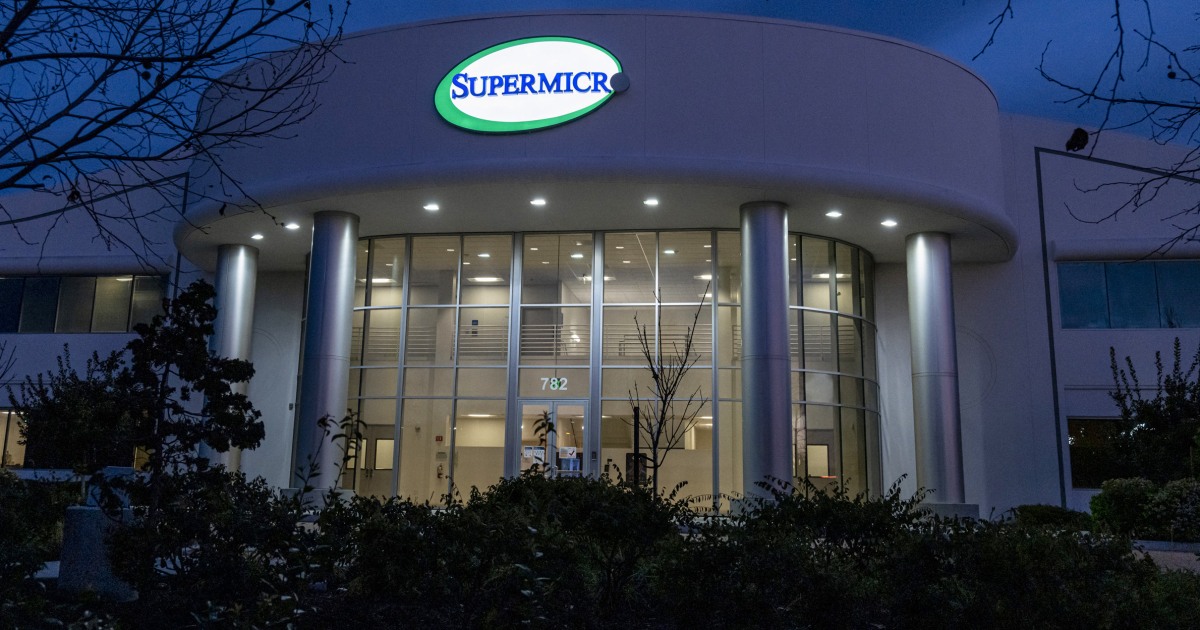
A co-founder of Super Micro Computer Inc. And two others linked to the Silicon Valley server maker were charged Thursday with conspiring to illegally ship billions of dollars in advanced Nvidia chips to China, circumventing U.S. Export controls. The U.S. Attorney’s Office for the Southern District of New York alleges that Yih-Shyan “Wally” Liaw, Ruei-Tsan “Steven” Chang, and Ting-Wei “Willy” Sun conspired to sell $2.5 billion worth of servers to a company in Southeast Asia, which then repackaged and shipped $510 million worth of servers containing the restricted chips to destinations within China, NBC News reported.
Liaw, a U.S. Citizen and Supermicro co-founder, and Sun, a citizen of Taiwan, were arrested Thursday. Chang, also a Taiwanese citizen, remains at large. Each man faces a count of conspiring to violate the Export Controls Reform Act, carrying a potential 20-year prison sentence. They are also charged with conspiring to smuggle goods and defraud the United States, each carrying a maximum five-year sentence.
The charges come as the U.S. Government has intensified efforts to prevent the flow of cutting-edge technology to China, particularly in the realm of artificial intelligence. In 2022, the U.S. Tightened export controls on advanced AI chips, including Nvidia’s B200 and H200 graphics processing units, requiring licenses for sales to China, according to CNBC. The restrictions aim to protect U.S. National security and maintain a competitive edge against Chinese AI rivals like DeepSeek.
Prosecutors allege the scheme involved a “tangled web of lies, obfuscation, and concealment” to drive sales and generate revenue in violation of U.S. Law. The indictment details how the defendants allegedly used fabricated documents and a pass-through company to mask the true destination of the servers and their contents, the Associated Press reported.
Supermicro confirmed the roles of Liaw, a senior vice president of business development and board member, and Chang, a sales manager based in Taiwan. The company stated that Sun was a third-party contractor whose relationship has been terminated. Supermicro said in a statement This proves “cooperating fully” with the investigation and that the alleged conduct contravenes its compliance policies. Shares of Super Micro fell approximately 12% in extended trading following the unsealing of the indictment.
Nvidia, whose chips were central to the alleged scheme, stated that strict compliance is a “top priority” and that it works with customers and the government on compliance programs. “Unlawful diversion of controlled U.S. Computers to China is a losing proposition across the board — NVIDIA does not provide any service or support for such systems, and the enforcement mechanisms are rigorous and effective,” a company spokesperson said.
The case highlights ongoing concerns about the circumvention of U.S. Export controls through transshipment routes, particularly via Southeast Asian countries. Chris McGuire, a senior fellow at the Council on Foreign Relations, noted the indictment underscores “glaring loopholes” in the current export system, adding that China is “aggressively stealing U.S. Technology” to bolster its AI industry, as reported by NBC News.
The timing of the charges also comes after a period of shifting U.S. Policy toward chip exports to China. While initially imposing strict bans, the White House in August agreed to allow Nvidia to sell less powerful H20 chips to China, with a condition that 15% of chip sales be paid to the U.S. Government. Nvidia CEO Jensen Huang recently stated that sales of limited quantities of H200 products to China-based customers had been approved by the U.S. Government.
Leave a Reply