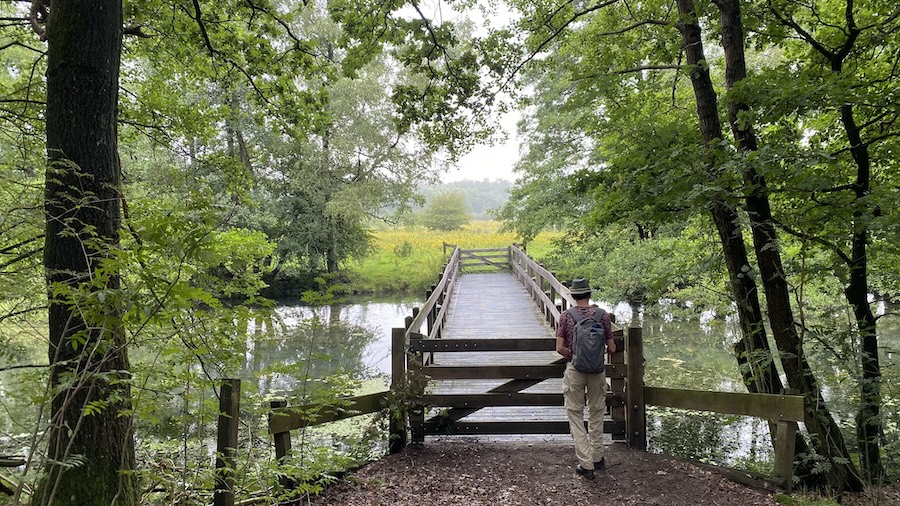
HARDENBERG, Netherlands – A recent journey through the Dutch province of Overijssel, prompted by memories of his late stepmother, Martha Muis, led writer Martin Rep and his brother, Arthur, on a search for traces of her early life. The trip, documented by Rep, revealed a landscape vastly different from the industrial surroundings of their upbringing in Zaandam, and a poignant exploration of family history.
Muis, who Rep refers to as his “second mother,” was born in a rural area near Hardenberg a century ago. She often recounted stories of a childhood spent amidst forests, meadows, and canals – a stark contrast to the factories and densely populated streets of Zaandam where Rep grew up. “I knew factories, a polluted and stinking stream and a long row of houses that had been built between the factories on either side of the Zaan,” Rep wrote. “The world of Martha consisted of forests, meadows, endless canals and beautiful gardens, and ditches with frogs that she and her six sisters blew up.”
The search began with a somewhat “halfhearted attempt” to identify remnants of Muis’s life, focusing on the area around Hardenberg. Their journey included a crossing of the Overijsselse Vecht river via the Marskampveer, a self-operated ferry powered by a solar panel. The slow, four-minute crossing, while not efficient, became a highlight of their walk, embodying the unhurried pace of the region.
Rep’s exploration led him to discover that Muis was born in a place called Moscou, or possibly Ambt Hardenberg, a location close to the German border where both Dutch and German were commonly spoken. She endured a long commute to school and even longer walks to church on Sundays.
Muis entered Rep’s life in 1956 after his father became a widower. She was sought as a housekeeper and companion, with marriage a possibility. She arrived with her young son, Arthur, and the two eventually married a year later. Rep described the adjustment of gaining a stepbrother as a ten-year-old as challenging, ending his status as the youngest child.
While previous visits to the area with his father had yielded no familial connections, Arthur recalled a few trips with his mother to the region. Their search for information at a local café proved fruitless, with locals unable to recall details from so long ago. However, they did learn that Muis had lived with an uncle, sluiswachter Ten Broeke, after her parents’ separation, and maintained a lifelong friendship with her cousin, Jannie ten Broeke.
The Vecht river, which they followed, proved more evocative than the Kanaal Almelo – de Haandrik, a more artificial waterway. Arthur shared memories of his mother’s struggles as a single mother in the 1950s, a time when unmarried mothers faced societal stigma. He recounted how she considered giving him up for adoption at an institution in Utrecht, but was persuaded to keep and raise him herself.
“It is just as well that my mother was Reformed and not Catholic,” Arthur told Rep. “Martha told me that she went to the home for unmarried mothers in the Biltstraat 186 Utrecht to deliver me up. But that was a Reformed institution, whose goal was to convince the mothers to raise their child themselves and to keep their child.” He explained that Catholic institutions often pressured mothers to relinquish their children, labeling them as “fallen women.”
The journey concluded with a sense of incomplete discovery. While they didn’t unearth significant physical traces of Muis’s past, Rep found a deeper understanding of his stepmother and a strengthened bond with his brother. The experience highlighted the enduring power of memory and the complexities of family history. The final day of their walk was planned to explore the Beerzezand area, but it was anticipated to yield no further clues to Muis’s life.
Leave a Reply