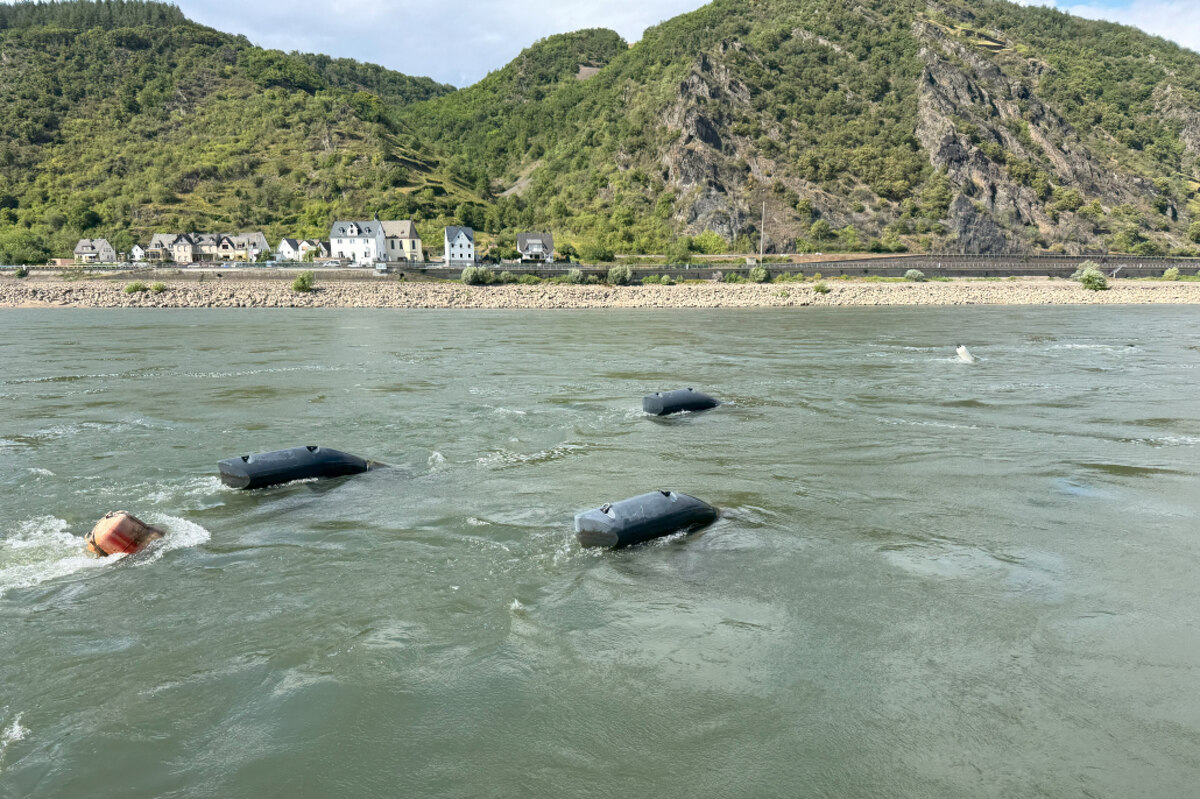
A novel hydropower system is taking shape on the Rhine River near Sankt Goar, Germany. The project involves anchoring so-called “Energyfishe” – floating stream turbines – to the riverbed. Each turbine measures approximately 2.8 meters by 2.4 meters, weighs 80 kilograms, and has a capacity of 6 kilowatts.
The Rhine at this location in the Rhein-Hunsrück-Kreis district experiences flow speeds of up to 2 meters per second. On average, a single turbine is projected to generate 15 megawatt-hours of electricity annually. A “swarm” of 100 such turbines could produce 1.5 gigawatt-hours per year, enough to power approximately 450 German households, according to project developers.
The technology offers several advantages. Installation requires no heavy machinery, and the turbines operate silently and continuously, even when sunlight or wind are unavailable. During periods of low water levels, the turbines descend to the riverbed but continue to generate power, albeit at a reduced rate. The system is also designed to withstand ice floes and flood conditions.
Unlike conventional hydropower plants, the Energyfishe system does not create a reservoir, thereby avoiding an obstacle to migratory fish species like the Nase and Barbe that inhabit the Middle Rhine. A study conducted by the Technical University of Munich found no negative impacts on fish populations. Three systems are currently operational, with plans to install 21 more, ultimately aiming for a swarm of 124 Energyfishe.
The expansion of the project was recently approved by Rhineland-Palatinate’s Minister for Environment and Climate Protection, Katrin Eder (Bündnis 90/Die Grünen). “It is key to me that everyone has access to affordable energy that does not harm the climate and the environment,” Eder stated. Georg Walder, CEO of Energyminer, the company behind the concept, added that the approval demonstrates “that innovation, science and careful official consideration can go hand in hand.”
Hydropower, in general, has faced criticism from environmental groups due to the impact of dams on fish habitats and the flooding of large areas. The swarm concept of the Energyfishe is intended to address these concerns. In 2025, hydropower accounted for roughly 3 percent of Germany’s gross electricity generation, equivalent to approximately 16 to 17 terawatt-hours. This represents a decrease from 4 percent in 2024, attributed to lower precipitation levels.
Rhineland-Palatinate has emerged as a leader in Germany’s energy transition, having phased out coal-fired power plants and installed 310,000 solar energy systems, despite having a population of just 3 million eligible voters. Renewable energy sources currently contribute 64 percent to the state’s gross electricity generation, compared to nearly 56 percent nationwide. Per capita energy-related emissions in Rhineland-Palatinate are below 7 tons per year, significantly lower than the German average of over 10 tons.
In 2014, Rhineland-Palatinate became one of the first German states to adopt a state climate protection law with binding reduction targets. The law mandates that the state administration become climate neutral by 2030, with the entire state aiming for climate neutrality between 2035 and 2040. Sabine Yacoub, state chairwoman of the German environmental organization BUND, acknowledged the state’s progress, praising the support provided to municipalities through a well-received funding program. A recent amendment to the climate protection law also establishes concrete goals for individual sectors.
Climate protection played a role in the recent Rhineland-Palatinate state election campaign. SPD candidate Alexander Schweitzer, the current Minister-President, stated during a discussion in Mainz, “Anyone who believes that we cannot afford climate protection because the economy is currently in difficulties does not understand the real situation of many companies.” He emphasized that numerous companies are investing in climate protection to remain economically successful, and pledged to increase investment in the area.
The state CDU, yet, consistently opposed climate protection measures during the campaign, making the election a referendum on the issue. BUND’s Sabine Yacoub expressed concern that a grand coalition led by the CDU could lead to setbacks in climate policy.
Leave a Reply