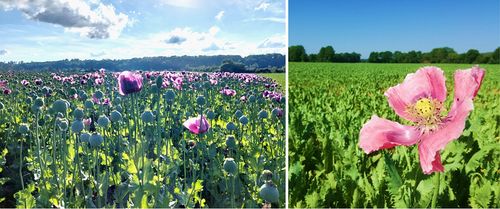
Farmers in Austria are increasingly turning to poppy cultivation as a means of diversifying crop rotations and supporting pollinator populations, according to agricultural experts. The Waldviertler Mohnhof, a family-run operation in Ottenschlag, Lower Austria, exemplifies this trend, having specialized in poppy cultivation for three decades.
Poppy cultivation offers a valuable contribution to biodiversity, providing a crucial food source for bees and insects. The vibrant spectacle of blooming poppy fields also draws significant public interest. The Waldviertler Mohnhof, owned by the Greßl family, carefully cultivates and refines select poppy varieties on surrounding fields.
The Waldviertler Graumohn, a protected designation of origin (g.U.), represents the highest standard for poppy from the Waldviertel region. This designation, recognized by the European Union, highlights the close connection between agricultural products and their specific geographic origins. Historically, the area around Zwettl has a long tradition of poppy cultivation, dating back to at least 1280, as evidenced by records from the Zwettl Abbey.
Beyond the aesthetic and ecological benefits, poppy cultivation can provide a excellent return for farmers. Yet, securing a reliable market is essential. Contract farming, such as that offered through AMT Austria Backsaaten – a collaboration between Saatbau Linz and AMT Austria – provides a pathway for farmers to guarantee the sale of their harvest.
The Waldviertler Mohnhof offers a range of poppy-based products, including oils, capsules, soaps, brandies, and creams, available both on-site and through an online shop. The family also operates a Mohnmuseum, showcasing the history and process of poppy cultivation, from planting to processing. The museum features a collection of poppy mills, illustrating the evolution of milling techniques.
The growing popularity of poppy-related products has spurred a market for poppy-themed accessories, books, and gifts, as offered by Waldland, a regional supplier. These include items like poppy seed honey, liqueurs, and decorative arrangements.
Despite the resurgence in interest, the Waldviertler Graumohn nearly disappeared in the 20th century due to mechanization challenges and increased imports. Initiatives by the Waldviertler Sonderkulturenverein were instrumental in revitalizing the industry.
Leave a Reply