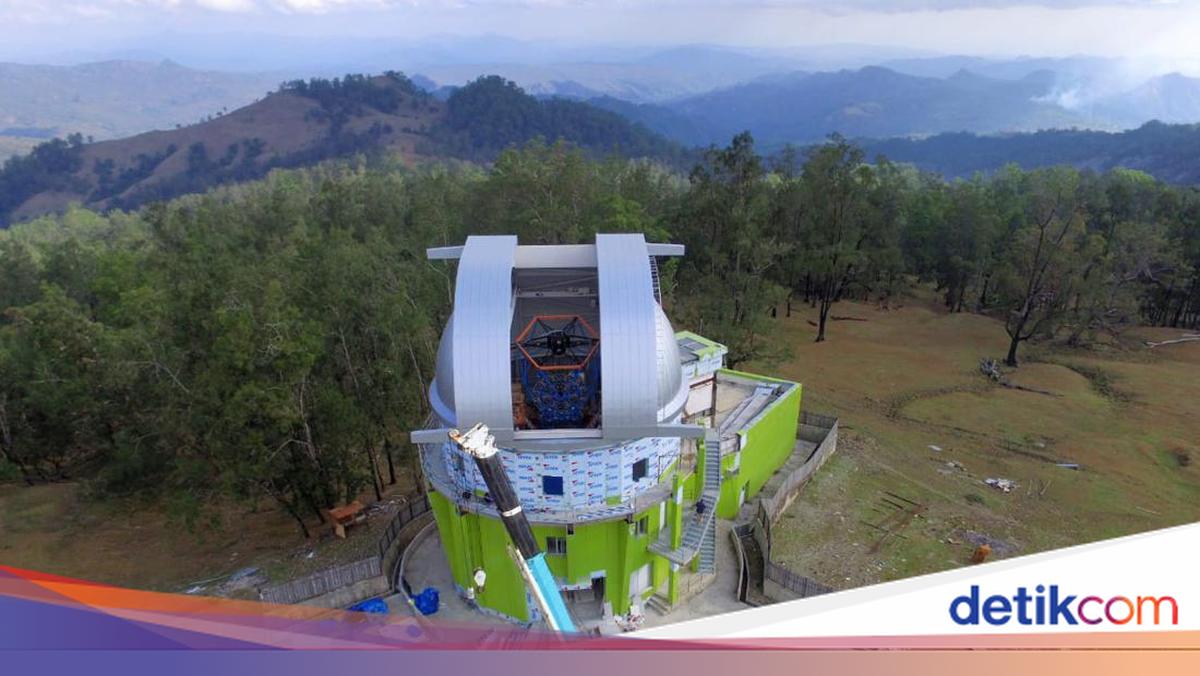
Indonesia is bolstering its national astronomy research capabilities with the ongoing development of the Timau National Observatory in Kupang, East Nusa Tenggara. The facility is entering a crucial phase, with a 3.8-meter optical telescope slated to initiate operations this year, according to Badan Riset dan Inovasi Nasional (BRIN), the National Research and Innovation Agency.
Robertus Heru Triharjanto, Head of the Aviation and Space Research Organization at BRIN, stated that the observatory’s construction represents a strategic move to enhance Indonesia’s astronomical research capacity. “BRIN has a mandate to conduct various research activities, including in the fields of science and space,” he said. “One of the efforts being made is to build the National Observatory in Timau, Amfoang, Kupang, East Nusa Tenggara.”
Beyond preparing the optical telescope for operation, BRIN is also developing specific regulations to protect the observatory grounds from light pollution and radio interference, ensuring optimal conditions for astronomical research. The Timau National Observatory will also house a radio telescope, designed to support multi-wavelength astronomy and monitor space debris, according to Peberlin Sitompul, a researcher at BRIN’s Center for Space Research.
“The Timau National Observatory is being built to support the development of multi-wavelength astronomy, as well as monitoring space debris using observations at optical and radio wavelengths,” Sitompul explained. The radio telescope system utilizes a log-periodic antenna array operating between 40 and 870 MHz, connected to a CALLISTO spectrometer and software-defined radio (SDR) receiver to record radio wave spectra. This technology will allow researchers to monitor solar activity, including solar radio bursts.
Initial testing of the radio telescope system has already successfully detected radio activity from the Sun, indicating the observation system is functioning correctly. Researchers have also conducted radio frequency interference (RFI) measurements to assess the level of radio signal interference around the observatory location. The tests revealed that much of the frequency spectrum in the Timau area is relatively free from man-made signal interference, making it an ideal location for radio telescope development.
Future development plans for the observatory include a parabolic antenna approximately 20 meters in diameter, capable of operating at frequencies between 1 and 50 GHz. Discussions at a recent meeting included input from Randall Wayth, a scientist from the Square Kilometre Array Observatory (SKAO), who presented developments in low-frequency radio telescopes for space weather research. Wayth detailed the experiences of the Murchison Widefield Array project in various research areas, including monitoring solar radio emissions, detecting coronal mass ejections using Interplanetary Scintillation (IPS) techniques, pulsar studies, and time-domain astronomy.
Taufiq Hidayat, a researcher from the Bandung Institute of Technology, presented advancements in radio telescopes and the Particularly Long Baseline Interferometry (VLBI) Global Observing System (VGOS) in Indonesia. VLBI technology combines signals from radio telescopes located far apart, enabling highly precise astronomical measurements.
Emanuel Sungging Mumpuni, Head of BRIN’s Center for Space Research, expressed hope that these recent developments will strengthen collaborative astronomy research in Indonesia. “We hope this meeting will not only capture place today, but can continue with further discussions to formulate various suggestions and recommendations. Through the development of a radio telescope at the Timau National Observatory, Indonesia is expected to increase its capacity for astronomical research and contribute to the monitoring of the space environment at the global level,” Mumpuni stated.
Leave a Reply